

You may not know George Westinghouse.
He lived in Pittsburgh more than 100 years ago in a house he called Solitude. George was also convinced that natural gas would become a vital fuel for the United States.
So, he did what any of us would do — he drilled for natural gas in his own backyard.
At first, the drillers found a small pocket.
But then around one-third of a mile down, they struck far more gas than anyone could’ve possibly expected.
Of course, you know as well as I do that a well like that is dangerous. So, Westinghouse invented a stopcock to bring the flow under control.
By the end of that summer he’d organized the Philadelphia Company to pipe the gas to customers. He didn’t stop inventing either. Soon he created things such as leak detectors, pressure regulators, and a meter to measure what people used.
Even though this was the man who became better known for providing electricity, he had to secure his fuel before he could build that part of his empire. 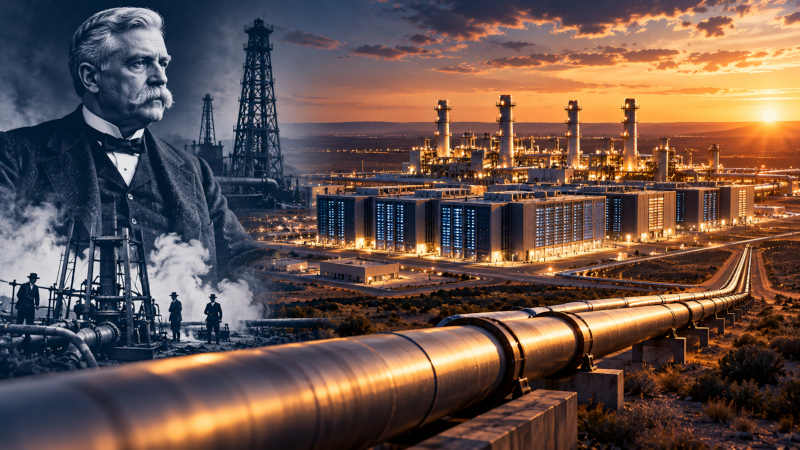
Interestingly, there’s a modern-day Solitude being built today up in Pecos County, Texas.
Except this time, it’s Amazon that had bought more than 8,000 acres for a data center campus.
The site carries an air permit for up to 7.65 gigawatts of gas-fired power, which would make it the biggest gas plant in the country if it gets built.
And in the same corner of West Texas, Microsoft is planning its own 2-gigawatt campus, which Chevron will supply with up to 2.67 gigawatts of power on site (the first of that power is due in 2028).
Look, it’s clear that neither Big Tech player is waiting for the U.S. grid to catch up.
It’s a move straight from George Westinghouse’s playbook that’s being executed 142 years later.
So how much natural gas are we actually talking about here?
The Best Free Investment You’ll Ever Make
Our analysts have traveled the world over, dedicated to finding the best and most profitable investments in the global energy markets. All you have to do to join our Energy and Capital investment community is sign up for the daily newsletter below.
Well, consider that the amount of natural gas that’ll be used for data centers alone will grow by 15 billion cubic feet a day over the next nine years.
Yes, that’s more than double what some analysts were expecting last December, and it’s assuming plenty of planned projects never get built.
For scale, that’s more than what every country on earth burns today except the U.S., China, Russia and Iran.
More importantly, that natural gas is projected to supply about 69% of the power for new grid-connected data centers.
And yet, data centers aren’t the biggest new buyer.
It turns out that LNG export demand is growing by 21 billion cubic feet a day over the same stretch. That makes sense given our LNG exports averaged 17.4 billion a day in the first half of this year, so AI is on track to add almost as much demand as the entire LNG export business uses today.
But why not just use the grid? For that answer, we can look at the largest one in the country.
PJM, which serves 13 states, held its capacity auction in July for power in 2028 and 2029.
Not surprisingly (to us, at least), the price hit the $325-a-megawatt-day cap, and the auction still came up 6,831 megawatts short of what the grid needs.
Some reports have warned that without the cap, the price would have been $555 in most of PJM and $777 in northern Illinois.
If you haven’t noticed yet, power bills are already a political issue, with data centers taking a lot of the blame.
So, the logical move is for those major players to simply build their own supply.
That’s why companies like NextEra announced a $22 billion, 6.47-gigawatt gas plant in La Salle County, Texas, to feed an adjacent 5-gigawatt data center.
Then last week, Enerflex said it won a contract for more than a gigawatt of on-site gas power for a North American data center it didn’t name, with deliveries running through 2028.
Now, you’ll hear the objection. The numbers don’t show a boom yet, the argument goes. The EIA expects gas burned for power at 37.0 billion cubic feet a day this year, barely above the 2024 high of 36.8. It sees gas share slipping from 40% to 39% next year as renewables grow.
Remember, this power build-out isn’t for today… it’s for a decade from now, and the investment dollars are flowing heavily. Even if some projects never get built, Goldman has estimated that only about 60% of the data center capacity due in the next year will come online.
Makes sense, right?
The demand isn’t here yet, but the decisions are being made now.
As you know, a gas plant needs turbines.
However, those turbines are becoming scarce. GE Vernova said that its gas turbine backlog and slot reservations reached 116 gigawatts at the end of June.
Meanwhile, Mitsubishi reported a 35-gigawatt backlog and Siemens Energy has approximately 69 gigawatts of firm orders.
The problem is that new orders face a waitlist of about three years, and even GE Vernova says orders in the first half were priced much higher per kilowatt than at the end of last year.
That brings us back to Westinghouse.
You see, he never stopped drilling. He built the valves, the regulators and the meters, AND the company that transported the natural gas.
Some of you may have caught the latest news out of Kinder Morgan. These guys reported a project backlog of $14.4 billion, which includes a $4.2 billion pipeline out of the Permian that will serve what the company calls an “A-rated hyperscaler.”
I don’t see how America builds out AI without the wells, the pipes and the equipment to run on gas… Do you?
The real question is how you take advantage of it.
Until next time,

Keith Kohl
 Check us out on YouTube!
A true insider in the technology and energy markets, Keith’s research has helped everyday investors capitalize from the rapid adoption of new technology trends and energy transitions. Keith connects with hundreds of thousands of readers as the Managing Editor of Energy & Capital, as well as the investment director of Angel Publishing’s Energy Investor and Technology and Opportunity.
For nearly two decades, Keith has been providing in-depth coverage of the hottest investment trends before they go mainstream — from the shale oil and gas boom in the United States to the red-hot EV revolution currently underway. Keith and his readers have banked hundreds of winning trades on the 5G rollout and on key advancements in robotics and AI technology.
Keith’s keen trading acumen and investment research also extend all the way into the complex biotech sector, where he and his readers take advantage of the newest and most groundbreaking medical therapies being developed by nearly 1,000 biotech companies. His network includes hundreds of experts, from M.D.s and Ph.D.s to lab scientists grinding out the latest medical technology and treatments. You can join his vast investment community and target the most profitable biotech stocks in Keith’s Topline Trader advisory newsletter.


