

The evening of March 23, 1983 was supposed to be routine.
Nestled inside the Oval Office, President Reagan sat down to offer some words about the defense budget.
Again, this was supposed to be routine, full of dry statistics and familiar talking points.
Then, near the end, he turned everyone’s attention to something else. President Reagan asked whether America could one day make nuclear weapons impotent and obsolete by simply knocking missiles out of the sky before they ever reached us.
He questioned whether it would be better to save lives than to avenge them.
Interestingly, his extra little passage almost didn’t make it into the speech. A few days prior, his Secretary of State pushed back and warned that it amounted to a revolution in strategic doctrine.
Reagan kept it anyway.
That now-famous televised address came to be known as Reagan’s Star Wars speech.
Of course, you know how the first chapter of this story ended. 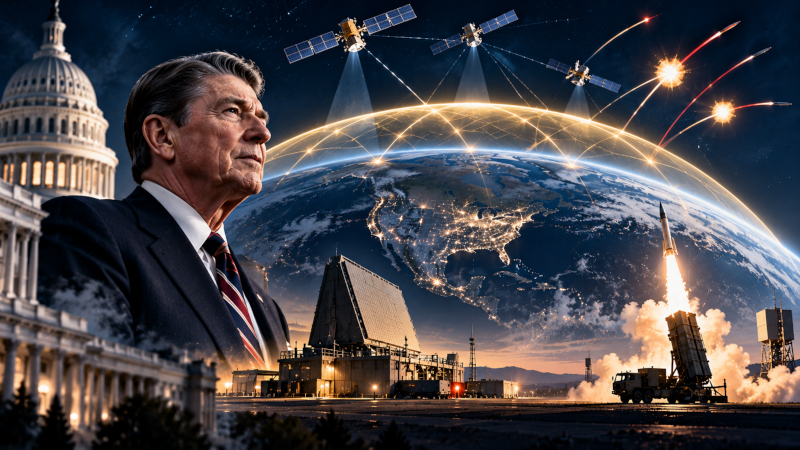
The Star Wars program swallowed enormous sums of cash as the Cold War wound down, and by the mid-1990s the whole effort had been quietly shelved.
Still, the idea never died (ideas like that rarely do), they just had to wait for the technology to catch up.
Now 43 years later, Reagan’s plan is back, except it goes by another, shinier name: The Golden Dome.
Just like last time, Washington can’t agree on what it costs, what it covers, or whether it can be built at all.
The difference, however, is that the 1983 plan depended heavily on satellites, sensors, and rockets that didn’t exist and were mere sketches on paper.
Today, some of them are already in orbit.
The Best Free Investment You’ll Ever Make
Our analysts have traveled the world over, dedicated to finding the best and most profitable investments in the global energy markets. All you have to do to join our Energy and Capital investment community is sign up for the daily newsletter below.
At current estimates, the Pentagon says the Golden Dome will cost $185 billion over the next decade.
When the Congressional Budget Office looked at the same plan, it came back with much different numbers — $1.2 trillion over 20 years.
Although the time frames differ, we’re still staring at a gap of roughly a trillion dollars.
In a Senate hearing last month, one senator said out loud what many people were already thinking… a dome over the entire country is definitely not in the cards.
The thing is, about 90% of the first round of funding is already committed. The Pentagon wants roughly $17 billion more, but nearly all of it rides on a reconciliation bill that Senate leadership has signaled won’t move until after the November midterms.
The man running the program has said that without new funding, there is no Golden Dome.
It’s that simple.
The most controversial piece here are the space-based interceptors, the satellites that would shoot missiles down. And the program office is adamant that they won’t make the final design until costs come down.
However, the first phase due by 2028 is a different animal entirely. It’s mostly about stitching together what already exists, such as the satellites that spot and track launches, networks that carry the data, and rockets to put it all in orbit.
And that, dear reader, is where the checks are being written right now.
The Space Force is asking for $71.1 billion next year, which is more than double what it had been getting. Of course, its two biggest unclassified programs are a tracking constellation at $7.9 billion and a data network at $4.5 billion.
You might also recall last May, when SpaceX won $6.45 billion in contracts to build exactly those two pieces.
Musk’s company also happened to pick up a cool $1.6 billion to fly 18 launches through 2027.
Then a month ago, Starship reached orbit for the first time and released 26 satellites before coming home a little early after losing an engine on the way up and hauling its cargo into space.
After all, you can’t build an orbital shield without a truck big enough to carry it.
Makes sense, right?
Truth be told, I wouldn’t bet a nickel on a dome covering the whole country.
The cost numbers don’t line up and the funding appears to be stuck. That’s also not to mention the fact that the hardest piece may never get built.
But what about the sensors, tracking, data links and the launches? Well, the ink is already dry on those contracts.
So, whatever shape the Golden Dome takes in the end, we know the companies building that layer get paid first.
My cubical cellmate, Jason Simpkins, hasn’t missed this crucial fact. In fact, he’s spent more than a decade and a half entrenched in the defense and space sector, and his readers have made a killing off his research and analysis.
While most of the investment herd will be spending the next year arguing about the blueprint, Jason and his readers will be capitalizing on this opportunity.
Want to see what’s in their cart?
You can see Jason’s presentation for yourself, absolutely free.
I strongly recommend you check this one out for yourself.
Until next time,

Keith Kohl
 Check us out on YouTube!
A true insider in the technology and energy markets, Keith’s research has helped everyday investors capitalize from the rapid adoption of new technology trends and energy transitions. Keith connects with hundreds of thousands of readers as the Managing Editor of Energy & Capital, as well as the investment director of Angel Publishing’s Energy Investor and Technology and Opportunity.
For nearly two decades, Keith has been providing in-depth coverage of the hottest investment trends before they go mainstream — from the shale oil and gas boom in the United States to the red-hot EV revolution currently underway. Keith and his readers have banked hundreds of winning trades on the 5G rollout and on key advancements in robotics and AI technology.
Keith’s keen trading acumen and investment research also extend all the way into the complex biotech sector, where he and his readers take advantage of the newest and most groundbreaking medical therapies being developed by nearly 1,000 biotech companies. His network includes hundreds of experts, from M.D.s and Ph.D.s to lab scientists grinding out the latest medical technology and treatments. You can join his vast investment community and target the most profitable biotech stocks in Keith’s Topline Trader advisory newsletter.


