

I’ll bet a few of you remember the promise Elon Musk made in 2017. You know, the one that most CEOs would’ve laughed off.
At the time, southern Australia had just been through a statewide blackout, and its politicians were getting desperate.
That’s when Musk said Tesla could install a giant battery within 100 days of the grid connection being signed.
Then he doubled down and said that if he couldn’t, it would be free.
Naturally, the skeptics rolled their eyes. After all, we know that utility projects like this don’t move fast. They take years of permits, studies and public debate before the construction begins.
However, Tesla finished in 63 days.
As you might imagine, that stole quite a few headlines. Yet everyone missed a crucial part of this story.
You see, just two weeks after the battery switched on, a coal unit in Victoria tripped offline. Usually, a coal plant needs a few minutes to respond to a failure like that, during which the grid wobbles a bit as operators start sweating.
This time, however, the battery pushed 100 megawatts onto the grid within 140 milliseconds.
Those grid operators took notice, trust me. 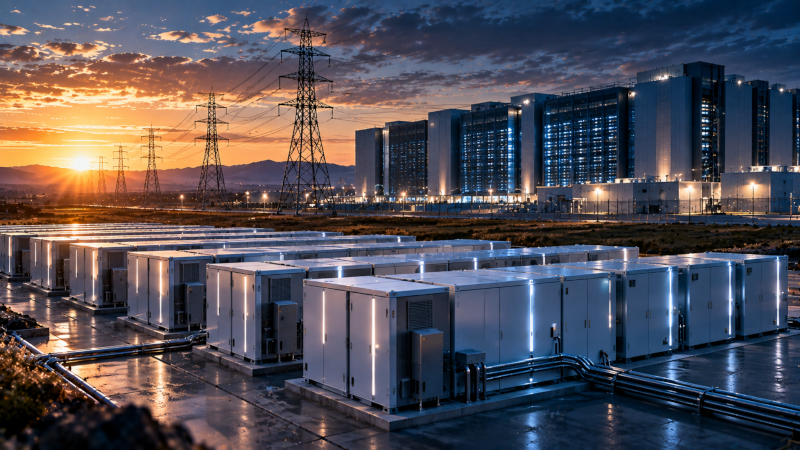
Still, most people filed the story under “car company does something clever.”
That’s understandable, isn’t it? Remember, the narrative surrounding battery technology was almost solely focused on EVs.
Now let’s look at where that boom is heading…
The Best Free Investment You’ll Ever Make
Our analysts have traveled the world over, dedicated to finding the best and most profitable investments in the global energy markets. All you have to do to join our Energy and Capital investment community is sign up for the daily newsletter below.
Car sales inside China fell about 20% in the first half of this year, yet global shipments of lithium-ion storage batteries jumped 71% over the same stretch, to more than 461 gigawatt-hours.
The battery story is quickly changing lanes, and there’s something far hungrier than your daily commute that’s taking us there.
Look, we all know that the foundation of today’s AI boom runs on electricity.
The problem is that data center developers are stuck waiting in line for connections.
Storage gets capacity online faster than almost anything else, which is why there’s a mad scramble for more power.
In fact, the numbers are already showing up:
- The U.S. installed a record 20.2 gigawatt-hours of storage in the second quarter. Batteries put more electricity on the grid in the first eight months of 2026 than in all of 2025.
- In China, storage battery sales hit 76.3 gigawatt-hours in August, up 114% from a year ago.
- In Europe, battery-electric car registrations jumped about 63% in August as fuel prices hit records.
By the way, that last point isn’t by accident.
The same Middle East supply shock that has Brent above $100 a barrel is sending European drivers to the charger, and we can’t ignore the fact that the oil price spike is also a battery demand shock, too.
Now, the political landscape is shifting directions as voters are furious about egregious power bills. That’s why the House just passed a bill, 417 to 3, that nudges states to make big data centers pay for their own grid upgrades.
And when the grid can’t build fast and the public won’t tolerate higher bills, batteries become the quick fix.
Remember, a data center can’t pause its operations when the wind dies or the sun sets, and its power draw swings hard from minute to minute.
This has been a serious issue that’s been hiding in plain sight. A battery smooths all of that out, and it can sit right next to the building.
Utilities love it because it’s fast, and developers love it because it’s faster than waiting years for a new line.
Considering that U.S. battery storage is expected to hit 207 gigawatts by 2031, we’re looking at more than a trend — this is the building.
Where things get even more interesting is when you look at the falling prices taking place during record demand. We saw lithium carbonate fall 21% in the third quarter, to about $19,000 a tonne; cobalt hydroxide prices dropped 31%.
We can’t help but wonder how both can be true at once.
And the answer is: Supply.
Chinese inventory estimates were revised higher in September as more cobalt is shipped out of the DRC. Meanwhile, recycled material is undercutting fresh mining, and prices are reacting to the warehouse, not the order book.
Don’t get me wrong, this isn’t a straight line.
A big Chinese battery maker is mass-producing sodium-ion batteries this quarter, with a goal of matching the cost of today’s workhorse chemistry by year-end. The makers call it a complement to lithium (not a replacement), but it still needs to be on your radar, because China also began taxing battery sales last month.
The rate doubles next year.
Those, dear reader, are real risks at play.
Despite that, the buyers aren’t going away, either.
Hyperscalers are locking themselves into multi-year buildouts. And once a battery contract is signed, the order doesn’t simply vanish because lithium had a bad quarter.
But think about what a price slump actually is…
You see, a slump lasts only as long as the oversupply does, and new mines take years to build.
Demand, meanwhile, is stacking up quarter after quarter.
Makes sense, right?
Also don’t forget that cheap prices cure themselves.
They always have.
The real question is who’s positioned when they do.
Recently, strategists over at Goldman projected that the five biggest tech companies are spending $1.2 trillion on AI infrastructure in 2027.
That’s not a typo.
And every dollar of it needs power.
Each step of this AI boom will have its own winners.
Right now, power storage is next up to bat.
And as always, the timing is everything.
Stay tuned.
Until next time,

Keith Kohl
 Check us out on YouTube!
A true insider in the technology and energy markets, Keith’s research has helped everyday investors capitalize from the rapid adoption of new technology trends and energy transitions. Keith connects with hundreds of thousands of readers as the Managing Editor of Energy & Capital, as well as the investment director of Angel Publishing’s Energy Investor and Technology and Opportunity.
For nearly two decades, Keith has been providing in-depth coverage of the hottest investment trends before they go mainstream — from the shale oil and gas boom in the United States to the red-hot EV revolution currently underway. Keith and his readers have banked hundreds of winning trades on the 5G rollout and on key advancements in robotics and AI technology.
Keith’s keen trading acumen and investment research also extend all the way into the complex biotech sector, where he and his readers take advantage of the newest and most groundbreaking medical therapies being developed by nearly 1,000 biotech companies. His network includes hundreds of experts, from M.D.s and Ph.D.s to lab scientists grinding out the latest medical technology and treatments. You can join his vast investment community and target the most profitable biotech stocks in Keith’s Topline Trader advisory newsletter.


