

It took just about 10 years for the U.S. to dominate the world’s LNG trade.
I know the veteran members of our investment community here know about the significance of the Asia Vision.
Back on February 24, 2016, the Asia Vision — a 285 m LNG tanker — departed Sabine Pass, Louisiana.
But it wasn’t the 2-year old tanker that captured our attention, but rather what was lying in its cargo hold.
You see, the Asia Vision was exporting the first-ever U.S. LNG shipment in the shale era.
After nearly a decade of fracking innovation, billions in infrastructure investment and regulatory battles fought and won, this single tanker steaming toward Brazil was laden with 3.4 billion cubic feet of super-chilled American natural gas.
However, this was more than simply a historic milestone. 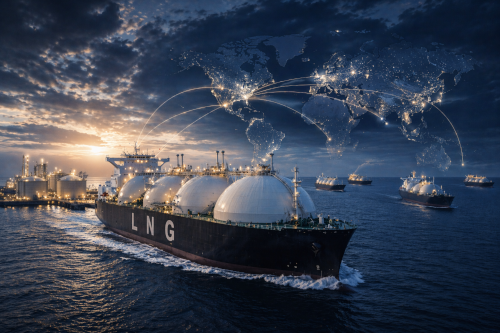
It marked the beginning of America’s energy renaissance.
At the time, few among the investment herd would realize that ten years later, the U.S. would be positioned as the world’s largest LNG exporter.
Of course, it wasn’t long before Sabine Pass evolved from a single terminal into a 30-million-ton-per-year export powerhouse.
Five more terminals were destined to come online in Corpus Christi, Cameron, Freeport, Calcasieu Pass, and Cove Point.
In fact, U.S. LNG exports went from zero in 2016 to 11.9 Bcf/d in 2024 — surpassing Qatar and Australia combined.
Soon, the world will realize that the situation has changed again.
The Best Free Investment You’ll Ever Make
Our analysts have traveled the world over, dedicated to finding the best and most profitable investments in the global energy markets. All you have to do to join our Energy and Capital investment community is sign up for the daily newsletter below.
The Forgotten LNG Crisis Looms
When Iranian missiles slammed into Qatar’s Ras Laffan Industrial City — the world’s largest LNG export facility — last month, all it took were two direct hits to change the course of global LNG markets for years to come.
Two LNG trains were destroyed and a gas-to-liquids facility was obliterated.
In the aftermath, 17% of Qatar’s export capacity was sidelined.
Yet it wasn’t until QatarEnergy held a press conference the next day that we were given the true extent of the damage — 12.8 million tons per year offline.
And then things turned from bad to worse as officials reported that the repair timeline would take a minimum of 3 to 5 years.
In case you’re keeping count, that’s $20 billion in annual revenue gone overnight.
Nobody saw this coming, or what came next…
QatarEnergy declared force majeure on its entire LNG output.
Italy, Belgium, South Korea, China — every major contract suspended indefinitely.
Well, that’s what happens when 20% of global LNG supply vanishes with the push of a button.
And yet, the market barely blinked.
We saw media headlines scream about oil; we saw the price for physical barrels of crude spike higher as blockades were announced.
LNG became the forgotten supply shock — an overlooked disruption that’ll define global gas markets for the rest of the decade (and beyond!).
But this supply gap is structural, not temporary, and the 12.8 million tons per year needs replacement.
Luckily for President Trump, there’s really only one country perfectly positioned to fill it.
And while Qatar’s facilities smolder, the U.S. is expanding LNG export capacity at breakneck speed to seize total control of global markets.
- Plaquemines LNG shipped its first cargo in December 2024, and accounted for 17% of total U.S. LNG exports by August of 2025. This facility uses modular train technology — faster commissioning, rapid scalability. Phase 1 brought 1.3 Bcf/d online, while Phase 2 added another 1.3 Bcf/d… But Venture Global isn’t stopping there. They’ve even announced plans to expand Plaquemines above 45 million tons annually — adding 18 million tons through 24 additional trains.
- Corpus Christi Stage 3 started producing LNG in December 2024, with its first cargo shipped in February, 2025. That’s 7 midscale trains with a combined capacity of 1.3 Bcf/d nominal, 1.5 Bcf/d peak. And Cheniere’s expanding its dominance as the largest U.S. LNG exporter.
- Golden Pass LNG — a joint venture with QatarEnergy — is ramping up in 2026 with three trains and repurposing import terminal infrastructure. Trains 2 and 3 are expected to go online later this year.
By the end of this year, our LNG export capacity will hit 20 billion cubic feet per day — representing a strong 43% increase year-over-year.
However, the pipeline doesn’t stop there.
Rio Grande LNG is targeting a startup date in 2027-2028 with 17 million tons per year Phase 1 capacity.
Port Arthur LNG follows in the late 2020s with 13.5 million tons annually, bringing total U.S. LNG export capacity to over 25 Bcf/d by 2030 — potentially reaching 160+ million tons annually.
The U.S. isn’t just filling Qatar’s gap, dear reader, we’re cementing our dominance in the global LNG trade.
And there’s a reason why U.S. LNG expansion is unstoppable…
We have the natural gas to do it!
Not only is our natural gas output at record levels, but growth is assured; the EIA forecasts 120.8 Bcf/d in 2026, then climbing to 122.3 Bcf/d in 2027.
That has directly led to an unprecedented surge in U.S. LNG exports:
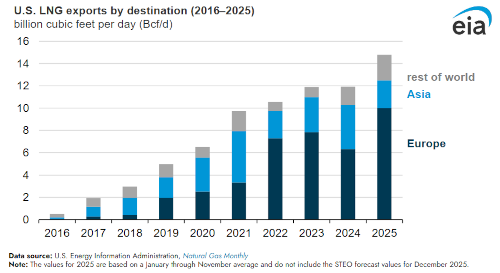
Of course, the Appalachia region, Haynesville shale, and Permian Basin account for 69% of growth.
The infrastructure is already built, too.
Pipelines connect Permian and Haynesville to Gulf Coast terminals, including processing facilities and export berths.
In other words, the U.S. can scale LNG exports without massive new capital outlays — just optimization and expansion of existing assets.
It’s a good thing, too, because Europe is getting desperate for more LNG supply.
The UK already relies on the U.S. for up to 70% of total LNG imports — it’s been that way for the last few years.
Remember, Russia’s Ukraine invasion forced Europe off Russian pipeline gas, and U.S. LNG became their lifeline.
Our LNG exports saved Europe once, and now we’re doing it all over again — except this time, the dependency’s permanent.
Last month, EU members accounted for 64% of U.S. LNG exports — 7.49 million tons. Now Asia is also scrambling, and the new competition has sent benchmark prices soaring after Qatar went offline — Dutch TTF up 50%, British wholesale gas up 50%, Asian LNG up 39%.
Granted, that doesn’t even mention the fact that Europe’s gas storage was sitting at only 30% in early 2026 (against the 54% seasonal average).
Qatar could be out of the game for half a decade, leaving the U.S. as the only player in town with available capacity, growing production, and the infrastructure to deliver.
It’s a win-win situation for us.
America’s LNG Takeover Begins
Look, it doesn’t matter on which side of the political aisle you reside.
The most sobering inevitability in this ongoing global energy crisis is that the U.S. is in an unassailable global position in LNG that’ll last decades.
With Qatar offline until about 2030, the world just learned a brutal lesson about concentrated energy facilities in conflict zones… and that single-point dependencies create catastrophic vulnerability.
Europe and Asia certainly won’t ever forget this lesson again.
In fact, they’ll lock in long-term U.S. contracts for energy security and to diversify its supply away from the Middle East.
Strong natural gas production at record levels is one of the few bright spots in U.S. energy right now, which is bolstered by stable associated gas production from areas like the Permian Basin; this’ll ensure we continue expanding our LNG export capacity.
All this is taking place with the market fixated on oil prices and Hormuz blockades.
Meanwhile, LNG is quietly reshaping global energy geopolitics.
Ten years ago, the Asia Vision sailed from Sabine Pass carrying America’s first shale-era LNG export cargo.
That was a milestone everyone celebrated, then forgot.
Ten years later, that voyage marked the beginning of U.S. energy dominance nobody saw coming.
I don’t expect that window of opportunity to stay open forever.
Until next time,

Keith Kohl
 Check us out on YouTube!
A true insider in the technology and energy markets, Keith’s research has helped everyday investors capitalize from the rapid adoption of new technology trends and energy transitions. Keith connects with hundreds of thousands of readers as the Managing Editor of Energy & Capital, as well as the investment director of Angel Publishing’s Energy Investor and Technology and Opportunity.
For nearly two decades, Keith has been providing in-depth coverage of the hottest investment trends before they go mainstream — from the shale oil and gas boom in the United States to the red-hot EV revolution currently underway. Keith and his readers have banked hundreds of winning trades on the 5G rollout and on key advancements in robotics and AI technology.
Keith’s keen trading acumen and investment research also extend all the way into the complex biotech sector, where he and his readers take advantage of the newest and most groundbreaking medical therapies being developed by nearly 1,000 biotech companies. His network includes hundreds of experts, from M.D.s and Ph.D.s to lab scientists grinding out the latest medical technology and treatments. You can join his vast investment community and target the most profitable biotech stocks in Keith’s Topline Trader advisory newsletter.


