

There once was a plant nobody wanted.
And 55 years ago, an oil company headquartered in Bartlesville, Oklahoma, used it to start shipping liquefied natural gas to Japan.
Phillips Petroleum, along with its partner Marathon, built this plant on Alaska’s Kenai Peninsula, loaded the gas onto specially built tankers and sent it across the Pacific to Japanese utilities.
For nearly half a century, it was the only LNG export plant in North America, marking its 1,000th shipment to Japan back in 1998.
Then, buyers started drying up which led to the plant being shut in 2015, then ultimately mothballed two years later.
To be fair, the idea of the U.S. as the world’s leading LNG exporter (to most people, at least) was a joke for a long time.
But now fast-forward to last week, when ConocoPhillips agreed to buy 1 million tonnes a year of LNG from Venture Global.
By the way, that contract is for 20 years, starting in 2030.
Nobody in the market is laughing anymore.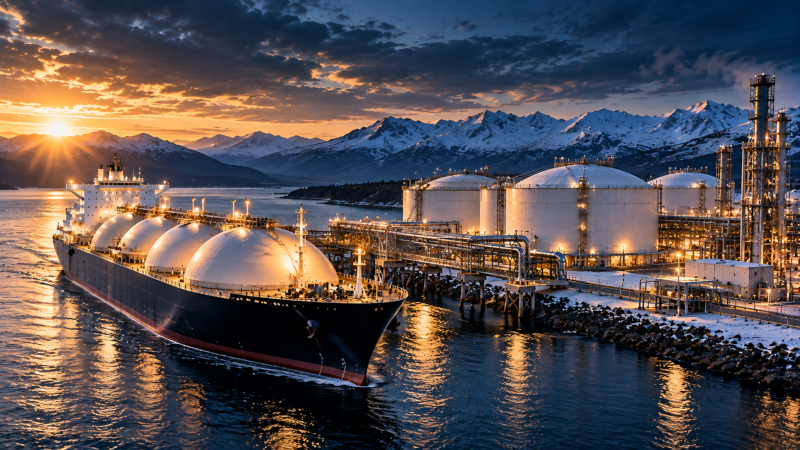
What jumps out (to us, at least) is the fact that ConocoPhillips also owns 30% of Qatar’s Ras Laffan LNG project.
If that name rings a bell to the veteran members of our investment community here, it should.
Ras Laffan happens to be the largest LNG-producing facility on earth.
Think about that…
A company with a stake in the world’s biggest LNG complex just locked in two decades worth of U.S. LNG.
That makes the U.S. officially the world’s top LNG supplier, thanks to the redrawing of the global energy map.
And as you know, the real money isn’t in the headlines — it’s in the contracts.
The Best Free Investment You’ll Ever Make
Our analysts have traveled the world over, dedicated to finding the best and most profitable investments in the global energy markets. All you have to do to join our Energy and Capital investment community is sign up for the daily newsletter below.
One of the biggest events to come out of the U.S.-Iran war since March has been the strikes on Ras Laffan.
If you recall, missiles struck in mid-March and took out two liquefaction trains.
Together, they carried roughly 12.8 million tonnes of LNG per year, or about 17% of everything Qatar can export.
Prior to this war, Qatar was the second-largest LNG exporter on the planet; now its CEO says repairs could take up to three years.
However, the damaged trains are only half the story.
The other half is the strait.
Remember, every Qatari LNG tanker has to pass through Hormuz. There’s simply no other way out, which is why Qatar’s energy minister painfully reminded everyone that a pipeline around the strait wouldn’t make economic sense.
So far, the IEA estimates the disruption has cut LNG supply from Qatar and the UAE by more than 300 million cubic metres a day since the beginning of March.
Even if peace magically descended upon the Middle East tomorrow (spoiler: It won’t!), the damage to the facility itself would ensure the supply disruption continues.
We also know that once ships can pass safely and regularly through the Strait of Hormuz, the 12 undamaged units would still need weeks to return to normal operations.
Again, the magic words here are: Once ships can pass safely.
Despite the fact that crude oil flows have bounced back as ship-to-ship transfers stepped up recently, LNG hasn’t gotten back to any semblance of normalcy. Tanker traffic out of Qatar hit its highest level in more than two months in late September, and it’s still far below where it stood before the war.
So, QatarEnergy keeps extending its force majeure.
All that means is that they legally can’t deliver LNG to their customers… and that it’s not their fault.
Truth is, Qatar has been extending this declaration about once a month since the war began. The latest extension came on September 28th, which pushed cancellations through November for Pakistan and Bangladesh; deliveries for Italy’s Edison were cancelled through early December.
We’re talking about seven months of this. That’s enough for buyers to stop forming their plans around Qatar LNG.
And it’s not shocking to see what they’re doing about it, too.
QatarEnergy itself bought as many as 33 U.S. spot LNG cargoes this year, representing a huge jump over last year. In fact, the company’s trading arm is reportedly negotiating 2 to 3 million tonnes a year of U.S. supply through 2031.
Of course, the Golden Pass LNG export project is 70% owned by QatarEnergy, and Qatar’s share of that output roughly equals the volume it lost at Ras Laffan.
Coincidence? I didn’t think so either.
In the end, the U.S. is now on track to double LNG export capacity by 2030.
Oh, how the tables have turned as the world’s second-largest LNG exporter is buying American gas to keep its own customers supplied.
That’s why ConocoPhillips’ move stands out, because its Qatar stake sits behind the strait while its new contract doesn’t.
And the price gap shows why.
In late September, natural gas in Europe traded around $24 per MMBtu; here in the U.S., it was about $3.20 per MMBtu.
Don’t get me wrong, this isn’t a straight line.
If Hormuz fully reopens, spot premiums could deflate in a hurry as a wave of new supply before 2030 helps form a new supply glut.
Add in higher U.S. LNG exports, and we’re looking at a perfect storm for lower prices.
The thing is, most people hear “LNG” and immediately think about price spikes and price crashes that’re coming this winter.
In other words, they’re banking on what’s coming up this winter.
That’s a coin flip compared to the 20-year contracts being inked right now by U.S. exporters. These deals are typically tied to the price at the Henry Hub, with an added fixed fee on top.
Prices can climb and fall, yet the toll is still collected.
We can see this reflecting in their performance, too. Venture Global’s second-quarter net income jumped 266% to $1.3 billion, and Cheniere has raised its 2026 guidance two quarters in a row.
In fact, Venture Global alone has more than 100 million tonnes a year of capacity in production, construction or development.
You can bet that’s a lot of capacity still looking for long-term buyers.
Meanwhile, the crowd is STILL staring at the spot price, even though the real winners signed years ago. And the ones signing now are locking in the next two decades.
When the whole world scrambles for the same supply, the people who already hold the contracts get paid first.
Look, fortunes get made when long-term demand and short-term fear collide… and they’re colliding right now!
Even Kenai is getting a second life as its owners start planning to turn it back into an export terminal by the end of 2028.
Suddenly, the plant nobody wanted in 2017 is worth talking about again.
Until next time,

Keith Kohl
 Check us out on YouTube!
A true insider in the technology and energy markets, Keith’s research has helped everyday investors capitalize from the rapid adoption of new technology trends and energy transitions. Keith connects with hundreds of thousands of readers as the Managing Editor of Energy & Capital, as well as the investment director of Angel Publishing’s Energy Investor and Technology and Opportunity.
For nearly two decades, Keith has been providing in-depth coverage of the hottest investment trends before they go mainstream — from the shale oil and gas boom in the United States to the red-hot EV revolution currently underway. Keith and his readers have banked hundreds of winning trades on the 5G rollout and on key advancements in robotics and AI technology.
Keith’s keen trading acumen and investment research also extend all the way into the complex biotech sector, where he and his readers take advantage of the newest and most groundbreaking medical therapies being developed by nearly 1,000 biotech companies. His network includes hundreds of experts, from M.D.s and Ph.D.s to lab scientists grinding out the latest medical technology and treatments. You can join his vast investment community and target the most profitable biotech stocks in Keith’s Topline Trader advisory newsletter.
P.S. Trump’s Greenland Deal Sent 3 Stocks Soaring
Three Greenland stocks surged after Trump’s security deal with Denmark put critical minerals back in the spotlight — but investors paid up before any new permits, contracts, or production began. Now attention is shifting to four American mineral deposits already drilled and moving through Washington’s critical-minerals push, with some tied to companies still trading under $4 a share.


