

If I asked you who the highest-paid CEO was back in 2013, who would pop into mind?
Bezos? Zuckerberg? Or perhaps Elon Musk or even Larry Page?
Believe it or not, it wasn’t any of them.
That honor goes to Charif Souki, who earned a total pay package of $142 million that year.
Name not ring a bell? Don’t worry, you’re not alone. I’d bet that few people out there would recognize Souki.
Whether or not he’s familiar to you, there’s no question that his legacy has changed the U.S. energy dynamic forever.
You see, Souki was building something nobody believed could work at the time — converting an LNG import terminal into an export terminal.
He was spending $20 billion to bet that America — a country that supposedly didn’t have enough natural gas — could export it to the world.
Wall Street thought he was insane.
Two years later, Carl Icahn forced him out and the Board wanted to return cash to the shareholders.
Souki wanted to keep building, but Icahn won.
Then, just two months later, history was made…
In February of 2016, the Asia Vision left port out of Sabine Pass, Louisiana.
I know my veteran readers remember this voyage. The Asia Vision was a 950-foot LNG tanker loaded with 3.3 billion cubic feet of American natural gas bound for Brazil.
It marked the first commercial LNG export from the lower 48 in the modern era.
In a cruel twist of fate, Souki wasn’t there to see it.
He’d already been fired. But the U.S. became an LNG exporter that morning anyway.
Ten years later, Charif Souki’s vindication isn’t a tanker leaving Louisiana.
It’s the fact that every person who said he was wrong is now watching the U.S. collect a geopolitical premium on every cubic foot of gas that leaves the Gulf Coast.
Souki’s revenge isn’t personal.
And it’s just getting started.
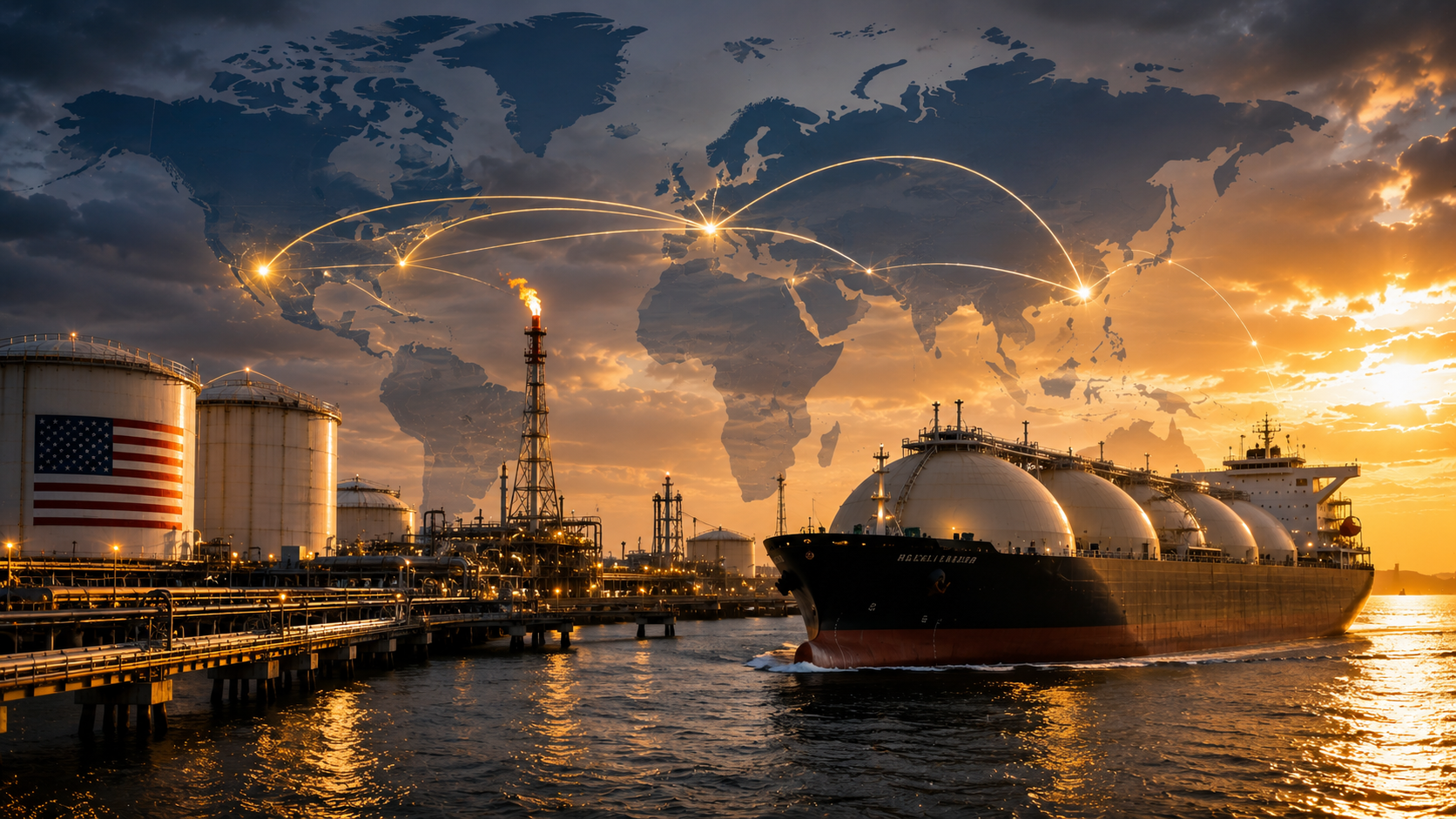
From one tanker departing Sabine Pass in 2016 now to 17.9 billion cubic feet per day of U.S. LNG exports in March 2026 — the second-highest single-month figure ever recorded.
In total, nine U.S. liquefaction terminals are currently in operation, and three more are under construction.
Of course, our client list has swelled to more than 40 destination countries.
And make no mistake, the U.S. is officially the world’s largest LNG exporter.
Yes, we’ve moved ahead of both Qatar and Australia.
But here’s the interesting part…
The premium American exporters are capturing right now didn’t exist when Souki built Sabine Pass.
It exists because of what happened 8,000 miles away in the Persian Gulf.
As you know full well, the war that ignited in the Middle East in late February has had a devastating impact on the global LNG trade. Not only did Iran target key LNG infrastructure controlled by Qatar, but also the Strait of Hormuz — where 20% of the world’s seaborne LNG trade transits. The Strait of Hormuz has been impassable for LNG tankers for months.
Qatar’s North Field Expansion, which was 85% complete at the start of the year, got suspended the moment Iranian missiles struck Ras Laffan and Mesaieed. Those facilities were supposed to add millions of tonnes of new LNG capacity to global markets but are offline indefinitely.
According to the numbers out of the IEA, roughly 120 billion cubic meters of LNG supply will be lost between 2026 and 2030 because of this disruption.
For the record, that’s the entire annual gas consumption of Germany and Italy combined.
However, global gas supply has been precarious for years, ever since Russian pipeline gas to Europe was shut down in 2022. Meanwhile, Algerian and Egyptian LNG exports have been hollowed out by domestic consumption.
Right now, there’s only one place on Earth that can pour more LNG into the global market.
One.
And it’s collecting a toll on every cargo.
The cost basis for U.S. LNG starts at Henry Hub, the domestic benchmark, which has averaged about $3.50 per million BTU in 2026.
The sale price for U.S. LNG delivered to Europe runs against the Title Transfer Facility benchmark — the Dutch hub. The sale price into Asia runs against the Japan-Korea Marker.
According to the EIA’s April 2026 outlook, the Henry Hub to TTF spread has averaged $14.89 per million BTU — an 83% jump month-over-month.
Meanwhile, the Henry Hub to JKM spread has averaged $15.23 per million BTU. That’s up 98% month-over-month.
Do the math.
A typical 160,000-cubic-meter LNG cargo carries roughly 3.4 billion BTU of energy.
3,400,000 million BTU times $15 per million BTU spread equals $51 million in gross spread per cargo.
That’s $51 million dollars of spread, per cargo, off a base feedstock cost that hasn’t budged.
That premium just didn’t exist in 2016, nor was it seen in 2020.
In fact, it barely existed in 2024.
Today, it’s a reality because the world has run out of alternatives.
You know as well as I do that the cure for high natural gas prices is supposed to be higher production.
But, that’s not the case when the production has to come from a basin that’s geopolitically off-limits, and certainly not when the only basin still standing is sitting on the U.S. Gulf Coast.
Now here’s why the premium goes to the exporter instead of getting competed away.
You see, U.S. LNG exporters don’t sell gas the way you’d sell a barrel of oil.
They sell it through long-dated, take-or-pay Sale and Purchase Agreements (SPA) that typically run 20 to 25 years.
The structure is actually quite brilliant.
The pricing formula works like this: take the Henry Hub price, multiply it by about 1.15, add a fixed fee of $2 to $3 per million BTU for liquefaction, then add shipping costs. The customer pays whatever Henry Hub does — there’s no negotiating around that baseline.
In other words, the U.S. exporter never loses money: the customer takes the upside and the downside, and the U.S. exporter clips the middle.
But here’s what most people can’t connect — the contracts being signed in 2026 are being signed at premium fee structures, because every counterparty knows there’s nowhere else to go.
For example, Cheniere and CPC Corporation in Taiwan signed a deal in January 2026 for 25 years for 1.2 million tonnes per year, 2026 to 2050.
Venture Global has roughly 84% of its 2026 production already contracted — up from 69% reported the prior quarter.
LNG has never been a spot market story.
And the geopolitical crisis that created the premium isn’t temporary, either. The damage has been structural. So even if the Strait of Hormuz reopens tomorrow (Spoiler: It won’t), Qatar’s North Field Expansion won’t come back online for years.
The facilities were suspended mid-construction. You don’t just flip a switch and resume building multi-billion-dollar LNG trains after a war.
So if the world needs 120 billion cubic meters of LNG supply to replace what’s been lost, the only place that can deliver it at scale is the United States.
That’s a long-term advantage that Souki’s successors will take full advantage of.
Of course, every new LNG terminal that comes online in the United States — Plaquemines, Corpus Christi Stage 3, Rio Grande, CP2 — locks in another 20 to 25 years of contracted cash flow at premiums that didn’t exist when those projects were sanctioned.
Souki spent a decade being told he was expanding too aggressively — that Cheniere should focus on returning cash to shareholders instead of building more capacity.
Carl Icahn fired him over it.
But the expansion strategy Souki championed — the one that got him fired — is exactly what’s allowing our LNG exporters to capture the premium today.
Just think, if Cheniere had stopped building after Sabine Pass, the company would’ve been capped at a fraction of its current export capacity.
If the industry had listened to the analysts who said LNG export growth was overbuilt, the United States wouldn’t have the infrastructure to meet global demand right now.
Souki was right… and not just about the Asia Vision or Sabine Pass.
Now, the U.S. could become the world’s swing LNG exporter. Naturally, whoever owned the export infrastructure when geopolitical events disrupted the alternative suppliers would be cashing royalty checks for decades.
That’s the situation we’re in right now.
And the toll booth Souki built is printing money for everyone who said he was wrong.
Now here’s the best part — this is just the beginning.
Today, there are three more LNG terminals under construction in the U.S.
By 2027, U.S. export capacity is projected to exceed 18 billion cubic feet per day — double what it was in 2020.
And every cubic foot of that capacity is being contracted at premiums that reflect a new reality: the world needs American LNG, and there’s no alternative supply coming online fast enough to compete.
This geopolitical premium isn’t going away.
Souki’s revenge isn’t that he was right.
It’s that the world finally ran out of alternatives.
Until next time,

Keith Kohl
 Check us out on YouTube!
A true insider in the technology and energy markets, Keith’s research has helped everyday investors capitalize from the rapid adoption of new technology trends and energy transitions. Keith connects with hundreds of thousands of readers as the Managing Editor of Energy & Capital, as well as the investment director of Angel Publishing’s Energy Investor and Technology and Opportunity.
For nearly two decades, Keith has been providing in-depth coverage of the hottest investment trends before they go mainstream — from the shale oil and gas boom in the United States to the red-hot EV revolution currently underway. Keith and his readers have banked hundreds of winning trades on the 5G rollout and on key advancements in robotics and AI technology.
Keith’s keen trading acumen and investment research also extend all the way into the complex biotech sector, where he and his readers take advantage of the newest and most groundbreaking medical therapies being developed by nearly 1,000 biotech companies. His network includes hundreds of experts, from M.D.s and Ph.D.s to lab scientists grinding out the latest medical technology and treatments. You can join his vast investment community and target the most profitable biotech stocks in Keith’s Topline Trader advisory newsletter.

The New Government Fund Nobody’s Explaining
What if I told you your next tax bill could be $0…
And instead of paying the government, you could start receiving massive dividend checks from them instead.
It sounds incredible, but it’s already happening…
Right now, Washington is undergoing the biggest financial transformation in history — and almost nobody is talking about it.
Trump has signed an executive order creating America’s first-ever National Investment Fund — a system designed to replace income taxes while sending direct payments to everyday Americans.
No more stress every April 15
- No more losing a third of your paycheck
- No more IRS audits
Instead of taking your money… the Government will PAY YOU.
And it starts with the BIGGEST dividend payout in U.S. History — with $1 TRILLION up for grabs!
But here’s the kicker…
A small group of early investors have found a way to start collecting payouts as high as $21,307 — before the first public checks even go out.
This is a once-in-a-lifetime financial shift — but the window to claim your stake is closing FAST.
Click here to see how you can profit BEFORE Trump rolls this out nationwide.


