

Since February, roughly one-fifth of the world’s LNG supply has been trapped behind a 21-mile-wide strait.
Qatari cargoes were attacked, and the mighty Ras Laffan was struck by missiles.
This has led to Asian and European buyers brawling over every spot cargo on the water.
Through all of it, one LNG exporter just kept loading more and more, from terminals that face nothing but open ocean, not locked in war-torn straits.
Now here’s a stat that’ll give you a hint of who’s winning: Germany — the industrial heart of Europe and hardwired for decades into Russian gas supply — now gets 92% of its LNG from the United States.
Read that again: Germany is now depending on the U.S. for nearly all of its LNG supply!
Perhaps you’re wondering how the U.S. managed to corner the most strategic commodity market on Earth?
Well that’s the fun part, dear reader. It started with the smartest people in energy being completely, catastrophically wrong — and an empire got built on the wreckage of their mistake.
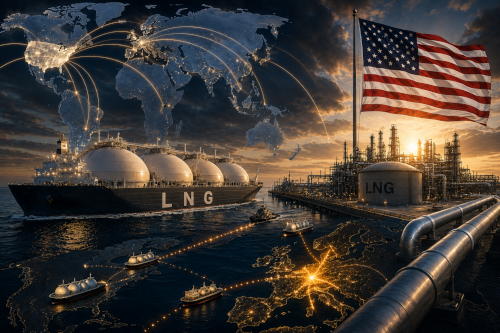
The Wrong Energy Bet Turned Into a Huge Pay Day
Let’s wind the clock back to 2005.
The consensus in American energy was pretty airtight.
At the time, everyone in the U.S had believed that our natural gas production peaked, which means that prices would climb forever.
The consensus was that America would spend the rest of its days dependent on imports from Qatar, Trinidad, and Nigeria.
So we built our infrastructure for that inevitability.
FERC approved LNG import terminals as fast as it could stamp the paperwork — Sabine Pass, Cove Point, Freeport, Cameron, Lake Charles.
Billions of dollars poured into storage tanks and jetties designed to move gas in one direction.
By 2008, Sabine Pass opened its doors to welcome foreign cargoes.
The Best Free Investment You’ll Ever Make
Our analysts have traveled the world over, dedicated to finding the best and most profitable investments in the global energy markets. All you have to do to join our Energy and Capital investment community is sign up for the daily newsletter below.
That’s when the shale revolution detonated every assumption people had made about America’s energy dynamic.
The Barnett, the Marcellus, the Haynesville, the Permian — suddenly America had more gas than it could possibly burn.
Of course, that flood of supply led to Henry Hub prices crashing from over $8/MMBtu to under $2/MMBtu.
And what do you think happened to those brand-new billion-dollar import terminals?
Well, they sat empty… waiting for a new spark.
So, Cheniere Energy did the only sensible thing — it turned Sabine Pass around.
And on February 24, 2016, the first shale-era cargo of LNG sailed for Brazil.
Now let’s look at the scoreboard 10 years later…
U.S. LNG exports have gone from half a billion cubic feet per day to 15.1 billion — jumping 26% last year alone, the biggest increase of any nation on Earth.
In fact, the U.S. now represents 26% of all global LNG trade.
And if that number doesn’t stop you cold, just consider this:
Since 2021, the U.S. has supplied roughly three-quarters of the entire world’s LNG trade growth. Qatar, Australia, Russia — all of them combined barely moved the needle. EU members now take 58% of its LNG from us, the most it has ever taken from any single source.
But don’t make the mistake of thinking we just out-pumped everybody.
America won because we rewrote the rules.
Legacy Qatari and Australian contracts chained cargoes to designated ports at rigid, oil-linked prices.
U.S. contracts did the opposite — cheap Henry Hub pricing, and destination flexibility let a buyer send the cargo anywhere, or resell it outright.
And when Russia invaded Ukraine and Europe’s pipelines went dark, only American cargoes could swing across the Atlantic overnight.
You see, it that flexibility was the key.
Everything else was noise.
An Insurance Policy the World Is Paying For
That brings us back to the chokepoint today at the Strait of Hormuz.
This energy crisis in the Strait of Hormuz (and other nearby chokepoints, too) is the stress test the U.S. LNG machine was accidentally built for.
Remember that Qatar, who happens to be the second-largest LNG exporter on the planet, has all of their exports routed through a corridor Iran can close with a press release.
So the buyers who took 80% of Qatari volumes are now bidding against European utilities sitting on storage levels below their five-year average.
Meanwhile, every cargo sailing out of our Gulf Coast hits open waters in the Atlantic, without any of the geopolitical obstacles that plague Qatar.
Naturally, Washington knows exactly what it’s holding, too. That’s why the Department of Energy just approved an immediate export increase from the Plaquemines terminal to steady global supplies.
America isn’t just the biggest LNG supplier anymore. We’re the world’s energy insurance policy, and the premiums get paid in Louisiana and Texas.
The second act of our LNG empire is already funded.
Keep in mind that five new U.S. projects reached a final investment decision last year — 54.5 million tonnes of new capacity, the strongest year on record — with three more greenlighted just since March.
By 2031, American export capacity nearly doubled.
Each of those trains represents twenty-year contracts locking in demand for American gas, decades into the future, regardless of where prices wander next quarter.
For us, the empire pays out on three levels.
We have the toll-collectors — liquefaction operators earning utility-like fees whether cargoes lift or not.
Then there’s the feedgas suppliers — those Marcellus, Haynesville and Permian producers feeding the Gulf Coast monster that’ll export cheap U.S. natural gas.
Finally, consider the pipes and infrastructure stitching these two together.
Two decades ago, we built the wrong terminals… and got laughed at.
Well, it turns out that punchline was the beginning of an energy empire.
P.S. This New Energy Source Could Change Everything
Scientists say this virtually limitless fuel source contains more usable energy than humanity could consume in billions of years. It’s free, abundant, and capable of powering everything from homes and vehicles to massive AI data centers and electric grids. If the technology to harness it scales as expected, it could trigger one of the biggest energy revolutions — and investment opportunities — of our lifetime.
Until next time,

Keith Kohl
 Check us out on YouTube!
A true insider in the technology and energy markets, Keith’s research has helped everyday investors capitalize from the rapid adoption of new technology trends and energy transitions. Keith connects with hundreds of thousands of readers as the Managing Editor of Energy & Capital, as well as the investment director of Angel Publishing’s Energy Investor and Technology and Opportunity.
For nearly two decades, Keith has been providing in-depth coverage of the hottest investment trends before they go mainstream — from the shale oil and gas boom in the United States to the red-hot EV revolution currently underway. Keith and his readers have banked hundreds of winning trades on the 5G rollout and on key advancements in robotics and AI technology.
Keith’s keen trading acumen and investment research also extend all the way into the complex biotech sector, where he and his readers take advantage of the newest and most groundbreaking medical therapies being developed by nearly 1,000 biotech companies. His network includes hundreds of experts, from M.D.s and Ph.D.s to lab scientists grinding out the latest medical technology and treatments. You can join his vast investment community and target the most profitable biotech stocks in Keith’s Topline Trader advisory newsletter.


