

Pop the champagne bottles, because the celebrations are in full swing.
I’m honestly surprised there weren’t fireworks going off in the Tokyo Bay as cheers erupted and media headlines focused on a 274-meter long oil tanker named OTIS.
OTIS’ warm welcome was deserved. Safely locked inside her hull sat 910,000 barrels of crude oil.
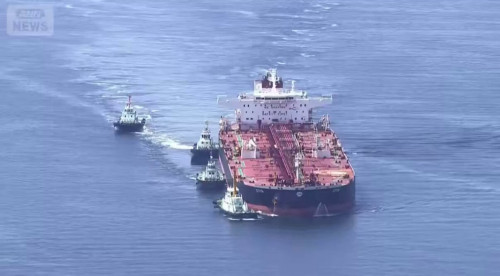
But this wasn’t your typical barrel.
This shipment marked the completion of a long journey from the U.S. Gulf Coast to Japan. If you recall, we recently highlighted the conga line of tankers making their way to load up in the Gulf of America.
It’s official, WTI crude is now flowing into Asian markets.
It’s about time, too.
Remember, countries like Japan are heavily dependent on the Middle East for its oil imports; we’re talking about the source for roughly 90% of Japan’s oil supply!
Keep in mind that Japan’s oil production is negligible.
So, it’s understandable how grateful they are for these barrels — certainly enough to roll out the red carpet — considering that the Strait of Hormuz has been effectively closed for 59 days,
Let them enjoy their crude, just don’t mention that 910,000 barrels of oil only accounts for about one-third of what Japan consumes on a daily basis.
Or that it took 35 days for the OTIS to make its way through the Panama Canal and across the Pacific to unload its crude delivery.
That’s a month of transit for a little over 7 hours of oil consumption.
Hey, take whatever you can get, right?
The Best Free Investment You’ll Ever Make
Our analysts have traveled the world over, dedicated to finding the best and most profitable investments in the global energy markets. All you have to do to join our Energy and Capital investment community is sign up for the daily newsletter below.
Unfortunately, the celebration will be short-lived.
It’s clear that the media is desperate for good news.
Any good news.
So how about a tanker unloading some oil in Japan? Oh, that’ll do.
But while everyone’s focused on feel-good stories about crude deliveries, the actual situation is deteriorating fast.
Are you noticing the warning signs popping up that’s turning this from an oil crisis into a full blown crude armageddon?
First up is something that is just starting to catch the market’s attention: inventory draws that are accelerating, not slowing down.
Even Wall Street is finally catching up with us as Goldman Sachs revises their oil price forecasts upward.
Again.
Their analysts now expect Brent crude to average $90 per barrel in the fourth quarter this year — up from their earlier projections of $80 per barrel.
For the record, that’s nearly $30/bbl higher than before the Hormuz shock, and they’re explicitly calling the inventory draws “extreme.”
But it should be the math that terrifies you — global oil stockpiles are draining at 11 to 12 million barrels per day throughout April.
We’re not talking about total disruption — just the rate at which inventories are dropping.
In fact, Goldman pegs production losses from the Persian Gulf at 14.5 million barrels per day.
And the EIA’s numbers? Their current estimates put shut-in volumes at about 7.5 million barrels per day in March, and 9.1 million barrels per day in April.
Iraq, Saudi Arabia, Kuwait, UAE, Qatar, Bahrain — they’re collectively shutting down production because storage is full and there’s nowhere for the oil to go.
Look, you can’t sell oil that can’t reach buyers.
Mind you, these aren’t temporary shutdowns that you flip back on like a light switch. Prolonged shut-ins damage reservoirs, and wells lose pressure.
Even after the strait reopens (cross your fingers, if you will) it’ll take months to restore full production capacity.
The reality of our current situation is brutal to those that recognize what’s going on — cumulative supply losses by the end of April will hit around 650 million barrels.
Furthermore, daily production outages now exceed 13 million barrels per day. The U.S. counter-blockade imposed April 13th added another 1.3 million barrels per day of Iranian crude that’s now offline.
What about the strategic reserves everyone’s counting on?
They’re stopgaps, nothing more.
The IEA’s 400-million-barrel emergency release sounds massive until you realize it won’t last. Of course, this isn’t to mention that it’s not the size of the release that is important, but rather the flow rates at which you can get that crude to market.
What’s worse is that draining those reserves today means we have to refill them tomorrow — a lesson we didn’t learn in 2022 when President Biden released half of our SPR to bring down prices after Russia invaded Ukraine.
That brings us to another timeline nobody wants to talk about.
Even if a peace deal gets signed today — and make no mistake, there’s absolutely zero indication that’s happening — Pentagon briefings to Congress estimated it could take six months to fully clear the Strait of Hormuz of mines laid by the IRGC.
That’s six months… minimum.
And demining operations can’t even start until hostilities actually end.
Iran has made it crystal clear that the strait stays closed as long as the U.S. blockades Iranian ports.
President Trump has made it clear that the blockade remains in place until they, among other things, give up all uranium enrichment — something Iran is adamantly opposed to doing.
In other words, we’ve got a dual blockade with no diplomatic off-ramp in sight.
Any talks in Islamabad will collapse before they begin.
Then, President Trump keeps extending the ceasefire indefinitely while threatening to destroy Iran’s infrastructure; Iran keeps seizing ships and firing on vessels trying to transit without paying tolls.
And so the circle goes.
This isn’t winding down, dear reader, it’s becoming the norm.
But there’s another catastrophe lurking just ahead, one that hasn’t reared its ugly head — demand destruction.
What’s interesting is that it hasn’t shown itself just yet.
Jet fuel demand has remained stubbornly normal despite warnings of shortages across Europe and Asia within weeks. This comes as the IEA has said Europe only has “maybe six weeks” of jet fuel left.
Soon, we’ll see airlines drastically cutting flights, imposing fuel surcharges, and watching costs double — but travelers are still booking.
Demand hasn’t broken yet.
We’re nowhere near the level of demand destruction that a 13-million-barrel-per-day supply disruption should trigger.
What’s the reason? Well, governments are shielding consumers from the full price impact through subsidies, tax relief, and price caps — all of which delays the pain and makes the eventual reckoning worse.
Mark my words, when demand destruction finally hits — and it inevitably will — it’s going to be sharp, sudden, and utterly brutal.
Get used to seeing this line pop up more and more as this war drags on: The longer this lasts, the more global inventories draw, and you can’t draw inventories forever.
And you can bet it’s going to drag.
If you haven’t seen the opportunity buried in this geopolitical chaos, just follow the path the OTIS took all the way back to the Gulf of America.
U.S. crude and petroleum product exports are — and will continue — surging.
Think about it… the U.S. is the only major oil producer not trapped behind the Hormuz blockade.
Our domestic output rests at a little over 13.5 million barrels per day.
And we know that Europe and Asia are scrambling for supply, and they’re willing to pay premium prices for barrels that don’t require navigating a war zone.
Throughout all of this, U.S. refiners are printing money.
Gulf Coast crack spreads — the difference between crude costs and refined product prices — averaged $41.75 per barrel in April. Although that’s down slightly from March’s $43.81 per barrel, it’s still 95% higher year-over-year.
Meanwhile, diesel margins are elevated, gasoline margins are strong, and refining margins remain well above historical norms even as they’ve eased off the absolute peaks.
Diesel crack spreads in particular are holding at levels that make U.S. refiners extremely profitable.
In fact, diesel prices averaged $61.42 per barrel in April, up 164% from a year ago.
The global diesel shortage — driven by the Hormuz closure cutting off Middle Eastern supply — is creating sustained elevated margins for refiners that can produce and deliver.
And then there are the Permian drillers, those elite E&P players that we’ve been talking about for years.
It’s finally their time to shine.
What most people don’t realize is that U.S. oil output actually has plateaued over the past year. The sweet spots in our shale plays are largely drilled, and operators are prioritizing shareholder returns over growth.
Remember when the Dallas Fed survey of oil executives showed their reluctance? Well 30% of those execs predicted no production increase this year in response to the Iran war, and only 1% saw more than a million barrels per day of additional output.
See, even with WTI soaring from $57 at the start of the year to over $100 during the crisis, drillers aren’t rushing to add rigs.
Why? Volatility, uncertainty, you name it.
But again, the thing here is that every day this dual blockade drags on, the closer we are to a doomsday scenario that’ll push crude prices well over $100/bbl until demand destruction finally kicks in.
Believe me, the opportunity’s there.
You just have to look past the Exxons and Chevrons. Everyone’s watching and looking for the overlooked operators with runway left.
We’ve jumped off the cliff, folks.
At this point, the Strait of Hormuz has been shut for 59 days, and inventory draws are about to accelerate at unprecedented rates.
Production shut-ins will compound the longer this “ceasefire” drags on, which threatens to damage reservoirs that’ll take months to restore.
Now here’s the scary part of this equation that will bring everything tumbling down — demand destruction hasn’t hit yet, which means the pain’s still building.
You see, even if a peace deal materializes tomorrow, we’re looking at a minimum six-month timeline to clear mines and restore normal operations.
A more realistic scenario is that this war drags through summer, maybe into fall. Prices will remain elevated throughout 2026 as recession risks build and the global economy teeters.
In the middle of it all, U.S. refiners will continue printing money on elevated crack spreads.
And that isn’t to mention the select group of Permian drillers with quality acreage and growth capacity quietly positioning themselves to be the biggest winners when the market wakes up to the fact that American oil is the only reliable supply left.
The media can celebrate tankers reaching Japan.
While they smile in relief, the rest of us will be watching the inventory draws, the production shut-ins, and the ongoing delay to reopen the strait.
This is an oil crisis nobody’s pricing in. At least, not until the mainstream media finally realizes the situation we’ve put ourselves in.
Well, I’m sorry to tell you that although things look grim this summer — it’s about to get a lot worse.
But the real question you should be asking yourself is whether you’re ready for that crude armageddon.
Perhaps this will help get you that market advantage.
Until next time,

Keith Kohl
 Check us out on YouTube!
A true insider in the technology and energy markets, Keith’s research has helped everyday investors capitalize from the rapid adoption of new technology trends and energy transitions. Keith connects with hundreds of thousands of readers as the Managing Editor of Energy & Capital, as well as the investment director of Angel Publishing’s Energy Investor and Technology and Opportunity.
For nearly two decades, Keith has been providing in-depth coverage of the hottest investment trends before they go mainstream — from the shale oil and gas boom in the United States to the red-hot EV revolution currently underway. Keith and his readers have banked hundreds of winning trades on the 5G rollout and on key advancements in robotics and AI technology.
Keith’s keen trading acumen and investment research also extend all the way into the complex biotech sector, where he and his readers take advantage of the newest and most groundbreaking medical therapies being developed by nearly 1,000 biotech companies. His network includes hundreds of experts, from M.D.s and Ph.D.s to lab scientists grinding out the latest medical technology and treatments. You can join his vast investment community and target the most profitable biotech stocks in Keith’s Topline Trader advisory newsletter.


