

More than a decade has passed since Japan decided to detain the capital of a Chinese fishing trawler near the disputed Senkaku Islands.
Beijing’s response, however, was interesting…
They simply cut off all rare earth exports to Japan.
For two months, Japanese manufacturers — Toyota, Panasonic, Hitachi — scrambled for alternatives as rare earth prices spiked tenfold and their production lines slowed.
China’s message was crystal clear: Don’t push our buttons or we’ll weaponize our rare earth monopoly.
Japan panicked.
And suddenly, investments flooded into Australian miner Lynas Corp. Stockpiling programs launched and recycling technology accelerated.
By 2012, all that hard work and sacrifice had cut Japan’s dependence on China for critical minerals from 90% to 60%.
But Japan’s a small economy. So when China wields the rare earth weapon against the United States, the impact is exponentially larger.
Then came last year. Beijing restricted exports of seven key critical minerals to the U.S. after President Trump unleashed his barrage of tariffs onto China. 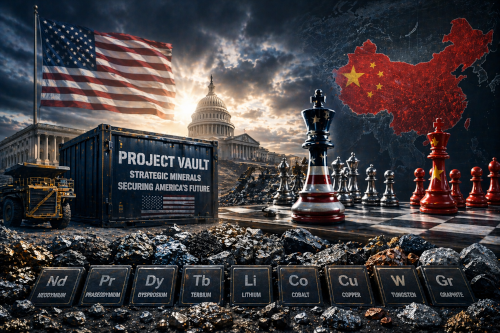
This time, it was U.S. automakers like Ford and GM that struggled to obtain the necessary resources or temporarily shut down their factories. Meanwhile, Defense contractors couldn’t source materials for F-35 components.
The embargo lasted two months before a trade deal eased restrictions.
However, it was enough to show our vulnerability.
President Trump’s answer to this is to never put ourselves in that situation again… so he unveiled Project Vault — a $12 billion strategic minerals stockpile.
Japan learned its lesson in 2010 and diversified.
The U.S. learned its lesson in 2025 and is rebuilding our entire supply chain from scratch — because the next crisis won’t be over a fishing boat.
It’ll be over Taiwan.
And you can bet that rare earths will be the 21st-century equivalent of the 1973 oil embargo.
The Best Free Investment You’ll Ever Make
Join Gold World today for FREE. Get the latest insight on gold, silver, and precious metals delivered straight to your inbox. When you become a member today, you’ll get our latest free report: “The #1 Golden Token to Buy Now.” Don’t Delay!
After getting your report, you’ll begin receiving the Gold World e-Letter, delivered to your inbox daily.
Forget Iran, China’s Next
The numbers that define America’s vulnerability are staggering.
China controls 70% of global rare earth mining, and up to 90% of all rare earth processing and refining.
The Middle Kingdom also controls near-monopolies on the downstream products that matter: 70% of lithium refining, 90% of battery-grade graphite, and total dominance of cobalt processing through the DRC-to-China pipeline.
Dysprosium and terbium — two rare earth elements critical for high-temperature magnets in F-35 actuators, Tesla’s humanoid robots, and Virginia-class submarines?
That’s right, China has a 100% monopoly on separation of those materials.
Yet, this didn’t happen by accident.
You see, China doesn’t have some geological advantage. The minerals exist everywhere — California, Texas, Nevada, Wyoming, Alaska.
However, what China has is a willingness to accept environmental and human costs that Western nations rejected.
For 30 years, Beijing handed out tens of billions in state subsidies — that’s zero-interest loans to mining firms, coupled with price controls that undercut competitors.
So while the U.S. imposed strict pollution controls and heavy liability, China tolerated environmental destruction in pursuit of strategic dominance.
Of course, you know the result just as well as I do.
Even when rare earths are mined in California or Australia, the ore gets shipped to China for refining, because processing is where the real control sits.
The IEA put it bluntly: China is the leading refiner for 19 out of 20 strategic minerals, with an average market share around 70%.
And remember, it’s not just rare earths. We’re talking about a host of strategic resources like lithium, graphite, cobalt, tungsten, manganese — the entire ecosystem of materials that underpin EVs, semiconductors, defense systems, and renewable energy.
And now, China’s proven its willingness to weaponize that dominance.
After all, April 2025 wasn’t the first time.
In December 2024, Beijing banned exports of antimony, gallium, and germanium to the U.S. in retaliation for semiconductor restrictions. Magnet imports dropped 75% overnight, and manufacturers couldn’t get the materials to build products.
Although the bans were suspended in November 2025 as part of a broader trade deal, the threat remains very much alive.
When Ford and GM idled production lines last year in April, it was because they couldn’t get Chinese magnets — the message landed: America’s defense industrial base and commercial manufacturing sector are entirely dependent on the goodwill of a strategic rival.
So you can understand why Trump’s response has been the most aggressive industrial policy shift in decades.
Project Vault launched February 2, 2026: the first-ever civilian strategic minerals reserve, modeled directly on the Strategic Petroleum Reserve.
It’s not just rare earths, too.
This initiative covers all 50+ critical minerals on the USGS list: lithium, uranium, copper, graphite, cobalt… the whole catalog.
We know how it works, too.
Companies lock in fixed prices and draw from the stockpile during shortages. GE Vernova, Boeing, and GM have all expressed interest. Western Digital and Clarios are on board.
The minerals get stored in a network of warehouse facilities across the United States. EXIM sources them both domestically and abroad. It’s not just about holding inventory. It’s about creating guaranteed demand that makes domestic production viable even when China floods the market.
But the stockpile is only one piece of this puzzle.
President Trump’s administration is also officially taking equity stakes in mining companies — something the U.S. government hasn’t done outside of crisis moments like the 2008 financial collapse.
You know that MP Materials — the only rare earth mine in the United States, located at Mountain Pass, California — got the first deal in July 2025. The Pentagon invested $400 million for a 15% equity stake, but the kicker was the price floor: $110 per kilogram for neodymium-praseodymium oxide.
For the record, that’s double China’s market rate.
That doesn’t include the 10-year offtake agreement, or that the government will buy every magnet produced at MP’s new 10,000-ton facility.
Granted, it wasn’t surprising that MP’s stock surged 40% after the announcement.
Then USA Rare Earth got the next deal after the Commerce Department took a 10% equity stake in exchange for $1.6 billion in CHIPS Act funding.
The company’s building a rare earth processing facility at Round Top, Texas, with commercial production targeted for late 2028.
Then there’s Korea Zinc, in which the U.S. government took a roughly 10% stake.
The U.S. is even exploring an 8% stake in Critical Minerals for access to the Kvanefjeld rare earths deposit in Greenland — tying into Trump’s not-so-subtle interest in acquiring the territory.
Then Intel got a 10% federal equity stake tied to semiconductor production.
By the end of 2025, the U.S. had acquired equity stakes in seven companies by converting federal grants into ownership positions. In other words, the government’s now a shareholder — board observation rights, direct involvement in corporate strategy, and veto power on certain decisions.
This isn’t laissez-faire capitalism, mind you. We’re talking about an industrial policy straight out of the Cold War playbook.
And it’s backed by permitting reform that’s moving at speeds unheard of in modern American mining.
Now here’s the problem…
The U.S. has the second-longest mine permitting timeline in the world — 7-10 years on average; Australia and Canada do it in less than half that.
Even if you find the deposit, secure financing, and line up buyers, you’re still stuck waiting a decade for approvals.
Trump’s executive order changed that.
Aptly titled Immediate Measures to Increase American Mineral Production, agencies have 10 days to identify projects that could be immediately approved.
The FAST-41 program, which fast-tracks infrastructure projects, added more than 20 critical mineral projects to its dashboard.
And Resolution Copper in Arizona is the poster child…
The project — a JV led by Rio Tinto — sat in regulatory purgatory for years despite being one of the largest untapped copper deposits in North America. Yet, it has the potential to supply 400,000 tons of copper annually, roughly 25% of total U.S. demand.
In March 2026, the Forest Service approved it.
That timeline measured in weeks, dear reader, NOT years.
Trump’s executive order also invoked the Defense Production Act, which means the Pentagon can now directly fund mineral production, issue purchase guarantees, and compel companies to prioritize government orders over commercial sales.
Federal lands are now prioritized for mining.
However, we’re not just talking about domestic development. President Trump is also coordinating with allies to build a non-Chinese supply chain.
At the G-7 summit in Kananaskis last June, world leaders launched the Critical Minerals Action Plan — a $6.4 billion dollars mobilized across 26 projects, with Canada leading the effort.
So far, the U.S. inked an $8.5 billion rare earth pact with Australia, as well as bilateral agreements with Malaysia, Thailand, Saudi Arabia, and Japan followed.
The message now to Beijing is just as clear: the West is building alternatives to China’s monopoly.
Trump’s Project Vault Takes on China’s Monopoly
Now here’s the brutal truth in this situation…
China’s lead in this resource race is measured in decades, not years.
Remember, processing rare earths isn’t like drilling for oil. It requires hundreds of chemical steps, with tight control at every stage, and the expertise that can’t be bought off a shelf.
Even with unlimited funding, U.S. domestic capacity won’t match China until the 2030s.
Remember MP Materials’ new magnet facility? Well, commercial production isn’t expected until 2028. Or what about USA Rare Earth’s Round Top mine? Now we’re talking about a late 2028 production target.
But here’s the thing: success doesn’t mean taking 50% market share from China.
Let’s be fair here, that’s not a realistic goal.
The goal is eliminating single-point vulnerability — building enough non-Chinese capacity to keep the Western defense base running independently.
In other words, creating leverage where the U.S. currently has none.
Price floors will ensure that domestic producers can compete even when China floods global markets to kill competitors — which Beijing has done repeatedly.
We also can’t forget the Taiwan variable.
If conflict erupts over Taiwan (or China suddenly feels emboldened to strike in the wake of the war with Iran), rare earth access becomes an immediate crisis.
Remember, each F-35 requires more than 400 kilograms of rare earth materials. Tomahawk missiles, precision-guided bombs, submarine propulsion systems — all depend on materials China currently dominates.
Unlike oil, where the Strategic Petroleum Reserve provides at least a little buffer, there’s no rare earth stockpile… not yet.
That’s the urgency, folks.
And it’s also why Trump’s treating this like a national security emergency — because it is!
For us, the signal is clear enough, isn’t it?
After all, Federal backing eliminates the single biggest risk for domestic miners: commodity price crashes that historically drove U.S. rare earth companies into bankruptcy.
Shares of MP Materials and USA Rare Earth surged when those deals were announced, making U.S. miners with “shovel-ready” projects positioned to capture government contracts worth billions.
But again, the window’s closing…
Japan took two months of pain in 2010 and cut Chinese dependence from 90% to 60% within two years.
The U.S. took two months of pain in 2025 and is attempting to rebuild an entire supply chain that took China three decades to dominate.
Granted, the difference is that Japan’s economy is 5x smaller than the United States’ — the stakes are exponentially higher.
Trump’s now betting that emergency powers, federal equity stakes, and allied coordination can compress thirty years of Chinese industrial policy into five years of American execution.
Whether it works depends on one question: Can the U.S. move fast enough before the next crisis?
Because when it comes, it won’t be over a fishing boat.
It’ll be over Taiwan.
Until next time,

Keith Kohl
 Check us out on YouTube!
A true insider in the technology and energy markets, Keith’s research has helped everyday investors capitalize from the rapid adoption of new technology trends and energy transitions. Keith connects with hundreds of thousands of readers as the Managing Editor of Energy & Capital, as well as the investment director of Angel Publishing’s Energy Investor and Technology and Opportunity.
For nearly two decades, Keith has been providing in-depth coverage of the hottest investment trends before they go mainstream — from the shale oil and gas boom in the United States to the red-hot EV revolution currently underway. Keith and his readers have banked hundreds of winning trades on the 5G rollout and on key advancements in robotics and AI technology.
Keith’s keen trading acumen and investment research also extend all the way into the complex biotech sector, where he and his readers take advantage of the newest and most groundbreaking medical therapies being developed by nearly 1,000 biotech companies. His network includes hundreds of experts, from M.D.s and Ph.D.s to lab scientists grinding out the latest medical technology and treatments. You can join his vast investment community and target the most profitable biotech stocks in Keith’s Topline Trader advisory newsletter.


