

It was the best of times, it was the worst of times for global oil markets.
It was the age of clickbait, it was the age of foolishness; a ceasefire of theater, and a prelude to catastrophe. It was the hour of official calm, it was the minute before the detonation.
A handshake no one trusts, and a threat everyone understands; a promise of restraint with the certainty of escalation.
Folks, this was the kind of peace only Washington and Tehran could call peace while both kept striking matches.
A ceasefire of liars with the calm of loaded guns… okay, you get the point. 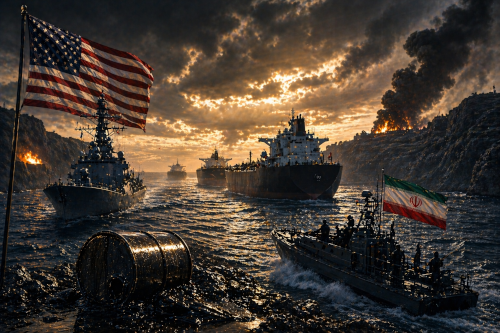
What we’re witnessing in real time is nothing short of diplomacy dressed in fancy farce, and the hope for peace at this point is so absurd it practically came with a lit fuse.
A few days ago, President Trump announced an indefinite ceasefire extension with Iran. With no end date, this is nothing more than an open-ended promise to hold off attacks “until such time as their proposal is submitted, and discussions are concluded, one way or the other.”
Finally, a little peace can descend onto this conflict… right?
Nope.
It only took a few hours until all hell broke loose again. This time, the Iranian navy (yes, the one that is supposedly operating at the bottom of the sea) seized two ships in the Strait of Hormuz.
Then, they fired on a third vessel before it tucked tail and turned around.
So, I guess this is what a ceasefire looks like in 2026.
At this point, the Strait of Hormuz — 21 miles wide at its narrowest point — now hosts two active blockades.
We’ve got the U.S. naval blockade that Trump ordered on April 13th, and Iran’s blockade, reimposed the same week after Tehran decided the Americans weren’t playing fair.
Both blockades are doing their jobs, too.
Last weekend, the USS Spruance — an Arleigh Burke-class guided-missile destroyer — fired its 5-inch MK 45 gun into the engine room of the Iranian-flagged cargo ship Touska.
It was a six-hour standoff that was filled with repeated warnings. And yet, the Touska refused to comply with U.S. orders to withdraw from its planned passage through the strait.
CENTCOM video shows three direct hits, effectively disabling the Touska’s propulsion. Then, marines from the USS Tripoli rappelled onto the deck and seized it.
We call it blockade enforcement, Iran calls it piracy.
The Best Free Investment You’ll Ever Make
Our analysts have traveled the world over, dedicated to finding the best and most profitable investments in the global energy markets. All you have to do to join our Energy and Capital investment community is sign up for the daily newsletter below.
To be fair, Iran has had its own fair share of enforcement. It attacked boats and opened fire on vessels trying to transit the strait without paying Tehran’s toll.
In fact, French shipping company CMA CGM confirmed one of its ships — the CMA CGM Everglade — took several warning shots.
Two Indian-flagged vessels came under fire and were forced to turn back.
One of them, the VLCC Sanmar Herald, were scammed into believing they actually paid the toll, and were met by Iranian gunfire.
This isn’t a paper blockade, dear reader, because both sides are firing at and seizing ships.
And still… President Trump decided on an indefinite ceasefire.
If there was any hope for a peaceful resolution in the near term, these events destroyed it.
Now here’s the part nobody’s talking about — the longer this drags on, the worse the oil crisis gets.
Production shut-ins across the Gulf have reached unprecedented levels.
The EIA estimates 9.1 million barrels per day shut-in for April.
Meanwhile, Iraq’s production collapsed 61% from 4.2 million bpd in February to 1.6 million bpd in March.
Kuwait cut output by 53%.
The UAE’s production is down 44%.
Even Saudi Arabia reduced output by 23%, from 10.1 million bpd to 7.8 million bpd.
In total, OPEC’s production plunged 27% month-over-month in March — from 28.7 million bbls/d to 20.8 million bbls/d.
But these aren’t strategic cuts, mind you.
These are forced shutdowns because there’s simply nowhere for the oil to go. Storage is full (or filling fast) as the Strait of Hormuz remains effectively closed.
Tankers can’t get in or out.
Global observed oil inventories outside the Middle East Gulf drew down by 205 million barrels in March alone.
For the record, that’s 6.6 million barrels per day.
We’re officially living through the largest supply disruption in history… and WTI crude is still trading under $100/bbl on Wednesday.
As we’ve talked about this before, the IEA’s 400-million-barrel strategic release is more of a bluff than anything.
But reserves don’t last forever.
And here’s the kicker in this whole mess — the longer production stays shut-in, the harder it is to bring it back online.
You see, oil fields aren’t light switches.
You don’t just flip them off and on. Prolonged shut-ins can damage reservoirs, wells can lose pressure, and equipment can degrade.
Saudi Aramco’s Khurais and Manifa fields — 600,000 bbls/d of capacity lost in the initial strikes — will take months to restore even after the strait reopens.
Right now, the estimate for Gulf Arab states to bring production back to full capacity — even under the most optimistic scenarios — is several months.
Of course, that also assumes the Strait of Hormuz re-opens soon.
Spoiler: It won’t.
What’s worse is that the average person out there reading the latest clickbait headlines doesn’t realize how fragile this situation truly is.
Sure, global oil inventories can bridge temporary supply gaps, but we’re two months into an 11-million-barrel-per-day disruption with no end in sight.
Storage draws can’t continue indefinitely, and at some point the math stops working.
However, the real monster ahead that’s lurking in the shadows is demand destruction.
Asian petrochemical producers have curtailed operating rates as feedstock supplies dried up.
We’re also seeing flight cancellations across the Middle East, Asia, and Europe after slashing jet fuel consumption. Countries are starting to implement policies to reduce fuel use.
What’s interesting is that a new dynamic is beginning to emerge…
Some countries are starting to take a page from Iran’s playbook.
Indonesia — yes, Indonesia — is now floating the idea of charging tolls on ships passing through the Strait of Malacca; their officials explicitly cited Iran’s toll system in the Strait of Hormuz as a “possible reference model.”
To put that into perspective, the Strait of Malacca carries roughly 40% of global trade.
Most oil shipments from the Middle East to China, Japan, and South Korea pass through it. So if Indonesia decides to impose a toll for passage — even de facto regulatory tolls disguised as environmental fees or service mandates — it fundamentally changes the cost structure of global shipping.
The precedent has already been set, and Iran proved that global trade chokepoints can easily be weaponized.
The illusion of “free seas” is shattered.
Everyone’s watching, and you can bet they’re taking notes.
Don’t worry, there is a winner buried in this mess: U.S. oil.
Remember, our crude oil and petroleum product exports are about to surge.
Why? Well, the U.S. is the only major oil producer not trapped behind the Hormuz blockade.
Asia and Europe are scrambling for supply, and both are willing to pay premium prices for barrels that don’t require navigating a war zone.
U.S. exports of petroleum products and crude are already rising, and refiners are ramping runs where they can.
Now throw in a waiver on The Jones Act that was issued last month, and President Trump has unlocked another regulator bottleneck.
Get used to this phrase whenever it comes to oil prices: Higher for longer.
Goldman expects Brent crude to average $80/barrel by year-end — about $20 higher than pre-war forecasts.
However, that assumes the strait reopens and production restores quickly. If the conflict drags into late 2026 — which looks increasingly likely — prices stay elevated much longer.
While most U.S. oil regions have plateaued, the Permian Basin remains the King of production.
You see, the small to mid-cap drillers that are still able to boost output through drilling efficiency — regardless of where oil prices move from here — are the hidden gems.
These aren’t the Exxons and Chevrons of the world that’ll be quick to open their war chests to buy more production for their books. No, I’m talking about those overlooked Permian oil stocks that don’t make the mainstream headlines.
The opportunity is there, you just have to know where to look.
Let me point you in the right direction.
Until next time,

Keith Kohl
 Check us out on YouTube!
A true insider in the technology and energy markets, Keith’s research has helped everyday investors capitalize from the rapid adoption of new technology trends and energy transitions. Keith connects with hundreds of thousands of readers as the Managing Editor of Energy & Capital, as well as the investment director of Angel Publishing’s Energy Investor and Technology and Opportunity.
For nearly two decades, Keith has been providing in-depth coverage of the hottest investment trends before they go mainstream — from the shale oil and gas boom in the United States to the red-hot EV revolution currently underway. Keith and his readers have banked hundreds of winning trades on the 5G rollout and on key advancements in robotics and AI technology.
Keith’s keen trading acumen and investment research also extend all the way into the complex biotech sector, where he and his readers take advantage of the newest and most groundbreaking medical therapies being developed by nearly 1,000 biotech companies. His network includes hundreds of experts, from M.D.s and Ph.D.s to lab scientists grinding out the latest medical technology and treatments. You can join his vast investment community and target the most profitable biotech stocks in Keith’s Topline Trader advisory newsletter.


