

121.
Keep that number in mind as you navigate the oil markets over the next few weeks.
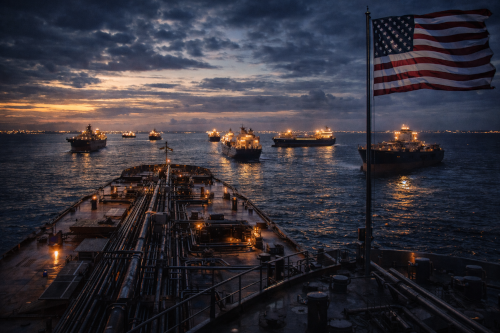
That’s the number of diverted oil tankers slowly marching their crude parade toward one destination.
This isn’t a short-term stunt, either.
It’s a veritable surge in maritime traffic — a 46% rise in tankers arriving through the northern corridor from Europe, and a 132% spike in vessels coming through the southern corridor from Asia.
Every single one of them ballast — completely empty — steaming toward terminals along the Gulf Coast.
Look, Trump wasn’t exaggerating (for once) when he posted Saturday morning that “massive numbers of completely empty oil tankers, some of the largest anywhere in the World” were heading to America.
You see, a fundamental shift just took place in the global oil dynamic.
For decades, the Gulf of America was a net exporter. Our tight oil revolution changed the game forever in 2008, and it was a good thing, too. We’re pumping out more than 13 million barrels per day, and foreign buyers are now lining up to secure as much of it as they can.
The world’s tankers are steaming toward us to load up.
I think those tankers know something that Wall Street hasn’t fully priced in yet — this crisis has no quick resolution!
When news of the ceasefire hit the markets last week, oil prices tanked as investors finally saw an end in sight.
They couldn’t have been more wrong.
All it took was 21 hours for the highly touted ceasefire negotiations to collapse in Islamabad.
And both sides are further apart from agreeing than ever before.
Vice President Vance led the U.S. delegation, and was given several demands by Iran: control of the Strait of Hormuz, war reparations, frozen assets released, and the right to continue enriching uranium.
For his part, VP Vance just wasn’t going to budge on uranium enrichment. That much has been set in stone from Day 1 of Operation Epic Fury.
Of course, without any movement from either side on that point, the breakdown in peace talks accelerated.
For the record, there’s ZERO common ground.
The Best Free Investment You’ll Ever Make
Our analysts have traveled the world over, dedicated to finding the best and most profitable investments in the global energy markets. All you have to do to join our Energy and Capital investment community is sign up for the daily newsletter below.
When Iran effectively closed the Strait of Hormuz on February 28th, approximately 11 million barrels per day was cut off from global markets — the single-largest supply disruption since the 1970s.
Oil spiked to $126 at its peak as the IEA scrambled to respond with historic SPR releases.
What happened next? Well, the world burned through 250 million barrels of stored crude in six weeks.
Then came the April 8th ceasefire, which let markets exhale and led to crude prices plummeting on a new hope for peace.
Finally, they thought… an off-ramp.
Things are about to get back to normal, right?
Wrong.
The thing is, Iran never actually reopened the strait. Ships were blocked as tanker traffic was trickle compared to pre-war levels.
Tehran started charging tolls — up to $2 million per vessel — for “safe passage.” Except, only friendly nations got through — all that crude was destined for China and India.
Everyone else could kick rocks.
Meanwhile, Iran’s shadow fleet kept operating. Dark tankers with manipulated tracking systems, and risky ship-to-ship transfers occurred in international waters.
Last month, Iran was still successfully exporting roughly 1.85 million barrels per day.
The Strait of Hormuz was supposedly closed, but Iran’s crude kept flowing through the very chokepoint they’d weaponized.
That status quo changed the second the ceasefire talks collapsed.
And President Trump is officially entering the blockade game:
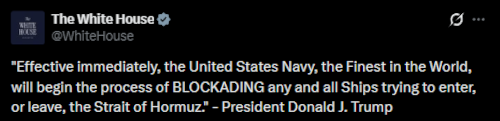
Trump’s oil blockade went live Monday morning at 10:00 A.M.
And for the record, nobody gets Iranian oil anymore.
Ships transiting between non-Iranian ports can pass, but any vessel entering or leaving Iran? Nope.
What about any ship that paid Tehran’s toll? They get intercepted too.
That’s up to 1.85 million barrels per day of Iranian exports gone… on top of the 11 million already shut in.
You don’t need me to tell you that this is bad news for oil bears.
In fact, crude prices hit $115 by Monday afternoon, and Brent crude climbed back above the levels that triggered the initial panic in early March.
But here’s the problem.
The world doesn’t have 1.85 million barrels per day of spare capacity sitting around.
Saudi Arabia, UAE, Kuwait — they’re already shut in because Iran won’t let their exports through Hormuz.
The East-West pipeline to Yanbu and the Abu Dhabi pipeline to Fujairah have a combined capacity of 9 million barrels per day — nowhere near enough to replace the 20 million barrels per day that normally flows through the strait (and that’s just crude oil and petroleum products!)
What about the SPR release? After all, the U.S. already coordinated the largest release in history.
We’re burning through reserves at roughly the same pace Iran was exporting before Trump’s blockade. Another massive SPR drawdown is coming. Yes, it’ll buy a little more time, but keep in mind that SPR levels do have a minimum level that we’ll get dangerously close to if this situation drags on.
SPR releases certainly won’t solve the problem, because this isn’t a supply disruption with a diplomatic fix around the corner.
As we clearly saw this past weekend, the two sides are at polar opposites when it comes to peace negotiations.
Iran believes nuclear development is their sovereign right — especially now. Israel’s been striking Hezbollah in Lebanon despite the ceasefire, and Tehran’s looking at the last two months and seeing exactly why they need a deterrent.
President Trump cannot leave office with Iran possessing nuclear capability.
If there’s one clear message in this entire mess, it’s that uranium enrichment is a red line for Trump. That’s non-negotiable, and he’s even threatening to hit their water desalination plants, their electrical grid, their entire infrastructure.
Neither side is ready to blink.
And here’s the part that the market is feverishly trying to ignore — the supply-demand gap widens every day, and global onshore crude inventories are quickly draining.
If this continues through to the summer months, the world faces a full-blown energy crisis that makes 1973 look like a day at the beach.
The endgame isn’t oil prices stabilizing over $120 per barrel.
We know better than that, don’t we? After all, there’s a reason why we say that the cure for high prices IS high prices.
No, dear reader, the endgame here is the demand destruction that’s about to take place.
And with it, comes a global recession triggered by energy costs that economies can’t sustain.
Prices climb until consumption collapses, then everything breaks.
That brings back to the 121 empty oil tankers sailing full steam toward the Gulf of America.
You see, they’re not export vessels leaving the U.S. loaded with crude for foreign markets.
They’re the opposite.
We’re talking about empty tankers that are inbound, hoping to load up with U.S. oil and get back home safe and sound.
Exporters along our Gulf Coast are salivating at the chance to tap into Asian and European markets.
The big players haven’t changed, either. Chevron, Exxon, and ConocoPhillips hold most of the cards, and they have the infrastructure to cash-in.
- Chevron’s got major export operations at Corpus Christi and Houston.
- ExxonMobil’s Beaumont refinery and export terminals can handle massive volumes.
- And ConocoPhillips has been ramping Permian output and has direct access to Gulf export capacity.
These aren’t speculative plays, mind you.
There’s a reason we refer to them as “Big Oil.” They’re operators with proven reserves, existing export infrastructure, and the ability to ramp production while the rest of the world shuts out of Hormuz.
But here’s the reality Wall Street’s missing: the surge in U.S. exports isn’t a solution, either!
Sure, getting our crude out there will help, and it’s certainly better than nothing… but it doesn’t fix the underlying problem — Time!
Under normal circumstances, it takes a tanker about 10 days to sail into the Gulf of America, load crude, and exit.
Again, that’s under normal circumstances.
The fact that there are well over a hundred vessels all trying to get their tankers loaded up, bottlenecks will naturally form, stretching loading times and building unavoidable queues.
And we’re not just talking crude, because you can expect LNG terminals are getting slammed too. Plaquemines LNG and Golden Pass LNG are coming online with total export capacity projected to hit 16.3 billion cubic feet per day by year-end.
Asian buyers who can’t get LNG through Hormuz are scrambling for American contracts.
But capacity is still capacity.
We can’t just conjure new export terminals or refineries overnight. The first new American oil refinery in nearly 50 years is under construction in Brownsville, Texas — designed specifically for domestic shale crude. But it won’t be operational for years.
For now, let’s also ignore the fact that the light, sweet crude that dominated tight oil production in the U.S. isn’t the same as the sour crude we’ve lost in the Middle East.
That leads us to the other elephant in the room that nobody is talking about…
Like it or not, we may have entered the twilight phase of the U.S. shale. Our oil output plateaued (and even declined a bit) over the last year thanks to dirt cheap oil prices.
So far, the market has ignored the fact that the easy barrels are drying up quicker than most realize. Permian oil operators alerted this fact to us last year, saying that their Tier-1 acreage is nearly gone.
But the operators that can still pump more oil? Those are the hidden gems in the Permian oil patch that are still trading at attractive metrics.
In fact, these are the names Big Oil will pay a premium for when it comes time to open their massive war chests and buy more reserves.
Because the majors know what’s coming…
Elevated prices for at least another year, possibly longer if this Iran standoff drags on.
Never forget that for Exxon, the only way to grow production is acquiring operators who still have an output runway.
All this at a time when over a hundred oil tanks are in a slow-moving conga line toward the Gulf of America.
They’re betting U.S. shale is the answer.
It’s not.
At best, it’ll be a small stopgap — a relief valve that buys time but doesn’t solve the underlying crisis.
Until one side capitulates — Iran gives up uranium enrichment or Trump accepts a nuclear Iran — the Strait of Hormuz will remain weaponized, more than 12 million barrels per day will stay shut-in, and oil prices keep climbing until demand destruction forces a global recession.
The tankers can keep coming.
American producers can keep pumping.
But bottlenecks, loading delays, and plateauing output mean the cavalry isn’t riding to the rescue fast enough.
The market’s finally waking up to that reality.
The only question I have is whether or not you’re positioned for what comes next.
P.S. Gold Just Dropped 11% — and It’s Triggering a Quiet Buying Opportunity
Gold’s sudden drop is rattling investors — but beneath the surface, high-quality assets are being mispriced in one of North America’s most strategic gold districts. Three sub-$10 companies are sitting on large-scale deposits as panic selling creates a rare entry point. See which names are positioned to surge when sentiment snaps back and this window closes.
Until next time,

Keith Kohl
 Check us out on YouTube!
A true insider in the technology and energy markets, Keith’s research has helped everyday investors capitalize from the rapid adoption of new technology trends and energy transitions. Keith connects with hundreds of thousands of readers as the Managing Editor of Energy & Capital, as well as the investment director of Angel Publishing’s Energy Investor and Technology and Opportunity.
For nearly two decades, Keith has been providing in-depth coverage of the hottest investment trends before they go mainstream — from the shale oil and gas boom in the United States to the red-hot EV revolution currently underway. Keith and his readers have banked hundreds of winning trades on the 5G rollout and on key advancements in robotics and AI technology.
Keith’s keen trading acumen and investment research also extend all the way into the complex biotech sector, where he and his readers take advantage of the newest and most groundbreaking medical therapies being developed by nearly 1,000 biotech companies. His network includes hundreds of experts, from M.D.s and Ph.D.s to lab scientists grinding out the latest medical technology and treatments. You can join his vast investment community and target the most profitable biotech stocks in Keith’s Topline Trader advisory newsletter.


