

About 20 years ago, 18 MIT scientists put their formidable minds together to answer one question — is EGS feasible?
You can’t really blame them for wanting an answer. After all, the promise of EGS is quite staggering: Unlimited clean baseload power.
And yes, that “baseload” caveat is a key factor.
The idea is simple, isn’t it? Drill deep enough, anywhere on Earth, and tap into heat that never runs out.
Not only would it provide a sizable amount of power, but unlike its clean energy counterparts like wind and solar, EGS comes with no intermittency or dependence on the weather outside.
What we crave today is constant, carbon-free electricity — the holy grail of power for every future data center being built today.
So what’s the problem? Well, at the time, nobody could drill that deep and economically get EGS up and running.
The technology just wasn’t ready at the time, and geothermal energy remained trapped in the places nature had built for it — Iceland’s volcanoes, California’s Geysers, and a handful of lucky spots where hot water already pooled underground waiting to be tapped.
As you can probably guess, that MIT report sat around and collected dust.
Today, you can bet it’s been taken off the shelf.
Now things are starting to move fast…
Last week’s IPO announcement from Fervo makes the company the first commercial-scale geothermal company to go public.
A few days later, Quaise Energy unveiled Project Obsidian — the world’s first superhot geothermal plant under construction in Oregon.
Again, we’re not talking about pilots, or lab experiments… This is a 50 MW power plant that’ll be up and running in the next few years, with the potential to expand to a full GW.
We’ve moved beyond science projects, dear reader. The projects that are now in play are bankable, investor-backed, and revenue-generating power plants.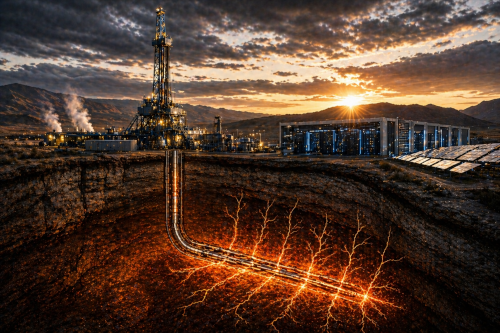
And what MIT couldn’t predict in 2006 is that it was our best oil and gas drillers that solved the technology problem by accident, all while chasing oil in the Permian Basin.
But there was something that nobody back then saw coming.
That is, the fact that AI data centers would create the exact demand geothermal was built to supply.
Think of it as a 20-year science project that just became a trillion-dollar industry.
And the best stocks are still hiding in plain sight.
Okay, so here’s what next-gen geothermal technology looks like.
First, you drill DEEP — 5,000 to 20,000 feet — and then fracture the hot rock, circulate water through the cracks, and extract heat to generate electricity. To put a little perspective on this, the average shale well typically ranges between 3,000 and 15,000 feet deep.
The Best Free Investment You’ll Ever Make
Our analysts have traveled the world over, dedicated to finding the best and most profitable investments in the global energy markets. All you have to do to join our Energy and Capital investment community is sign up for the daily newsletter below.
If you think you recognize this technology — you should!
It’s fracking… except their goal is to extract heat instead of hydrocarbons.
It’s the same horizontal drilling and completion techniques, as well as the same fiber-optic diagnostics monitoring downhole conditions in real time. Drillers are also using the same proppants holding fractures open.
This entire technology stack came straight from the shale revolution.
And they’re getting better with every well they’re drilling, too.
Fervo was founded back in 2017 by Tim Latimer, a former BHP drilling engineer who saw the connection immediately.
Their early wells took about 30 days to drill. Today, however, Fervo’s averaging 15 to 16 days.
Utah FORGE — a Department of Energy field lab testing enhanced geothermal techniques — doubled drilling rates from 8 meters per hour to 15, with peak rates hitting 26 meters per hour.
Now, Fervo’s consistently hitting 30 meters per hour.
The company drills down 8,500 feet to tap rock at 450 degrees Fahrenheit, and Phase I comes online in October 2026.
Within two years, the full build-out will hit 500 megawatts.
Of course, all 500 megawatts are already contracted.
Shell Energy inked a 15-year power purchase agreement for 31 megawatts starting in 2026, and Google has locked in 115 megawatts for its Nevada data centers.
Meanwhile, Quaise Energy (an MIT spinout, I might add) is commercializing millimeter-wave drilling technology that uses electromagnetic waves to vaporize rock instead of grinding through it with drill bits.
Their target is superhot rock at temperatures between 300 and 500 degrees Celsius, and depths of up to 16,000 feet.
At those temperatures, a single well delivers 10 to 100 times more power than conventional geothermal.
Project Obsidian in Oregon is targeting 50 megawatts by 2030, and the company has already signed a power purchase agreement for the first 50 megawatts and is seeking $200 million in funding.
In case you’re wondering why this rush is happening right now, it’s primarily due to the onslaught of data centers that’ll come online over the next few years.
You see, AI training and inference requires 24/7 baseload power.
As you know, solar and wind are intermittent, and batteries are too expensive for multi-day coverage at the kind of scale that data centers need.
Even our steady, secure sources of baseload power like natural gas creates carbon emissions, which conflicts with every tech company’s net-zero pledge.
And what about nuclear energy? Despite the strong push toward developing new nuclear capacity, permits and construction still take a decade or more.
Geothermal delivers 24/7 carbon-free electricity with 15-year power purchase agreements at or below current grid prices.
Some projections are calling for EGS to provide 64% of new data center energy demand by 2030, with data center electricity consumption projected to surge more than 300%.
Google, Meta, and Shell aren’t signing those deals for public relations. They’re signing because geothermal solves the problem that renewables can’t — constant power with zero emissions.
It turns out that the Trump administration sees this potential, too.
In February, the Department of Energy announced $171.5 million for next-gen geothermal field tests — up to 28 awards ranging from $4 million to $25 million each.
And now Pennsylvania is spending $14 million to convert existing Appalachian shale gas wells into geothermal wells, which could unlock massive scalability if it works.
Over in New Mexico, the state is opening trust lands to geothermal leasing.
According to the Department of Energy, more than 90 GW of geothermal capacity could be up and running by 2050.
Now here’s the real kicker — our drillers already know how to do this.
The rigs are the same, as are the crews running them. The supply chains are also identical — every technique Fervo and Quaise uses came directly from oil and gas.
It’s the perfect pivot for Big Oil… and it’s happening under everyone’s radar.
As shale production plateaus across the Permian, drillers need new markets. Geothermal is the natural pivot using the exact skillsets they’ve spent 15 years perfecting.
What the market is missing, however, is that everyone is watching Fervo.
Although Fervo is ready to go public, both it and Quaise are still private companies with solid backing.
Nobody’s watching the drillers and service companies that supply them.
Not only are they still trading at attractive metrics, but they clearly possess the exact expertise geothermal needs.
Horizontal drilling and fracking expertise? Check. Fiber-optic diagnostics for downhole monitoring? That’s another big check.
The industry standards in oil and gas drilling operations are the backbone of geothermal reservoir management.
Sounds pretty straightforward, doesn’t it?
Look, it’s no secret why data centers are co-locating directly at geothermal sites (which solves the transmission bottleneck that’s plagued renewable energy, by the way).
And we have a major geological advantage — accessible heat in the West, and now potentially massive conversion opportunities in the Appalachia region where existing shale gas wells can be repurposed.
Oil and gas drillers have the rigs. They have the crews. They have the knowledge. And as Permian production plateaus, they need growth markets.
Geothermal demand is ramping exactly as shale demand flattens.
Twenty years ago, more than a dozen MIT scientists told us flat-out that geothermal works — if someone solved the drilling problem.
Well, it looks like the Permian drillers solved it while chasing oil.
Of course, the smart money will be scrambling to find the players that have been hiding in plain sight — the ones who’ve been perfecting the exact techniques geothermal needs for the last fifteen years.
Let me give you a headstart right here.
Until next time,

Keith Kohl
 Check us out on YouTube!
A true insider in the technology and energy markets, Keith’s research has helped everyday investors capitalize from the rapid adoption of new technology trends and energy transitions. Keith connects with hundreds of thousands of readers as the Managing Editor of Energy & Capital, as well as the investment director of Angel Publishing’s Energy Investor and Technology and Opportunity.
For nearly two decades, Keith has been providing in-depth coverage of the hottest investment trends before they go mainstream — from the shale oil and gas boom in the United States to the red-hot EV revolution currently underway. Keith and his readers have banked hundreds of winning trades on the 5G rollout and on key advancements in robotics and AI technology.
Keith’s keen trading acumen and investment research also extend all the way into the complex biotech sector, where he and his readers take advantage of the newest and most groundbreaking medical therapies being developed by nearly 1,000 biotech companies. His network includes hundreds of experts, from M.D.s and Ph.D.s to lab scientists grinding out the latest medical technology and treatments. You can join his vast investment community and target the most profitable biotech stocks in Keith’s Topline Trader advisory newsletter.


