

In 1252, the Italian city-state of Florence minted the fiorino d’oro — the florin — containing 3.5 grams of pure gold.
This coin became the most trusted currency in medieval Europe for 300 years.
However, its stability wasn’t due to Florence being the richest or most powerful city-state, but because the florin never changed its gold content.
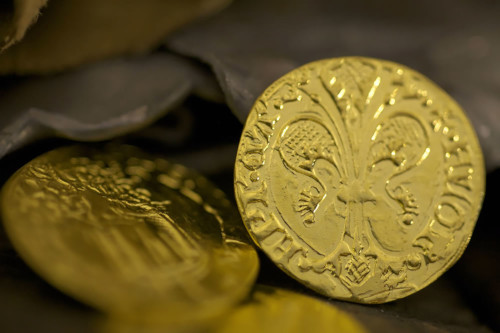
Not once.
While kings debased their coins to fund wars, Florence held the line and built a level of trust proving that the florin was incorruptible.
And 774 years later, gold’s role hasn’t changed one iota — it’s still the asset governments can’t debase.
But that doesn’t mean the gold market will remain archaic.
Today, gold trades around $4,700/oz, well below January’s all-time high of $5,595/oz, but still up massively from where it started this bull run.
Gold bugs are now caught between geopolitical chaos in the Middle East and mounting questions about whether the rally’s exhausted.
Wall Street doesn’t think so.
The Best Free Investment You’ll Ever Make
Join Gold World today for FREE. Get the latest insight on gold, silver, and precious metals delivered straight to your inbox. When you become a member today, you’ll get our latest free report: “The #1 Golden Token to Buy Now.” Don’t Delay!
After getting your report, you’ll begin receiving the Gold World e-Letter, delivered to your inbox daily.
The big banks are STILL calling for gold prices to range between $5,000-$6,000/oz or more by the time we ring in the New Year.
The investment thesis has been simple since the start, too: central banks are buying, investors are diversifying, and the structural forces propping up gold aren’t going anywhere.
But the smart money can see a deeper, more fundamental shift happening that the herd is missing entirely.
You see, gold isn’t just rising, it’s evolving.
And the florin just went digital.
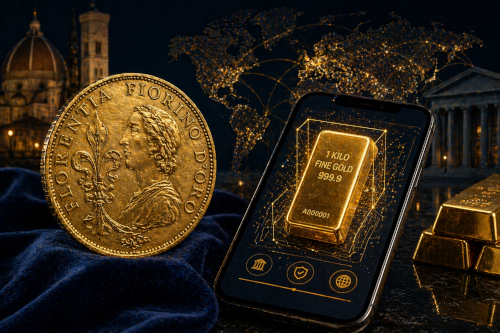
Gold’s 774-Year Evolution
Look, we can easily start with the catalysts that’ll propel gold toward $6,000/oz once this volatility dries up.
The buying spree continues as central banks picked up 863 tonnes of gold in 2025. Although that’s less than the 1,000 tonnes per year it was acquiring between 2022-2024, it’s still double the pre-2022 average of 400-500 tonnes annually.
At current prices near $4,750 an ounce, those 863 tonnes represent roughly $95 billion in institutional capital deployed into gold.
Even more telling is the fact that they bought it while gold was setting all-time highs.
This year, we’re expecting to see central banks purchase around 755 tonnes of gold.
Last year, China added 27 tonnes, bringing its total reserves to 2,306 tonnes, and Poland bought 20 tonnes (and targeting 100 tonnes by 2028). We saw the Czech Republic go on a 36-month buying spree, and countries like Uzbekistan, Malaysia, and South Korea accelerated their buying.
We’ve moved beyond pure speculation, dear reader, because central banks don’t trade based on quarterly earnings or technical charts.
No, they’re building strategic reserves with a time frame that measures in the decades. And you can bet that their mandate is purchasing power preservation — not short-term performance!
That’ll establish a price floor supporting the market that didn’t exist before 2022.
Gold bugs are getting in on the action after taking a short break, too. In 2025, Western gold ETFs saw massive resurgence, and analysts are forecasting around 250 tonnes of ETF inflows in 2026.
Meanwhile, bar and coin demand is projected to exceed 1,200 tonnes — elevated levels that reflect retail conviction in gold as an inflation hedge.
The macro backdrop supports it as well…
Inflation remains sticky — core CPI hovering near 3.5%, well above the Fed’s 2% target. Real interest rates are still slightly negative when you subtract inflation from Treasury yields, which historically is bullish for gold.
The Fed’s expected to cut rates at least twice more in 2026, which lowers the opportunity cost of holding non-yielding assets like gold.
Of course, you and I both know painfully well that geopolitical risk isn’t going anywhere either.
The Middle East has turned out to be the powder keg we all knew it to be. And as the Third Gulf War drags on, U.S.-China tensions are simmering.
Fiscal deficits keep widening — U.S. national debt continues climbing with no resolution in sight. All this while de-dollarization accelerates from BRICS nations and others reducing their reliance on the dollar.
Not surprisingly, gold is the only globally recognized reserve asset with zero counterparty risk.
In a world where currency weaponization is becoming standard policy, gold’s appeal as a neutral store of value only increases.
In other words, the bullish case for $6,000/oz gold is anchored in durable, structural demand meeting constrained supply.
And here’s the interesting part — gold doesn’t need everything to go right.
It just needs these trends to continue, and all the signs are pointing to a prolonged bullish outlook.
From Florentine Florins to Blockchain Bars
There’s a part of gold’s story that isn’t making headlines: gold is going digital.
I’m not talking about “digital” in the sense of ETFs or futures contracts — those have existed for decades.
This “digital” is more of a blockchain-native, tokenized representation of physical gold that can be traded, transferred, and settled on-chain with the speed and transparency of cryptocurrencies, but backed one-to-one by real bars sitting in vaults.
It’s the gold market’s inevitable evolution.
Granted, tokenized gold already exists.
A few major players launched roughly five years ago, commanding a combined market cap of around $5 billion as of April 2026.
The appeal is obvious: instant settlement, 24/7 trading, no custodial friction, programmability.
You get exposure to gold’s price movements without dealing with physical storage, insurance, or the logistical headaches of moving actual bars.
However, the market has been fragmented.
Every issuer builds their own custody infrastructure, their own audit processes, their own verification systems. There’s no standardization, nor limited interoperability. Banks and institutional investors need compliance layers and reconciliation processes that independent blockchains don’t natively provide.
That’s starting to change.
Last month, a major industry initiative launched to standardize tokenized gold markets. The framework proposes an open platform connecting physical gold custody directly to digital issuance and management systems.
Think of it as the blockchain equivalent of the federal assay office during the California Gold Rush — a standardized system that ensures every tokenized ounce is verifiable, auditable, and fungible across platforms.
Gold’s evolution isn’t replacing the metal, it’s giving it a much-needed upgrade.
Florence’s florin dominated medieval trade for 300 years because it was trusted — every coin contained exactly 3.5 grams of gold, verified and guaranteed.
That kind of trust made it the reserve currency of its era.
Tokenized gold, if built on the right infrastructure, offers the same guarantee. Except instead of trusting the Florentine mint, you trust transparent blockchain ledgers and continuous audits connecting digital tokens to physical bars.
The critical ingredient that separates real digital gold from worthless tokens comes down to the fact that the physical backing has to be real, verifiable, and transparent.
And if the next evolution of gold infrastructure works the way it’s supposed to — with real physical backing, transparent audits, and institutional-grade custody — $6,000/oz won’t be the ceiling.
It’ll be the floor.
Until next time,

Keith Kohl
 Check us out on YouTube!
A true insider in the technology and energy markets, Keith’s research has helped everyday investors capitalize from the rapid adoption of new technology trends and energy transitions. Keith connects with hundreds of thousands of readers as the Managing Editor of Energy & Capital, as well as the investment director of Angel Publishing’s Energy Investor and Technology and Opportunity.
For nearly two decades, Keith has been providing in-depth coverage of the hottest investment trends before they go mainstream — from the shale oil and gas boom in the United States to the red-hot EV revolution currently underway. Keith and his readers have banked hundreds of winning trades on the 5G rollout and on key advancements in robotics and AI technology.
Keith’s keen trading acumen and investment research also extend all the way into the complex biotech sector, where he and his readers take advantage of the newest and most groundbreaking medical therapies being developed by nearly 1,000 biotech companies. His network includes hundreds of experts, from M.D.s and Ph.D.s to lab scientists grinding out the latest medical technology and treatments. You can join his vast investment community and target the most profitable biotech stocks in Keith’s Topline Trader advisory newsletter.


