

Iceland had a problem in 1973.
For my older readers, this energy crisis may feel eerily similar. You see, roughly half of Icelandic homes were heated with imported oil, and they relied on foreign crude the same way we did in the U.S. to fuel our cars.
Then the embargo hit, and prices went vertical everywhere.
In fact, the Icelandic government had to subsidize oil just to keep houses warm, which isn’t exactly a sustainable plan for such a small island sitting at the top of the world.
So, they did something radical…
The country started pouring money into drilling beneath its own feet, then piping hot water straight from the ground into homes.
In the early 1970s, geothermal supplied roughly 43% of house heating.
Today, about 90% of Icelandic households rely on it.
Think about that for a second…
The country went from buying its heat abroad to pulling it out of its own backyard.
Now fifty years later, the whole scene is playing out again.
Here we are in October, dear reader, and WTI crude is trading just shy of $91 a barrel as I write this; Brent is a little over $98 per barrel.
And yet, the standoff over the Strait of Hormuz remains unresolved.
Sound familiar?
Well, there’s a bit of a catch. As you probably know, Iceland sits on a volcanic rift.
Almost nobody else gets that kind of luck… until now!
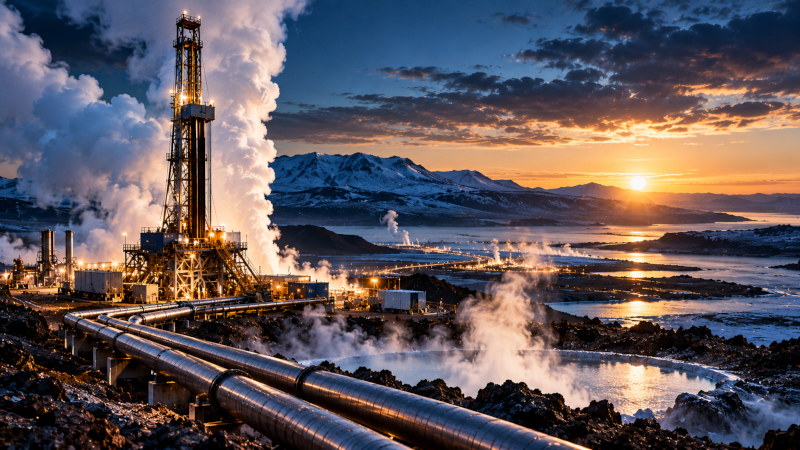
Deeper, Hotter, Faster.
Look, the mechanism here is simpler than you’d think.
California’s Geysers field is the world’s largest geothermal complex, and by 1987 it was running upwards of 2,000 megawatts.
Then the steam began to sag and two years later the pressure had fallen far enough that output started to slide.
Don’t get me wrong, the rock certainly still had the heat. However, what it lacked was water.
So, the operators did something almost comically unglamorous.
In October of 1997, they started piping in recycled wastewater from nearby communities, with roughly 20 million gallons a day going down those wells today.
Water goes in, power comes out.
It’s as simple as that.
This is the whole idea behind enhanced geothermal energy.
Still, injecting that much water doesn’t come without its own consequences, such as small tremors that now occur.
The Best Free Investment You’ll Ever Make
Our analysts have traveled the world over, dedicated to finding the best and most profitable investments in the global energy markets. All you have to do to join our Energy and Capital investment community is sign up for the daily newsletter below.
Then last week, a project called Cape Station in Utah started feeding power directly to the grid.
For the record, it’s the first time a greenfield enhanced geothermal system has ever done that. And don’t ever forget that this time we’re talking about electricity, not just hot water for radiators.
Truth is, the heat was never the scarce part. The hard part has always been the ability to tap into that energy source at scale, and at a price that makes sense.
That’s what the market has missed, and the geothermal narrative is no longer about geography, it’s become a manufacturing story.
And because it’s a greenfield site, nobody needed a natural hot spring to make it work.
The interesting twist to this story is that money was actually saved with the drill bits.
Four years ago, the first well in this style reached 11,220 feet within 70 days. Compare that to the latest EGS well, which hit 19,448 feet (with a 7,500-foot horizontal leg) in only three weeks.
Mind you, that’s through solid rock that’s heated to 460 degrees.
Deeper. Hotter. Faster.
Now, crews can stimulate six wells at once from a single pad, which you know as well as I do is a move straight out of the shale playbook.
Just three rigs give the developer capacity for about 54 wells a year, and the project’s target for the next phase is $5,500 per kilowatt, with a long-term goal of $3,000.
You know as well as I do who’s been perfecting this skill set for two decades: The oil patch.
Yes, we’re talking about the same companies that were responsible for the biggest oil boom in U.S. history. Naturally, those rig contractors and service giants are already building geothermal-ready rigs and crews.
The forecasts look strong, too. The IEA has reported that costs could fall 80% by 2035, to about $50 per megawatt-hour.
That’s what you get with the oil and gas expertise that comes with these major players, and the IEA report also called for a ceiling of 800 gigawatts worldwide by 2050.
And that’s not to mention the demand side of the equation.
We know that Big Tech is signing up, with one developer reporting 658 megawatts of binding contracts, and another renewing its plant’s contract at roughly 27% higher prices.
In other words, buyers are willing to pony up for an energy source that’ll never turn off.
For once, Washington is helping.
You see, geothermal energy keeps federal tax-credit eligibility into the 2030s, even as credits for other clean power were trimmed. And back in April, the Bureau of Land Management approved a faster permitting path for exploration.
In fact, the Department of Energy funded a new round of field tests late last week.
Is this still too early to jump in? Perhaps, but the trajectory is hard to miss.
I’ll let you make that call.
So, where does the money go?
Look, most people ask the wrong question by only trying to single-out which geothermal stock will win this lottery.
The better question is: Who’s holding the drillbits?
Think back to the peak of the tight oil and gas boom, when Permian production took off. Back then, the real leverage sat with the drillers who drilled faster and spent less with each new well.
The name of the energy game has always been about one thing — efficiency.
You know, the kind of drilling efficiency that cuts drilling time from 90 days down to 21.
That’s a cost-per-foot business.
And for us, that’s the key distinction in the geothermal story. It’s the rigs, crews, and subsurface expertise that’ll control the pace of the entire geothermal buildout.
Of course, every data center that needs round-the-clock power is another customer for the people who can drill hot rock on schedule.
Meanwhile, the market still treats this as one headline about one project.
Spoiler: It isn’t.
We’re looking at an industry forming in real time, and the foundation is being built by the drillers.
If you’re trying to think a step ahead, this is where I’d start.
I’ll even show you who’s holding the first drills.
Until next time,

Keith Kohl
 Check us out on YouTube!
A true insider in the technology and energy markets, Keith’s research has helped everyday investors capitalize from the rapid adoption of new technology trends and energy transitions. Keith connects with hundreds of thousands of readers as the Managing Editor of Energy & Capital, as well as the investment director of Angel Publishing’s Energy Investor and Technology and Opportunity.
For nearly two decades, Keith has been providing in-depth coverage of the hottest investment trends before they go mainstream — from the shale oil and gas boom in the United States to the red-hot EV revolution currently underway. Keith and his readers have banked hundreds of winning trades on the 5G rollout and on key advancements in robotics and AI technology.
Keith’s keen trading acumen and investment research also extend all the way into the complex biotech sector, where he and his readers take advantage of the newest and most groundbreaking medical therapies being developed by nearly 1,000 biotech companies. His network includes hundreds of experts, from M.D.s and Ph.D.s to lab scientists grinding out the latest medical technology and treatments. You can join his vast investment community and target the most profitable biotech stocks in Keith’s Topline Trader advisory newsletter.


