

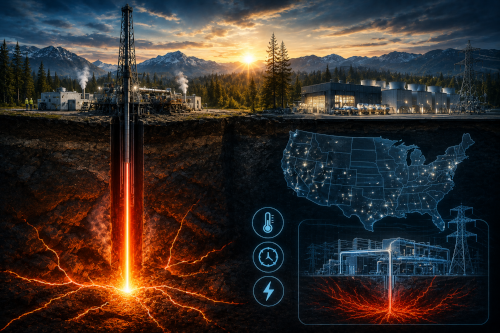
Three miles beneath central Oregon, a beam of energy is vaporizing solid rock right now.
We’re not talking about your typical drilling operations that your standard oil and gas rig crews have been doing for centuries.
This time, they’re vaporizing it using millimeter waves powerful enough to hit granite at temperatures hot enough to melt steel. This beam goes straight into the hardrock so hot that conventional drill bits simply can’t survive down there.
We’ve moved far beyond the pitch deck of a science fiction screening, folks.
And it’s happening right now, funded and under construction in the Deschutes National Forest.
While mainstream headlines are focused on geopolitical chaos surrounding oil markets today, geothermal energy has quietly become one of the most interesting stories in American energy that you’ve never heard of.
Almost everyone outside the industry hasn’t noticed it… yet.
But that’s about to change.
So, who’s doing the vaporizing?
Well, it’s a tiny spinout from MIT that just closed the first tranche of its Series B — $134 million, led by Prelude Ventures. It’s strategically pouring money in from two of Japan’s largest energy companies, JERA and Idemitsu.
In total, there’s over $230 million on the table.
These proceeds are funding Project Obsidian, the world’s first commercial superhot geothermal plant, targeting rock at 300 to 500 degrees Celsius — a temperature range that unlocks a power density rivaling nuclear plants.
And the best part is that it’s using a resource sitting underneath us all.
But this opportunity didn’t grow in a vacuum.
The Best Free Investment You’ll Ever Make
Our analysts have traveled the world over, dedicated to finding the best and most profitable investments in the global energy markets. All you have to do to join our Energy and Capital investment community is sign up for the daily newsletter below.
Just weeks before Quaise’s raise closed, a different geothermal company did something nobody in the sector had ever done.
You might remember back when Fervo Energy went public on May 13th, in what became the largest renewable energy IPO in U.S. history.
Boasting a market cap north of $10 billion, these guys are proving the viability of next-gen geothermal drilling works at commercial scale
Normally, I’d be impressed if things just stopped there… but it didn’t.
Another 61-year incumbent in geothermal power has been setting up its next-gen drilling technology to capitalize on this momentum. If it works, Ormat gets rights to build and operate plants using it.
In fact, they just unveiled the Ormega100 — the largest binary power generation unit in the industry at 100 megawatts, purpose-built for exactly the higher-temperature, higher-output conditions next-generation systems are expected to produce.
Ormat even landed expedited approval from the Bureau of Land Management for a new geothermal project in Nevada, riding the same accelerated federal permitting push that’s been clearing the way for critical minerals projects all year.
Now I want you to connect the pieces, and you’ll understand where this is going.
Oddly enough, the endgame here isn’t a single company at all.
Truth is, it’s a government field lab in Milford, Utah, called FORGE — the Frontier Observatory for Research in Geothermal Energy.
Since 2019, FORGE has served as the industry’s shared proving ground for enhanced geothermal systems, drilling the first-ever highly deviated geothermal well back in 2021 and successfully creating a working EGS reservoir by 2023.
And up until this past May, FORGE has shared more than 133 terabytes of technical data publicly, available to any researcher, investor, or company willing to use it.
Fervo built its massive Cape Station project directly adjacent to the FORGE site specifically to take advantage of that research, and its own CEO has credited FORGE’s data with accelerating the company’s path to commercial viability.
You see the pattern here, right?
After all, it should sound eerily familiar to the veteran members of our investment community here. Especially after we had front-row seats to the shale boom, which unlocked an ocean of oil and gas resources in the United States.
That same playbook is now aimed at heat instead of oil, and the resource it unlocks doesn’t require a tectonic hotspot or a lucky location.
It works almost anywhere.
Today, geothermal supplies a mere 0.4% of America’s electricity, which is about 4 gigawatts spread across 99 plants.
By the Department of Energy’s own projections, that ceiling runs as high as 90 gigawatts by 2050 if the cost curve keeps bending the way it has the last few years.
For the record, that’s more than a twentyfold increase from where the industry sits today.
And unlike wind or solar, geothermal doesn’t need the sun to shine or the wind to blow. It runs around the clock, which is exactly the kind of baseload power the AI buildout has been starving for all year.
The best part is that we’re STILL in the early innings.
And this is where you should be looking right now.
Until next time,

Keith Kohl
 Check us out on YouTube!
A true insider in the technology and energy markets, Keith’s research has helped everyday investors capitalize from the rapid adoption of new technology trends and energy transitions. Keith connects with hundreds of thousands of readers as the Managing Editor of Energy & Capital, as well as the investment director of Angel Publishing’s Energy Investor and Technology and Opportunity.
For nearly two decades, Keith has been providing in-depth coverage of the hottest investment trends before they go mainstream — from the shale oil and gas boom in the United States to the red-hot EV revolution currently underway. Keith and his readers have banked hundreds of winning trades on the 5G rollout and on key advancements in robotics and AI technology.
Keith’s keen trading acumen and investment research also extend all the way into the complex biotech sector, where he and his readers take advantage of the newest and most groundbreaking medical therapies being developed by nearly 1,000 biotech companies. His network includes hundreds of experts, from M.D.s and Ph.D.s to lab scientists grinding out the latest medical technology and treatments. You can join his vast investment community and target the most profitable biotech stocks in Keith’s Topline Trader advisory newsletter.


