

Eighteen years ago, a rocket carrying nothing of particular value reached orbit.
Not ringing a bell? It was the fourth flight of the Falcon 1 on September 28, 2008.
Granted, the first three failed and nearly bankrupted the company at the time; so it’s fair to say that there was a lot riding on that launch.
Another failure and there might’ve never been a fifth flight.
If you were wondering what the Falcon 1 was carrying, it was nothing more than a dummy called RatSat, a 165-kilogram hunk of aluminum built to give the rocket something to carry.
Fortunately for Musk and the future of SpaceX, the gamble worked, and Falcon 1 officially became the first privately built, liquid-fueled rocket to reach orbit.
For the record, across all five Falcon 1 flights, exactly one carried an operational customer satellite.
Now fast-forward 18 years, and SpaceX hit another milestone on the same date. This time with a very different cargo.
Starship, the biggest rocket ever built, reached orbit for the first time. As you may know, all of its thirteen previous flights were suborbital. 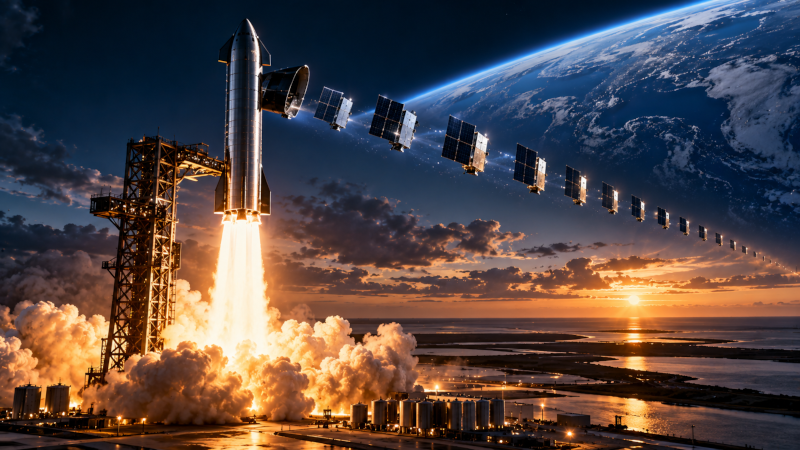
Don’t think for a moment that the mission went smoothly, because the shuttle lost an engine on the way up and kept going anyway.
Then it opened a door in its side and released 26 Starlink V3 satellites, each too large for Falcon 9 to carry.
Moreover, each one packs roughly ten times the data capacity of the last generation.
You’d think Wall Street would have thrown a parade.
Trust me, it didn’t.
The market yawned as SpaceX shares barely budged. Keep in mind that this is a program that has cost more than $15 billion and was originally supposed to reach orbit by 2022.
You see, the market has figured out something most people miss.
The investment herd missed the fact that the rocket wasn’t the product.
So what did Starship’s recent success actually prove?
Quite a bit, actually… all because it almost didn’t happen.
You see, one of the ship’s six engines shut down early, and at one point a SpaceX spokesperson called it off.
That’s when the flight controllers reversed course and pressed ahead.
The Best Free Investment You’ll Ever Make
Our analysts have traveled the world over, dedicated to finding the best and most profitable investments in the global energy markets. All you have to do to join our Energy and Capital investment community is sign up for the daily newsletter below.
Talk about brass balls, dear reader.
Soon after, the ship reached orbit and deployed all 26 satellites onboard, then came home for a spectacular controlled splashdown in the Pacific.
To be fair, SpaceX did cut the mission short. The flight lasted roughly three hours instead of ten, so the six planned orbits never really happened. The booster also had engine trouble of its own.
Other than that, every goal was met.
I’ll also note that this was the rocket’s first revenue-generating flight.
That’s the milestone.
It means that Starship is no longer simply a test article; it’s a delivery truck with paying cargo on board.
Granted, the V3 design can’t fly on anything else in the SpaceX fleet, yet this isn’t a side project.
This is the plan, folks.
The V3 satellites carry solar arrays built to generate about twice the power of the older generation. I can’t help but point out that even in orbit, everything comes down to power.
Don’t get me wrong, I’m not saying the economics are settled.
After all, this flight’s launch cost per terabit of network capacity was close to Falcon 9’s. That could potentially drop 16-fold over the next decade, but only with fuller loads, reuse, and manufacturing gains.
And remember, these are just forecasts. You and I both know full well that some projections were made to be revised.
However, I also want you to notice something peculiar about Starship’s cargo. Those satellites are SpaceX’s own, which means they were built in-house for the company’s own network.
We’ve seen this pattern emerge not too long ago after touching on Musk’s recent ambition to build a 16-inch natural gas pipeline.
Are we really shocked that major players like SpaceX want to cut out the middlemen and secure their own power?
Now, the company is reportedly winding down Falcon 9’s workload, and has stopped offering new rideshare slots. Existing contracts stay in place, but the door is closing for new customers.
I know what you’re thinking: Doesn’t a rocket that big mean more room for everybody?
Maybe, since cheaper access helps everyone.
But right now, the biggest launch capacity ever built is pointed at one customer — themself.
Then there’s another, perhaps larger point to be made that’s hiding in plain sight in Starship’s payload bay.
RatSat was worth nothing, yet those 26 satellites are the reason the rocket exists.
You see, the rocket is merely the delivery truck; the satellite is the true treasure.
And every time a launch gets bigger and cheaper to execute, the bottleneck moves up the chain to the companies that build the satellites, the sensors, and the spacecraft.
And there’s one very large buyer who knows this all too well.
Naturally, this brings us back to that lump of aluminum.
RatSat was a placeholder, a stand-in for the thing that actually matters.
Starship makes the ride bigger, but it doesn’t build the satellite; nor does it build the sensors or the spacecraft.
So you remember back in August, when the Space Force asked Congress for $71.3 billion?
Again, that’s more than double what it received the year before.
But the thing is, that money doesn’t stay in the building.
It’s dished out to the real players. You know, the ones that are actually building those crucial components.
My colleague Jason Simpkins has been tracking this build-out for years. And he’s identified the smaller companies he believes are best positioned on the building side of it.
In fact, he’s revealed ALL of his findings in his latest investment report.
And as a premium member of the Energy & Capital investment community, you can check out all the details absolutely free right here.
I strongly recommend you see this one out for yourself.
Until next time,

Keith Kohl
 Check us out on YouTube!
A true insider in the technology and energy markets, Keith’s research has helped everyday investors capitalize from the rapid adoption of new technology trends and energy transitions. Keith connects with hundreds of thousands of readers as the Managing Editor of Energy & Capital, as well as the investment director of Angel Publishing’s Energy Investor and Technology and Opportunity.
For nearly two decades, Keith has been providing in-depth coverage of the hottest investment trends before they go mainstream — from the shale oil and gas boom in the United States to the red-hot EV revolution currently underway. Keith and his readers have banked hundreds of winning trades on the 5G rollout and on key advancements in robotics and AI technology.
Keith’s keen trading acumen and investment research also extend all the way into the complex biotech sector, where he and his readers take advantage of the newest and most groundbreaking medical therapies being developed by nearly 1,000 biotech companies. His network includes hundreds of experts, from M.D.s and Ph.D.s to lab scientists grinding out the latest medical technology and treatments. You can join his vast investment community and target the most profitable biotech stocks in Keith’s Topline Trader advisory newsletter.


