

Fool us once, shame on you, but fool us twice, shame on us.
And believe me, we just got rope-a-doped twice in 20 years.
To understand just how insane it was to mend ties with Venezuela again, let’s first take a little trip into the past.
It happened just after midnight on May 1, 2007.
Suddenly Venezuelan flags went up over four oil fields in the Orinoco Belt.
By sunrise, PDVSA workers had swapped their blue helmets for red ones… and they did it on live national television.
Meanwhile, Russian-made Sukhoi fighter jets screamed over the Jose oil complex.
That day, Hugo Chávez stood in front of a crowd of oil workers and declared, “Today, we are ending this perverse era.”
This was the May Day takeover, dear reader, and despite the celebrations taking place in Caracas, there were some people that were heavily sulking in their chairs.
They should’ve named it: Big Oil and the terrible, horrible, no good, very bad day.
Exxon, Chevron, ConocoPhillips, BP, Total, Statoil — all of them — suddenly lost control of $30 billion worth of oil projects that day morning.
That was also the last time there was a reason for Venezuelans to smile over their oil industry.
At the time, the country’s oil output stood at a little over 3 million barrels per day.
Since then, it has plummeted to around 1.1 million.
Yet, it’s become very apparent recently that nobody has learned their lesson.
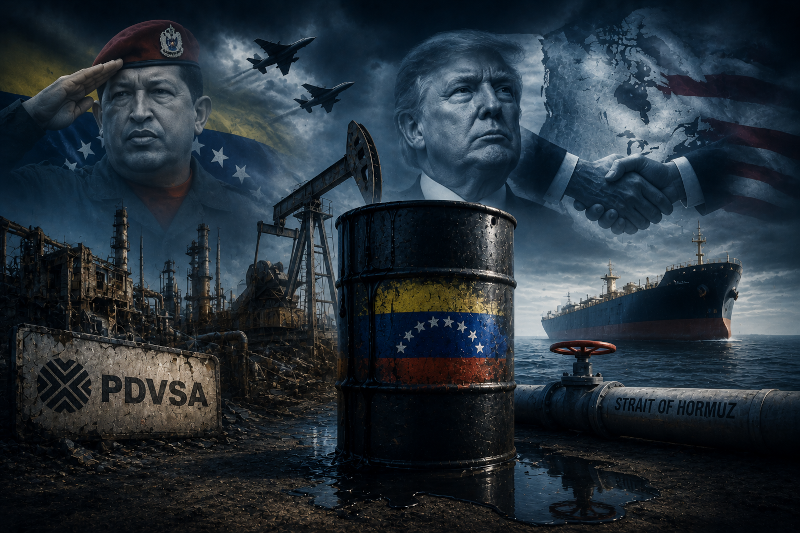
Last week, President Trump thought he announced a bombshell when he touted that America had secured majority control of 65 billion barrels of Venezuelan reserves.
To most people, this deal turned out to be a great soundbite.
After all, President Trump said he’d use this oil to top off the Strategic Petroleum Reserve, even calling it a gift from Venezuela to the People of the United States.
It was also the most ridiculous deal imaginable to anyone that’s followed the real story.
The deal works like this…
The Best Free Investment You’ll Ever Make
Our analysts have traveled the world over, dedicated to finding the best and most profitable investments in the global energy markets. All you have to do to join our Energy and Capital investment community is sign up for the daily newsletter below.
The Pentagon takes a 35% equity stake in a private outfit called North American Blue Energy Partners, which holds the Venezuelan concessions. In exchange, we get the right to buy 20% of whatever comes out of the ground at cost, with NABEP investing up to $100 billion in the project.
I know, I know… that number is enormous.
But the deal gets more sour the deeper you dive into the details.
Start with that 65 billion barrel figure, because it’s carrying an awful lot of weight in the hype over this oil deal.
Remember that reserves measure what’s underground, but it’s output is what actually comes out of the ground.
Those are two very different things, and nobody on Earth demonstrates the gap better than Venezuela.
Rystad Energy pegged the amount of genuinely recoverable reserves in Venezuela at roughly 29 billion barrels. For the record, that’s about one-tenth of PDVSA’s official number.
And that’s not to mention the fact that current Orinoco projects need north of $12 billion in investment just to hit peak output of 660,000 barrels a day.
But wait, things get worse…
You know as well as I do that Orinoco crude is of very poor quality, meaning that it’s extra-heavy and full of sulphur. It’s the thick, tar-like stuff that needs to be diluted before it’ll even move through a pipe.
That’s a problem because the engineers that designed our Strategic Petroleum Reserve weren’t built for this kind of oil.
You also don’t need an expert to realize this incompatibility.
The Department of Energy already studied it for us.
About ten years ago, the DoE gave Congress a report that concluded: The costs outweigh the benefits and storing heavy oil would present considerable operational difficulties.
They knew because they’ve trident.
A lesser known moment in U.S. energy history was when the DoE stored heavier Mexican crude in the SPR back in the ’80s and ’90s.
They found that keeping it segregated had the effect of reducing the site’s operational flexibility, efficiency, and drawdown capability during an energy emergency.
Needless to say, they quickly swapped it back out for lighter crude.
Right now, our SPR is sitting at just under 290 million barrels against 700-plus million barrels of capacity — the lowest it’s been since the 1980s.
Filling that hole with Venezuelan crude and wrecking our ability to pull it out during a crisis kind of defeats the entire point of having a strategic reserve, don’t you think?
And the thing is, this is just the tip of the iceberg when it comes to this oil deal.
For starters, we know it’s going to take tens of billions of investment dollars and several years to successfully increase daily oil output in Venezuela by any significant amount.
Of course, the current supply crisis isn’t going away anytime soon, especially if Iran stays as stubborn as they have been thus far.
Twenty years of neglect and corruption in the Orinoco Belt won’t be undone by a signing ceremony that was announced on social media.
In fact, there’s only one company that’s legitimately excited for this deal: Chevron.
The folks over at Chevron must be elated at this news because they’re the only ones with something to lose.
Big Oil members like Exxon may have learned their lesson from the May Day takeover.
If you recall, Exxon was one of the few outspoken opponents to trusting Venezuela, reminding everyone that their assets were seized at the drop of a red hat.
As he put it, “To reenter a third time would require some pretty significant changes.”
Remember, Exxon asked for as much as $12 billion in arbitration over what Chávez took from them.
They got $908 million.
So, you can understand why they’re a bit sore over the whole matter.
Look, my problem with this deal isn’t really the deal itself.
It’s that a headline this hyperbolic makes it very easy for the market to stop paying attention to two things that genuinely matter.
The first one is that the Strait of Hormuz bottleneck is nowhere near a resolution.
The second one is a little bit quieter, and it all comes down to whether or not U.S. oil output is starting to roll-over.
Oil production in Texas has fallen two months running now, and it’s been sliding since April. For a little more perspective, Texas’ oil output in June was actually slightly lower than where it was a year ago.
And to pour a little more salt on the wound, the EIA is projecting U.S. production declines in 2026 — that’s the first time in four years.
When the Permian Basin stops growing, then it’s hard to make wild growth claims for our domestic production.
However, this also means that the only oil drillers worth owning are the ones cutting drilling days per well, cutting cost per lateral foot, and squeezing more out of the same acreage everyone else has.
My veteran readers know just as well as I do that the name of the game in U.S. oil production right now is drilling efficiency.
And while everybody argues about crude, the money’s already getting made one step downstream.
Venezuela’s industry got destroyed when politics took charge of oil production, and this deal hands the wheel back to politics and expects a different result — the very definition of insanity.
That makes these small Permian oil gems even more vital to future supply.
Until next time,

Keith Kohl
 Check us out on YouTube!
A true insider in the technology and energy markets, Keith’s research has helped everyday investors capitalize from the rapid adoption of new technology trends and energy transitions. Keith connects with hundreds of thousands of readers as the Managing Editor of Energy & Capital, as well as the investment director of Angel Publishing’s Energy Investor and Technology and Opportunity.
For nearly two decades, Keith has been providing in-depth coverage of the hottest investment trends before they go mainstream — from the shale oil and gas boom in the United States to the red-hot EV revolution currently underway. Keith and his readers have banked hundreds of winning trades on the 5G rollout and on key advancements in robotics and AI technology.
Keith’s keen trading acumen and investment research also extend all the way into the complex biotech sector, where he and his readers take advantage of the newest and most groundbreaking medical therapies being developed by nearly 1,000 biotech companies. His network includes hundreds of experts, from M.D.s and Ph.D.s to lab scientists grinding out the latest medical technology and treatments. You can join his vast investment community and target the most profitable biotech stocks in Keith’s Topline Trader advisory newsletter.


