

If you’ve been trading oil off the headlines this year, I’m sorry — you’ve been trading theater.
Just look at the tape…
Brent spiked past $116/bbl in March when the Strait of Hormuz slammed shut. What followed was a media obsessed on ceasefire deals, even if it meant someone would violate the peace deal within hours.
But as we painfully learned, all you need is a false bit of peaceful optimism to send crude prices plummeting.
How weird have things really gotten, you ask? Well, just think when crude prices crashed below $70/bbl in a matter of weeks leading up to the over-hyped Islamabad Memorandum that was “signed” by both sides… that one lasted a few hours before the next missiles struck.
Think about that for a minute.
WTI crude crashed from $90/bbl to $67/bbl during June on nothing more than headlines.
Every one of those bearish moves came from a press conference in Tehran or a tweet from Washington.
And you know as well as I do that not a single one of them added a barrel of supply to a market that just lived through the largest disruption in its history — shut-ins peaked at a staggering 11.2 million barrels per day back in May.
What we do know for sure is that when all is said and done from this conflict (don’t hold your breath), the dynamics of Middle East oil exports through the Strait of Hormuz will never be the same.
We went from free and safe passage for tankers pre-Operation Epic Fury to two separate blockades constricting flow in a matter of months, before news finally broke that the blockades were lifted and the Strait of Hormuz was open for business once again.
If you believed that would last, I have some high-speed rail in California I’d like to sell you.
Because things got much, much worse this week.
Not only does the IRGC now fully believe they own and control any and all passage through the Strait of Hormuz, but a new owner has joined the fray…
Folks, I give you the Guardians of Hormuz:
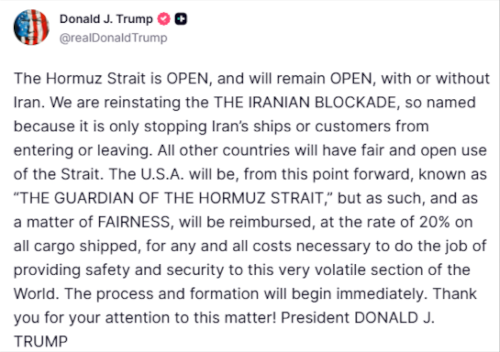
Now, any tankers hoping to get OPEC crude out of the Strait of Hormuz can first pay the IRGC for safe transit, then dish out another 20% (on all cargo shipped, not just oil) to the Trump administration.
This war has officially jumped the shark on lunacy.
The Best Free Investment You’ll Ever Make
Our analysts have traveled the world over, dedicated to finding the best and most profitable investments in the global energy markets. All you have to do to join our Energy and Capital investment community is sign up for the daily newsletter below.
At some point, you might start wondering where the world will start looking for crude — somewhere without the chaos and volatility that plagues the Middle East.
Well, right now there’s a place that produces nearly a million barrels a day of some of the cheapest, most profitable crude on the planet — from a place with no strait to close, no tankers to board, and no war premium to price.
That place is Guyana.
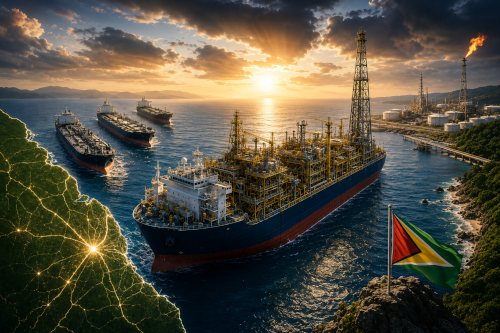
In 2019, Guyana produced zero barrels of oil.
Today, ExxonMobil is extracting roughly 914,000 barrels per day from the Stabroek block — zero to nearly a million in seven years, the fastest production ramp in modern petroleum history.
And here’s the part most people miss: Big Oil keeps beating its own spec sheet.
Four floating production vessels — Destiny, Unity, Prosperity, and the ONE GUYANA — are all running at or above nameplate capacity.
Yellowtail (the newest) was designed for 250,000 barrels per day, and is already pumping more than that. In fact, Exxon is now looking for permission to boost that production toward 290,000.
Mind you, the next leg is already built.
The $12.7 billion Uaru vessel will arrive later this year to add another 250,000 barrels per day and carry Guyana past 1.1 million barrels per day. Then, Whiptail will follow in 2027, and Hammerhead — a $6.8 billion project — comes online in 2029.
Add it up and the consortium is targeting 1.7 million barrels of oil equivalent per day by 2030, from eight developments.
Now this is the part of the story where things get fun…
Breakeven costs across the block run around $30 per barrel.
At Yellowtail, those barrels break even as low as $25, too. To put a little perspective on that, just keep in mind that it’s roughly half the breakeven of most Permian Basin operators.
Do that math. Exxon and Chevron booked a combined $7.6 billion in Guyana profit last year — and that was before the Hormuz crisis sent crude to triple digits this spring.
And the ownership tells us everything about how badly the majors want in.
Exxon operates with 45% interest. Chevron, on the other hand, controls 30% — a stake it spent two years and $53 billion fighting Exxon in arbitration to secure through the Hess deal.
Of course, China’s CNOOC holds the remaining 25%.
Don’t get me wrong — the Hormuz crisis is real.
And that’s exactly the point.
This is what volatility-free oil looks like.
Here’s where I’ll save you some trouble, because the answer isn’t simply to buy Big Oil.
Sure, they capture the headline profit, but every generalist fund on the planet already owns them, and Guyana’s success is baked into both stocks.
Look, that trade will happen with or without you.
But when a basin scales from 914,000 barrels to 1.7 million in four years, the money won’t just stop at Big Oil’s coffers.
It’ll flow down through everyone building, feeding, and servicing the machine.
Think about who actually constructs these floating cities…
A single company has built every FPSO on the block — with more on order — and the offshore services and subsea names attached to Stabroek are riding more than $60 billion in committed capital spending that doesn’t care where Brent trades next Tuesday.
That’s not to mention the fact that this oil consortium is close to recouping its initial investment, which means Guyana’s share of profit spikes from 12.5% to 50% — that’s a sovereign spending wave about to wash over a country of 800,000 people, from ports, to pipelines and power.
The market is still trading the theater, but the smart money is already trading somewhere else entirely.
Until next time,

Keith Kohl
 Check us out on YouTube!
A true insider in the technology and energy markets, Keith’s research has helped everyday investors capitalize from the rapid adoption of new technology trends and energy transitions. Keith connects with hundreds of thousands of readers as the Managing Editor of Energy & Capital, as well as the investment director of Angel Publishing’s Energy Investor and Technology and Opportunity.
For nearly two decades, Keith has been providing in-depth coverage of the hottest investment trends before they go mainstream — from the shale oil and gas boom in the United States to the red-hot EV revolution currently underway. Keith and his readers have banked hundreds of winning trades on the 5G rollout and on key advancements in robotics and AI technology.
Keith’s keen trading acumen and investment research also extend all the way into the complex biotech sector, where he and his readers take advantage of the newest and most groundbreaking medical therapies being developed by nearly 1,000 biotech companies. His network includes hundreds of experts, from M.D.s and Ph.D.s to lab scientists grinding out the latest medical technology and treatments. You can join his vast investment community and target the most profitable biotech stocks in Keith’s Topline Trader advisory newsletter.


