

Close your eyes, and picture a drill rig sitting on a mesa in New Mexico, grinding down through granite that hasn’t seen daylight in a billion years.
The year is 1974.
We’ve been entrenched in Vietnam for nearly 19 years at this point. President Nixon resigned in early August, paving the way for VP Gerald Ford to ascend to the presidency. West Germany tops the Netherlands for the World Cup. It was also a tumultuous and unfortunate year for plane crashes.
And yet, that rig crew was still working a nameless drill-site in the Jemez Mountains.
They may not have known the name, but they did know that the rock they were digging into was so hot that it could boil water on contact.
Of course, they were also betting their entire government research budget on something nobody had ever thought possible.
Their goal was to fracture the dry rock, blast it with water, then pull back heat as if they were mining it.
Then two miles down, they found something…
It worked.
The Fenton Hill project officially became the first place on Earth where engineers proved that you don’t need some lucky hot spring or a volcano nearby to make geothermal energy.
It turns out that you can build the reservoir yourself, assuming that the rock was hot enough.
Drilling continued for over two decades as the team refined their technique, chasing deeper and deeper wells. 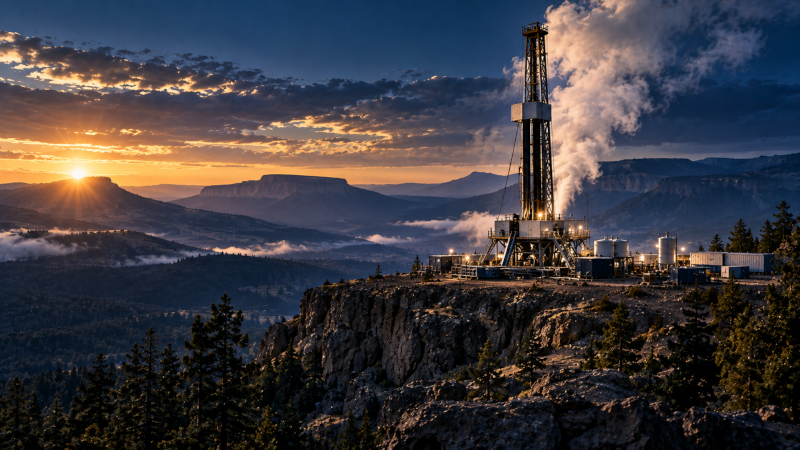
And then with a whisper, the entire operation quietly ended.
By 1995, the rigs were gone as the site was handed back to the Forest Service. No word filtered out to the press, nor were there any clickbait headlines that would’ve dominated the media today.
All that happened was a little-known research program had run out of money while proving its point.
Nothing went horribly wrong, mind you. The geology cooperated exactly like the scientists had hoped.
But what Fenton Hill lacked wasn’t science.
It was a drill bit fast enough to make it profitable.
Today, we have that drill, but it’s just not for geothermal energy.
The Best Free Investment You’ll Ever Make
Our analysts have traveled the world over, dedicated to finding the best and most profitable investments in the global energy markets. All you have to do to join our Energy and Capital investment community is sign up for the daily newsletter below.
The Ghost of Fenton Hill Still Haunts Our Power Grid
The truth is that drilling technology came from an entirely different corner of the energy sector: oil and gas.
Granted, it took pioneers like George Mitchell 15 years perfecting the idea of using horizontal drilling and hydraulic fracturing together to unlock an ocean of tight oil and gas from underground.
Now, Fenton Hill’s ghost is having its moment, and the best part is that nobody but us are paying attention.
To understand just how little-utilized geothermal is right now on the U.S. power grid, just remember that our country only utilizes about 4 GW of it for power.
That’s TOTAL, mind you.
The potential, however, is what becomes mindblowing to us.
The technical resource sitting underground (the same kind of resource those Los Alamos scientists proved you could tap fifty years ago) is measured in the hundreds of gigawatts.
Of course, you know as well as I do that “technically possible” and “profitable” are two very different things.
While Fenton Hill proved the first one, what’s happening right now is the slow, unglamorous work of proving the second.
Over at Utah’s FORGE site, which isn’t too far from where this whole story began, another team is finally taking the next step.
Last month, they began an “extended circulation” test, running fluid continuously through an engineered reservoir for 90 to 120 days straight.
Again, don’t forget that only a handful of EGS projects on the entire planet have ever reached this stage.
What FORGE is proving now is whether that circulation holds up for months at a time, without the reservoir cooling faster than expected or losing water along the way.
It’s the exact question that kept Fenton Hill a small research project instead of a power plant.
Now here’s the catch…
The demand side of this story isn’t waiting around for them to finish solving the geothermal equation.
In early September, the largest enhanced geothermal power deal ever signed hit the wires. In total, the deal was for 396 megawatts, with an option to expand toward nearly a full gigawatt by 2030.
That means that we’re looking at a hyperscaler betting almost a gigawatt of power on 24/7 carbon-free power.
Despite that deal, the most visible publicly traded EGS stock is trading more than 50% below its IPO peak.
In fact, revenue guidance just got cut, but not because the technology failed, but rather due to a transmission bottleneck.
You read that right.
We’re staring at a grid crisis, not a problem with the geology.
You know as well as I do that markets overreact.
However, what’s rarer is catching the moment it happens in real time.
For the past two months, one company’s transmission headache felt like the ghost of Fenton Hill had come back to prove the skeptics right after all.
The whole sector got hit while a single stock stumbled.
And that, dear reader, is usually exactly where mispricing hides, when a single stock’s bad quarter gets mistaken as a verdict on the whole technology — certainly not a reason to walk away.
Fenton Hill showed us all that EGS works.
Now everyone else is about to catch up.
Until next time,

Keith Kohl
 Check us out on YouTube!
A true insider in the technology and energy markets, Keith’s research has helped everyday investors capitalize from the rapid adoption of new technology trends and energy transitions. Keith connects with hundreds of thousands of readers as the Managing Editor of Energy & Capital, as well as the investment director of Angel Publishing’s Energy Investor and Technology and Opportunity.
For nearly two decades, Keith has been providing in-depth coverage of the hottest investment trends before they go mainstream — from the shale oil and gas boom in the United States to the red-hot EV revolution currently underway. Keith and his readers have banked hundreds of winning trades on the 5G rollout and on key advancements in robotics and AI technology.
Keith’s keen trading acumen and investment research also extend all the way into the complex biotech sector, where he and his readers take advantage of the newest and most groundbreaking medical therapies being developed by nearly 1,000 biotech companies. His network includes hundreds of experts, from M.D.s and Ph.D.s to lab scientists grinding out the latest medical technology and treatments. You can join his vast investment community and target the most profitable biotech stocks in Keith’s Topline Trader advisory newsletter.


