

I’ve got Iran to the left of me. Houthis to the right. Here I am, stuck in the middle with Yanbu.
That’s the jingle humming inside Crown Prince Mohammed bin Salman’s head for the last few days.
It must be a frustrating tune to have stuck in your head during what is unarguably the most volatile energy crisis of our lifetimes.
For nearly five months, MBS has had an escape valve.
The Strait of Hormuz has been effectively shut since late February.
So the Saudis rerouted its crude westward — pumping millions of barrels overland through the East-West Pipeline to Red Sea terminals at Yanbu, then out to the rest of the world.
Even though the East-West Pipeline’s capacity was 7 million barrels per day, the infrastructure at Yanbu is only around 5 million barrels per day.
But hey, beggars can’t be choosers, right? Besides, it must’ve been a little relief to MBS for a short spell as exports through that corridor quadrupled from under a million barrels a day to roughly four million.
Then the walls of Saudi exports came crashing down.
Go ahead and see what that looks like:
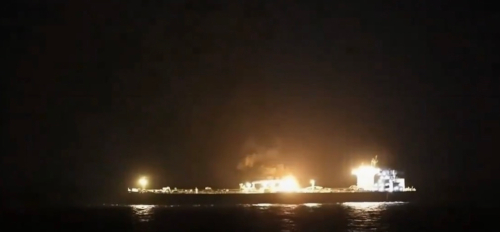
It turns out that the Houthis have enacted their own naval blockade, this time in the Bab al-Mandab Strait.
Saudi Arabia is officially boxed in on both sides.
By now, everyone knows that (under normal conditions) roughly one-fifth of the world’s seaborne oil traffic was carried through the Strait of Hormuz. It’s been running at close to 89% interdiction since Iran began enforcing its closure back in February.
The Bab al-Mandeb Strait may be smaller, but don’t let that fool you…
Total petroleum volumes transiting the strait hit 7.4 million barrels per day in June — about 7% of global output, and nearly double what it carried a year earlier as Saudi exports flooded through it.
Put those two together and you get a figure that should stop you cold — as much as a quarter of the world’s oil and gas supply now sits behind two closed doors.
At the same time.
By the way, if you’re questioning the voracity of the IRGC and the Houthis, I’ll direct you back to those Saudi oil tankers on fire above.
The Best Free Investment You’ll Ever Make
Our analysts have traveled the world over, dedicated to finding the best and most profitable investments in the global energy markets. All you have to do to join our Energy and Capital investment community is sign up for the daily newsletter below.
To be clear, that has never happened before in the modern history of energy markets.
For MBS and Saudi Aramco, their solution to the crisis in Hormuz has already proven to be just as fragile. Back in April, a single Iranian strike on one Petroline pumping station cut throughput by 700,000 barrels per day.
Saudi Arabia scrambled and restored capacity within days, but that was without a blockade waiting at the other end.

What’s more unsettling is that the blockade announcement barely moved oil prices.
That fear wasn’t realized until the tankers were on fire, with Brent and WTI crude prices spiking yesterday to their highest levels since June.
Here’s what should unsettle you more than the blockade announcement itself: oil barely moved.
Granted, the Houthis have threatened this strait before, going all the way back to 2018.
Nothing came of it back then.
Now we’re seeing risk finally start to price itself into the market.
And while the world’s attention is glued to tanker traffic, a second, quieter front in this war has been building for months.
Along with the consistent strikes against oil tankers, the conflict has escalated in the last few days as Iran has repeatedly struck power and desalination infrastructure across Gulf states that aren’t even combatants in this fight.
Kuwait has had power and water plants hit multiple times since the war began — most recently on July 17th, when a strike sparked fires across several electricity-generating units and forced officials to urge citizens to ration power.
Bahrain’s desalination infrastructure was damaged by drone attack back in March.
In fact, Iran has openly warned that if the U.S. strikes its national power grid, Gulf desalination plants become fair targets in return.
The stakes behind that threat are hard to overstate.
Remember, the Gulf produces roughly 40% of the world’s desalinated water, spread across hundreds of coastal plants.
Kuwait, Qatar, and Bahrain depend on desalination for up to 99% of their drinking water.
Let that sink in for a moment.
After all, there IS NO backup system.
Without those plants running, cities of millions have no alternative water supply.
None!
The strategy right now seems pretty obvious: this war is being fought against the infrastructure civilians can’t live without, on two tracks at once.
Oil chokepoints threaten the world’s energy supply; strikes on power and desalination plants threaten the water supply of people who never chose to be part of this fight.
That’s the part the oil price doesn’t capture.
And it’s exactly why treating this as a single-strait story — Hormuz, and only Hormuz — undersells what’s actually unfolding here.
Two chokepoints are now contested, and civilian infrastructure across multiple nations is being targeted on a recurring basis.
Still have hopes that any ceasefire deal can be relied upon to keep the peace?
The last Memorandum of Misunderstanding lasted mere hours.
Two critical oil chokepoints are now blockaded with the fire and fury of two militaries that won’t back down.
If you’ve been waiting for a buy signal, perhaps you just got one.
Until next time,

Keith Kohl
 Check us out on YouTube!
A true insider in the technology and energy markets, Keith’s research has helped everyday investors capitalize from the rapid adoption of new technology trends and energy transitions. Keith connects with hundreds of thousands of readers as the Managing Editor of Energy & Capital, as well as the investment director of Angel Publishing’s Energy Investor and Technology and Opportunity.
For nearly two decades, Keith has been providing in-depth coverage of the hottest investment trends before they go mainstream — from the shale oil and gas boom in the United States to the red-hot EV revolution currently underway. Keith and his readers have banked hundreds of winning trades on the 5G rollout and on key advancements in robotics and AI technology.
Keith’s keen trading acumen and investment research also extend all the way into the complex biotech sector, where he and his readers take advantage of the newest and most groundbreaking medical therapies being developed by nearly 1,000 biotech companies. His network includes hundreds of experts, from M.D.s and Ph.D.s to lab scientists grinding out the latest medical technology and treatments. You can join his vast investment community and target the most profitable biotech stocks in Keith’s Topline Trader advisory newsletter.


