

For about an hour on July 17, 1955, the town of Arco, Idaho, ran entirely on nuclear power.
Even though it only served about 1,200 people, that moment deserves its place in the history books.
While 80% of U.S. power generation came from fossil fuels that year, these Idahoans relied solely on a test reactor sitting twenty miles out in the desert.
After the switch was thrown, some residents didn’t even realize what was going on.
The reactor behind it was a pretty simple idea: It boiled water.
We’re hitting another inflection point for our nuclear power generation.
Except this time, that vital electricity is powering more than just homes in Idaho.
This is the lifeblood of the AI boom.
So what happened? Well, earlier this week, federal regulators approved construction of the first small modular reactor in the country. It’s a 300-megawatt boiling-water design for the Tennessee Valley Authority, and the review wrapped up in 14 months, ahead of schedule.
Originally, the TVA had braced itself for roughly two years.
Of course, that follows a summer in which four advanced reactors went critical in June and July, with three of them coincidentally sitting in that same stretch of Idaho desert where Arco’s lights came from.
For the first time in a generation, American nuclear power is moving at the speed of the demand.
We’re talking regulator approval, construction commencements, and some of the biggest companies in the world lining up to buy that power. 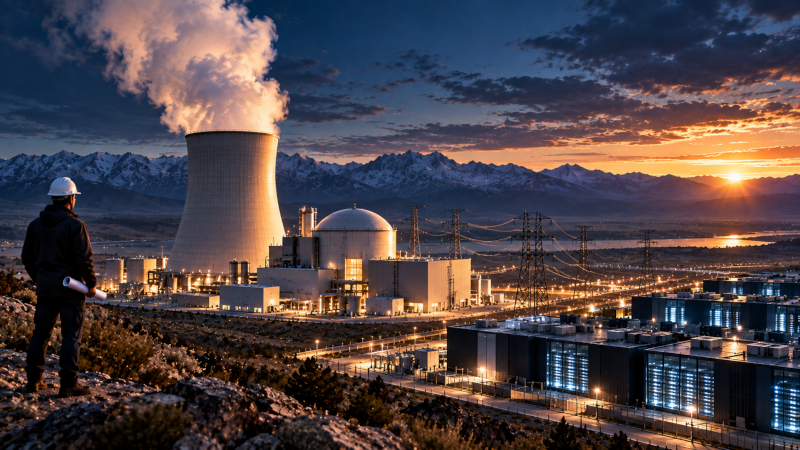
As you might’ve guessed, there’s a bit of a catch.
You see, “going critical” isn’t the same as making power.
And we both know full well that a construction permit isn’t a power plant.
Now the real work begins.
The Best Free Investment You’ll Ever Make
Our analysts have traveled the world over, dedicated to finding the best and most profitable investments in the global energy markets. All you have to do to join our Energy and Capital investment community is sign up for the daily newsletter below.
First, let’s talk about what criticality actually means.
This is the moment a reactor sustains its own chain reaction. Sure, it’s important, but all four hit it at zero power, with no heat being carried off to spin a turbine.
So the deadline that came from Trump’s executive orders in May 2025 (which asked for three reactors to get there by July of 2026) ended up delivering four.
For a program that only launched last year, we’ll consider that real progress.
So what happens next? It turns out that the developers are refreshingly candid.
One expects its first electricity by late 2027, with field deployments by the end of 2028. Another hopes to sell test power next year and go fully commercial in 2028.
A third is already running its reactor at 100 kilowatts of heat, or about enough to power a small computer.
Hey, that may not sound like much, but it’s a start… despite none of them being anywhere close to selling power to a grid.
That’s an honest timeline through 2027 and 2028.
Again, this is ahead of the deadline set last March, when the Nuclear Regulatory Commission issued the first construction permit ever for a commercial reactor that isn’t water-cooled.
So, this week’s approval makes two major reactor approvals this year. And the same executive orders capped new-reactor licensing decisions at 18 months.
But the thing is, the TVA still needs a separate operating license before it can load a single fuel pellet. Their permit gives it a construction-completion window between October 2031 and September 2032, and the utility says nuclear construction hasn’t started yet. In fact, it’s still negotiating cost sharing with industry partners.
By the way, that price tag comes out to a jaw-dropping $5.4 billion for that one 300-megawatt unit.
The demand side isn’t waiting around for anybody, too.
The plan calls for quadrupling U.S. nuclear capacity, from roughly 100 gigawatts to 400 gigawatts by 2050.
As you know, one of the world’s biggest tech companies has already agreed to fund two advanced reactors in Wyoming, with rights to power from up to six more by 2035.
Then, there’s a little problem that nobody is talking about… the fuel.
Remember, most advanced designs burn a richer form of uranium called HALEU.
The Department of Energy itself has said it isn’t currently available from domestic suppliers.
Right now, Russia is the only commercial source at scale, and America has banned Russian imports.
Do you think it was a coincidence that President Trump committed $2.7 billion in January to rebuild domestic enrichment?
The issue is that enrichment plants don’t appear overnight.
It’s a classic chicken-and-egg problem. Fuel makers want firm orders before they build, and reactor builders want firm fuel before they order.
Mind you, the TVA design runs on conventional fuel, so it sidesteps that particular bottleneck. Many of the advanced designs behind the pilot reactors don’t.
Don’t get me wrong, those skeptics have a point.
Critics argue these demonstrations say little about safety or commercial viability, and a reactor that works on a test pad still has to work on a balance sheet.
So where does that leave us?
I know most people will watch the companies designing reactors, or who’s going critical first.
Sure, those may win the headlines, but a better focus for us is on the supply line instead.
After all, every single reactor needs the same thing. You know them just as well as I do… things like fuel, enrichment, heavy forgings, engineering, and even construction talent.
Of course, the end-all-be-all is a grid connection at the end. Those bottlenecks don’t care which design wins, because every buildout has a chokepoint.
The nuclear story is no different.
Makes sense, right?
The good part is that it’s a lot less crowded than you’d think.
The reactor race has dozens of entrants and a flood of headlines each week, while the supply side of this story has far fewer players, long lead times and very few shortcuts.
And if you’re trying to get a step ahead of the crowd, this is the best place to start.
Until next time,

Keith Kohl
 Check us out on YouTube!
A true insider in the technology and energy markets, Keith’s research has helped everyday investors capitalize from the rapid adoption of new technology trends and energy transitions. Keith connects with hundreds of thousands of readers as the Managing Editor of Energy & Capital, as well as the investment director of Angel Publishing’s Energy Investor and Technology and Opportunity.
For nearly two decades, Keith has been providing in-depth coverage of the hottest investment trends before they go mainstream — from the shale oil and gas boom in the United States to the red-hot EV revolution currently underway. Keith and his readers have banked hundreds of winning trades on the 5G rollout and on key advancements in robotics and AI technology.
Keith’s keen trading acumen and investment research also extend all the way into the complex biotech sector, where he and his readers take advantage of the newest and most groundbreaking medical therapies being developed by nearly 1,000 biotech companies. His network includes hundreds of experts, from M.D.s and Ph.D.s to lab scientists grinding out the latest medical technology and treatments. You can join his vast investment community and target the most profitable biotech stocks in Keith’s Topline Trader advisory newsletter.


