

History has a knack for teaching us crucial lessons today.
Take the silver miners in Saxony as a perfect example.
Back in the 1500s, these miners kept hauling up a heavy, dull ore that should have been loaded with silver.
Except, it wasn’t.
What’s worse is that when it was smelted, this metal gave off toxic fumes that made them sick and ruined every batch.
By the way, we know today that the culprit was arsenic.
But this was several hundred years ago, so the miners blamed mischievous underground, goblin-like spirits called kobolds.
Naturally, that led to them naming the worthless rock “kobold,” which you and I know today as cobalt.
It turns out that a Swedish chemist Georg Brandt proved it was a real element in 1735.
And this goblin ore has been quietly running the battery industry ever since.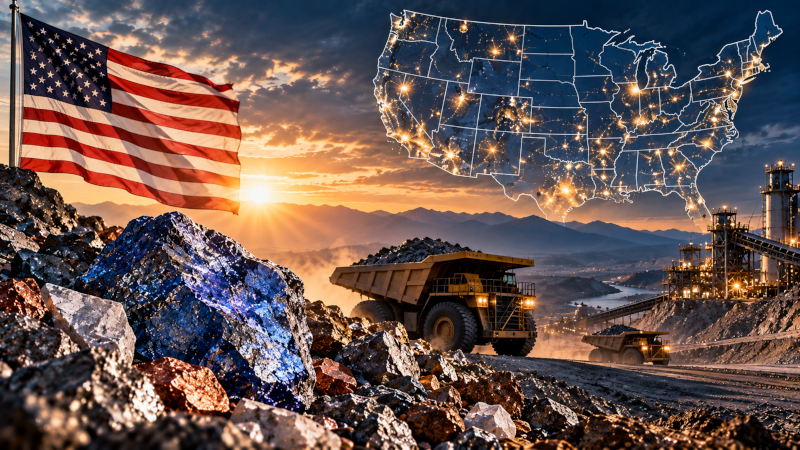
These days, those goblin spirits live in Kinshasa, the capital and largest city in the Democratic Republic of Congo.
It’s also home to approximately 76% of the world’s cobalt supply.
Then in February of 2025, the DRC slammed the export door shut, followed it up with an export quota of 96,600 metric tons for 2026 and 2027. But anything that’s not shipped by June 30th of this year, they’ll be revoked and moved into their reserve.
That move effectively sent cobalt prices from about $21,000 a metric ton in early 2025 to more than $56,000 by the start of 2026.
Yes, that’s a 160% price spike after Glencore’s first-quarter cobalt output fell 39%.
The ore didn’t change, but rather who controls it.
And the problem today isn’t goblins.
Look, cobalt is just one of dozens of metals the U.S. desperately needs right now.
But digging it up is only half the fight because China refines roughly 80% of the world’s cobalt,
And whoever controls the refining, owns the leash.
The problem is that they wield this power as battery demand builds momentum.
In fact, global shipments of lithium-ion storage batteries jumped 71% in the first half of this year to more than 461 gigawatt-hours, with strategists at Goldman expecting to see the five biggest tech companies spending $1.2 trillion on AI infrastructure in 2027.
Every one of those projects needs this metal from foreign sources.
And you can bet that Washington keeps a list of these metals, and that list keeps growing.
Some of you might remember when the Interior Department finalized its critical minerals list at 60 entries last November, adding copper, silver, uranium, lead and potash, among others.
This week, the doors on that list blew wide open.
You see, the U.S. Geological Survey released an updated map of known domestic critical mineral deposits… and the count spiked from 684 to 1,271.
The Interior Secretary Doug Burgum called it “MASSIVE untapped potential.”
You and I know already know what’s in it::
- 1,271 known deposits across 41 states and Puerto Rico
- 412 of them, about a third, have documented critical mineral resources but no production
- 59 minerals are tracked
- Nine of the 10 critical minerals at greatest risk of supply disruption are present in the U.S., including four rare earths, according to Assistant Secretary Andrea Travnicek
- USGS’s airborne survey effort, Earth MRI, has re-mapped only about a third of the country so far, with a goal of 2031
Think about that…
The Best Free Investment You’ll Ever Make
Our analysts have traveled the world over, dedicated to finding the best and most profitable investments in the global energy markets. All you have to do to join our Energy and Capital investment community is sign up for the daily newsletter below.
One-third of the United States is mapped, and nearly 33% of the deposits found so far aren’t producing anything.
Now, don’t get me wrong, much of that jump comes from adding previously known deposits and a longer mineral list. So, they weren’t technically new discoveries.
Furthermore, the 2024 count was compiled differently, so the two numbers aren’t directly comparable.
Unfortunately, the cold, bitter truth to swallow is that a map ISN’T a mine, and rock in the ground is not the same as metal in a warehouse.
In between that involves a mountain of obstacles, from site permits and funding, all the way down the chain to processing infrastructure… most of which don’t exist here yet.
And cobalt is the perfect example.
When the Pentagon’s Defense Logistics Agency began fast-tracking a cobalt purchase last October of up to $500 million, about 7,500 metric tons over five years, it represented the first U.S. cobalt stockpile since 1990.
Work those numbers out for yourself, and you’ll find it’s only about 1,500 tons a year. Now compare that to the 96,000 tons the DRC allows itself to ship out.
In other words, we’re only buying roughly 1.5% of that supply.
And for a little more perspective, consider that the GAO pegs the Pentagon’s overall critical-material shortfall at roughly $18.5 billion.
Makes sense, right? It’s a start, not a solution.
So, you might ask yourself, “What the hell are we doing about it?”
Well, glad you asked.
The answer is that President Trump has a hunger to build — and fast.
In March 2025, President Trump signed Executive Order 14241, “Immediate Measures to Increase American Mineral Production.”
Essentially, this EO leans on the Defense Production Act and puts the Pentagon in charge of speeding up domestic supply.
The next hurdle was money.
So a few months after signing that EO (in July, 2025), the Defense Department put $400 million into MP Materials, becoming its largest shareholder with a stake of about 15% once converted.
It also guaranteed a $110-per-kilogram price floor on neodymium-praseodymium, a rare earth, under a 10-year offtake deal.
Other stakes soon followed, including $35.6 million for about 10% of Trilogy Metals and $670 million for magnet maker Vulcan Elements.
One tally even pinned federal spending on critical minerals stakes at more than $1 billion in 2025 alone.
That’s also not to mention the fact that the Export-Import Bank has approved up to $10 billion in financing for Project Vault, our new strategic reserve of critical raw materials.
While the world’s eyes are fixated on the war raging in the Middle East, almost exclusively on petroleum prices, our government is quietly taking equity, guaranteeing prices and filling stockpiles all while mapping the locations of our domestic deposits.
That’s the race we’re running right now, and we’ve only just passed the starting line.
And when policy and scarcity collide like this, fortunes get made.
But it won’t be through the lazy way of chasing yesterday’s headlines.
No, dear reader, it’ll be targeting those investment gems that fit right into Trump’s mad dash to develop U.S. critical resources.
Until next time,

Keith Kohl
 Check us out on YouTube!
A true insider in the technology and energy markets, Keith’s research has helped everyday investors capitalize from the rapid adoption of new technology trends and energy transitions. Keith connects with hundreds of thousands of readers as the Managing Editor of Energy & Capital, as well as the investment director of Angel Publishing’s Energy Investor and Technology and Opportunity.
For nearly two decades, Keith has been providing in-depth coverage of the hottest investment trends before they go mainstream — from the shale oil and gas boom in the United States to the red-hot EV revolution currently underway. Keith and his readers have banked hundreds of winning trades on the 5G rollout and on key advancements in robotics and AI technology.
Keith’s keen trading acumen and investment research also extend all the way into the complex biotech sector, where he and his readers take advantage of the newest and most groundbreaking medical therapies being developed by nearly 1,000 biotech companies. His network includes hundreds of experts, from M.D.s and Ph.D.s to lab scientists grinding out the latest medical technology and treatments. You can join his vast investment community and target the most profitable biotech stocks in Keith’s Topline Trader advisory newsletter.


