

Magic was in the air the morning that Anthony Lucas’ drilling crew was working a rotary rig four miles south of Beaumont, Texas.
It may not have felt special at the time. After all, his team had been drilling for months, hitting nothing but quicksand and gas pockets as the drill struggled through the hard limestone.
Then it happened…
Once the bit hit 1,139 feet, the world changed forever.
You see, that’s the moment that the drill punched right into pressurized oil.
First, the mud started bubbling as the roughnecks scattered.
All of a sudden, 6 tons of 4-inch drilling pipe shot out of the ground like a cannon.
Then silence.
What came next wrote history for the next century — crude oil erupted 150 feet into the air.
The Lucas Gusher flowed for nine days at an estimated 100,000 barrels per day before workers could cap it. the well extracted more oil in a single day than every other oil well in the U.S. — COMBINED!
Of course, the Spindletop field has become a place of legend in the oil industry.
And within three months, Beaumont’s population tripled.
By 1902, over 500 companies had formed, two of the more famous being Texaco and Gulf Oil.
The modern petroleum industry started that morning on January 10, 1901, at 10:30 a.m.
Anthony Lucas may have just been drilling for oil, but he found an industry.
Yet here we are 125 years later, the descendants of that wooden derrick. Except today’s oil drilling is quite a different picture — horizontal wells, hydraulic fracturing, and fiber-optic sensing.
And soon, these wells will be targeting something that even Lucas would’ve never imagined.
Why? Well, because they’re not going after oil.
Our drillers want to tap something else altogether…
Heat.
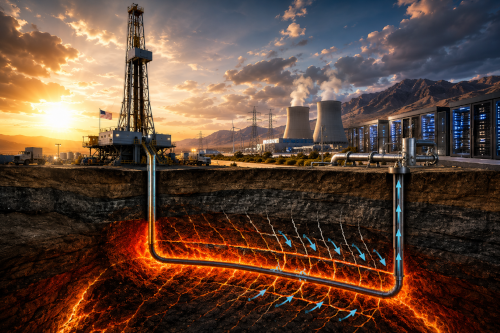
Last year, the U.S. generated 4 gigawatts of geothermal electricity
In case you’re wondering, that’s less than half a percent of total power generation.
But now consider what the total recoverable U.S. geothermal resource is — that amount tops 500 gigawatts.
Do that math with me. 500 gigawatts of potential minus 4 gigawatts installed equals 496 gigawatts of untapped baseload power.
It’s just sitting there beneath our feet, mostly in Western states the federal government already owns.
And it’s the same drilling technology that gave us the shale boom that’ll close the gap.
Because AI is coming for the grid… again!
Remember, U.S. data center electricity demand is projected to hit roughly 580 terawatt-hours by 2028. That’s about 12% of total U.S. electricity, up from 4.4% in 2023.
In other words, AI workloads alone will consume more power than 22 million American homes by the end of the decade.
We both know the biggest problem, too. The grid needs 24/7 firm baseload power, and without sufficient battery capacity, any dreams of powering that flood of data centers with solar and wind is nothing more than a pipe dream.
However, the problem compounds when you also take into account the fact that our coal plants are quickly aging out. Even natural gas runs into pipeline constraints in exactly the places where data centers are being built.
Of course, a new nuclear plant takes eight-plus years to permit and construct (and that’s assuming the government doesn’t add more delays).
That’s why we’re finally seeing the market start to realize the potential that geothermal holds — the only renewable resource that delivers 24/7 baseload power from day one, with capacity factors above 90%.
But for 70 years, geothermal had a geography problem.
As you know, conventional geothermal needed three things to coincide naturally: heat, water, and permeable rock.
That’s why 95% of pre-2020 U.S. geothermal sat in California, Nevada, and Hawaii’s volcanic zones.
However, things radically changed with the emergence of Enhanced Geothermal Systems (EGS).
With EGS, companies drill down vertically, then kick the well sideways and go horizontally. Then, they utilize hydraulic fracturing techniques to crack the rock and create the permeability where it didn’t naturally exist.
Folks, this is the same playbook George Mitchell used to crack the Barnett Shale in the 1980s.
Granted, the federal government has been testing this at the DOE’s FORGE site in Milford, Utah — the “lab in the rock” — for years.
They’ve confirmed connectivity between injection and production wells at two to three kilometers depth, with sustained circulation at 10 barrels per minute. Then, the water returns at 370 degrees Fahrenheit.
But here’s the number that matters…
Drilling time went from 440 hours, to just 60 hours at 6,000-foot equivalent depth.
That’s a 7x efficiency improvement in less than five years.
In fact, it’s the same learning curve the Permian saw between 2010 and 2018, when U.S. drillers figured out how to drill faster and cheaper.
So far, Fervo Energy’s Cape Station project in Beaver County, Utah, is the proof at commercial scale, with the first 100 megawatts of power hitting the grid late 2026; phase two adds 400 megawatts by 2028. Total: 500 megawatts.
Naturally, all of it fully contracted through power purchase agreements, such as Southern California Edison, who bought 320 megawatts, or the 31 megawatts bought by Shell.
And the drilling pace at Cape Station has already cut per-well costs by roughly half compared to Fervo’s first-generation wells in Nevada.
Look — the same technology that has been under fire from environmentalists a decade ago is now the (clean!) technology that could power this massive AI buildout.
Look, the rigs didn’t change, and the same roughnecks are running the operations.
The drill bit is simply targeting a whole new product.
And here’s the most important part — the smart money has figured it out before most people even knew geothermal was back.
In North America alone, cash is flowing into geothermal. In fact, the $1.7 billion invested in the first quarter of 2025 was 85% of the entire annual investment the year prior.
And not too long ago, Fervo Energy closed an oversubscribed $462 million Series E in December 2025. New investors included Google, B Capital, Mitsui, CalSTRS, and JB Straubel — the Tesla co-founder.
Remember, Google already has a power purchase agreement with Fervo for 115 megawatts in Nevada, and power is flowing to Google’s data centers right now. Google even inked a separate deal with Ormat Technologies for up to 150 megawatts to support Nevada data centers.
Meta signed a 150-megawatt PPA with Sage Geosystems for data centers east of the Rocky Mountains. Sage raised $97 million in January 2026 to deploy its first commercial facility.
Trust me, when Bill Gates, Google, Meta, Mitsui, and a Tesla co-founder all show up to the same party, you don’t ask whether the party is real… you ask whether you got there before they did.
As I just mentioned, the smart money’s already in and Fervo’s IPO prices this week. The institutional investors who wanted exposure bought the Series E in December or they’re in the IPO allocation, and the retail crowd will finally get a taste of EGS potential.
But here’s the catch — Fervo’s not where the highest profits will be made.
Although the company is certainly worth watching, the last thing anyone wants to do is chase it higher.
Worth watching. Not necessarily worth chasing.
That’s why my readers and I prefer to find the geothermal players that the herd hasn’t caught onto… not yet, at least.
And right now, there are three that are grossly overlooked, each bringing their own value to the geothermal boom.
Look, Spindletop wasn’t really about oil.
It was about technology.
EGS in 2026 isn’t really about geothermal.
It’s about the same Texas drilling crews, the same fracking know-how, and the same data-driven reservoir modeling — pointed at a 500-gigawatt resource the United States has been sitting on for a century.
The smart money knows it, and they’re already piling into FERVO.
But let me show you the three under-the-radar geothermal names my readers and I have uncovered — and the catalyst windows that should pull each one out of obscurity in short order.
Until next time,

Keith Kohl
 Check us out on YouTube!
A true insider in the technology and energy markets, Keith’s research has helped everyday investors capitalize from the rapid adoption of new technology trends and energy transitions. Keith connects with hundreds of thousands of readers as the Managing Editor of Energy & Capital, as well as the investment director of Angel Publishing’s Energy Investor and Technology and Opportunity.
For nearly two decades, Keith has been providing in-depth coverage of the hottest investment trends before they go mainstream — from the shale oil and gas boom in the United States to the red-hot EV revolution currently underway. Keith and his readers have banked hundreds of winning trades on the 5G rollout and on key advancements in robotics and AI technology.
Keith’s keen trading acumen and investment research also extend all the way into the complex biotech sector, where he and his readers take advantage of the newest and most groundbreaking medical therapies being developed by nearly 1,000 biotech companies. His network includes hundreds of experts, from M.D.s and Ph.D.s to lab scientists grinding out the latest medical technology and treatments. You can join his vast investment community and target the most profitable biotech stocks in Keith’s Topline Trader advisory newsletter.


