

Perhaps the most frustrating thing a gold bug can experience is finding out your gold is stuck in limbo.
That’s what happened to Czechoslovakia after German troops marched into Prague in WWII.
At the time, the Czech gold was sitting in London. And within days of the invasion, the Bank for International Settlements asked the Bank of England to move that gold out of the Czech National Bank’s account and into one held by the German Reichsbank.
The Bank of England said yes.
In total, we’re talking about £5.6 million, which is roughly $1.1 billion in today’s money.
Around £4 million went to banks in Belgium and the Netherlands, and the rest was sold in London; another tranche was sold that June.
Even the Bank’s own archives show its officials dodged questions from the British government about what had happened.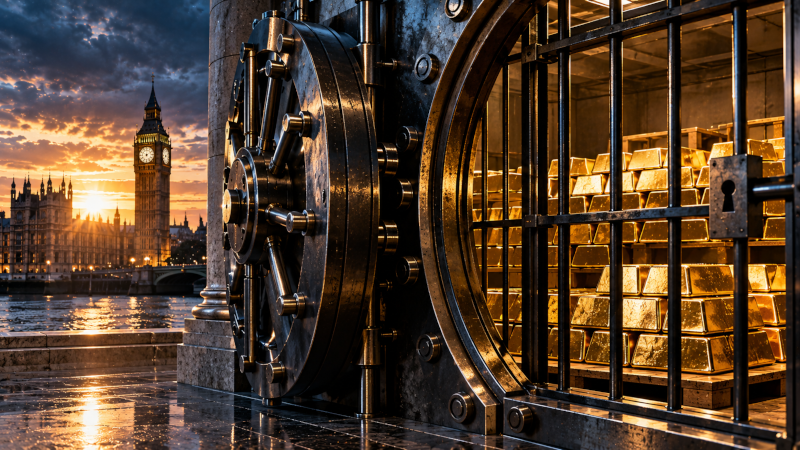
You see the problem here, right? A country that had just been taken over had its gold handed over to the invader by the people entrusted to guard it.
That may be one of the biggest breaches of trust in monetary history.
That Czech gold was only owned on paper, so whoever controlled the vault got to decide its fate.
I only bring this up because there’s a version of this story playing out right now.
Except this time, there’s no invasion, nor villain.
There’s just a vault full of gold that won’t open.
The Best Free Investment You’ll Ever Make
Join Gold World today for FREE. Get the latest insight on gold, silver, and precious metals delivered straight to your inbox. When you become a member today, you’ll get our latest free report: “The #1 Golden Token to Buy Now.” Don’t Delay!
After getting your report, you’ll begin receiving the Gold World e-Letter, delivered to your inbox daily.
Locked Out of Your Gold
Since 2018, the Bank of England has been holding 31 tonnes of gold that belongs to Venezuela.
At today’s prices, that’s about $4 billion.
And Venezuela wants it back.
Good luck… so how exactly did this gold get stuck?
It turns out that Venezuela had two rival claimants to its government, and Britain sided with Maduro’s rival. Mind you, both camps went to court over who could give the Bank of England instructions, and in December, 2021, the UK Supreme Court backed the government’s position.
Thus the gold sat, untouched.
And then came the earthquakes.
On June 24, 2026, two major earthquakes (and their aftershocks) killed more than 6,000 people in Venezuela.
Of course, Maduro had already been captured by that time.
The Rodríguez government and opposition sectors made a joint request for the gold, and the plan was for the money to go into audited accounts in the U.S. Treasury.
The Bank of England’s answer was frustrating, saying it’s waiting on a legal ruling.
And that’s the strange part in this story — everyone involved can point to somebody else.
Remember, we’re talking about Venezuela, a country with inflation around 575%, roughly $240 billion in debt, and a disaster that had killed thousands.
It was desperate and looking for help from the IMF, because $4 billion of its own savings is sitting in a London vault.
I know this is a legal dispute, and courts move slowly for good reason; recognition rules exist because nobody wants a bank handing a country’s gold to whoever walks in and asks for it.
But for seven years, a nation couldn’t touch its own gold reserves, despite having legitimate paperwork.
Still, the underlying question is the same one the Czechs faced in 1939: Who gets to decide?
Central banks seem to have noticed this little twist
According to the World Gold Council, Poland has added about 90 tonnes this year, and now holds around 640 tonnes; their target is to own 700 tonnes by yearend.
Meanwhile, China has bought gold for 21 straight months.
And the Czech National Bank, of all institutions, has been a gold buyer for 41 months in a row.
We can’t read their minds, but I’ll bet every one of those buyers has asked the same question. If they ever needed this gold in a hurry, could they actually get it?
That makes where your gold sits an important calculation.
Granted, nobody is saying London is about to seize anyone’s reserves. Most central banks keep gold abroad and never have a problem.
But it’s the kind of risk people don’t think about until a case like Venezuela’s shows what it looks like.
Makes sense, right? After all, owning gold and being able to use it turned out to be two separate things.
Welcome to the New Gold World
Here’s what it all keeps coming back to…
If a bar in a vault can be stuck for seven years, can your gold be made to move the way everything else does?
The market is already working on the answer, and its solution is digital. Each ounce is backed by real bars in a vault, yet can change hands in minutes, at any hour of the day.
The old guard is paying attention, too.
Gold is in the early stages of a real, evolutionary change in how it’s held and traded.
The vaults aren’t going anywhere, but the players building the rails that connect them to the digital world are the ones we want to keep an eye on.
Until next time,

Keith Kohl
 Check us out on YouTube!
A true insider in the technology and energy markets, Keith’s research has helped everyday investors capitalize from the rapid adoption of new technology trends and energy transitions. Keith connects with hundreds of thousands of readers as the Managing Editor of Energy & Capital, as well as the investment director of Angel Publishing’s Energy Investor and Technology and Opportunity.
For nearly two decades, Keith has been providing in-depth coverage of the hottest investment trends before they go mainstream — from the shale oil and gas boom in the United States to the red-hot EV revolution currently underway. Keith and his readers have banked hundreds of winning trades on the 5G rollout and on key advancements in robotics and AI technology.
Keith’s keen trading acumen and investment research also extend all the way into the complex biotech sector, where he and his readers take advantage of the newest and most groundbreaking medical therapies being developed by nearly 1,000 biotech companies. His network includes hundreds of experts, from M.D.s and Ph.D.s to lab scientists grinding out the latest medical technology and treatments. You can join his vast investment community and target the most profitable biotech stocks in Keith’s Topline Trader advisory newsletter.


