

Just about two years ago, a crew in central England worked their final shift at the Ratcliffe-on-Soar power plant.
And the moment the clock struck midnight, the last coal-fired power station in Britain went dark.
I know that may not sound momentous, but that officially ended 142 years of coal-generated electricity in the country that launched the Industrial Revolution.
In fact, when Thomas Edison opened a station in London back in 1882, coal supplied roughly 80% of Britain’s power; by 2023 that share had plummeted to 1%.
It was an emotional day for many, on both sides of the aisle.
Whether you were cheering the coming of cleaner sources of power or lamenting the loss of a cheap source of electricity, there’s no denying that it marked the end of an era.
Makes sense, right? The future was clean, and it heralded the death of coal.
Then came 2026.
Since the U.S.-Iran war began, the Strait of Hormuz choked off about one-fifth of the world’s gas supply, sending gas-hungry countries scrambling for a fallback.
Perhaps they were a little too premature to shut the doors on coal?
The climb back into fossil fuels’ lap has already begun, too, as Germany and Poland have recently started leaning back toward coal. Japan is starting to relax their limits on older plants, and even Italy has proposed delaying its coal phase-out by 13 years.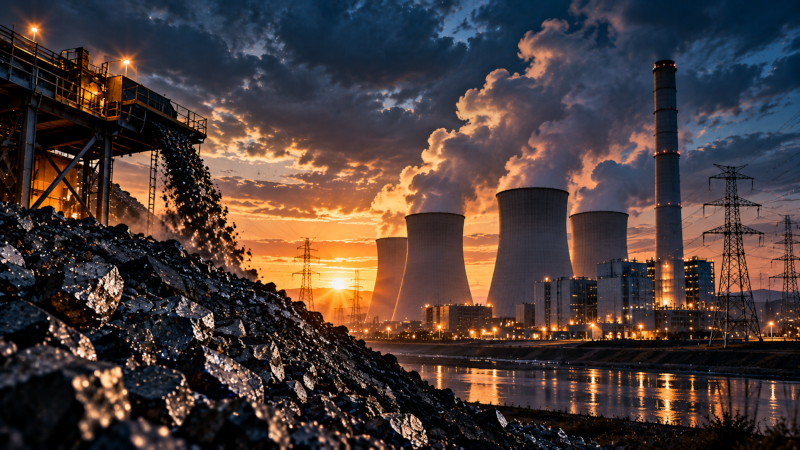
Unfortunately for some, Britain can’t join in because they have no coal plants left to turn on.
Globally, old king coal is making a comeback as demand is projected to rise 1.2% this year to a record 9.94 billion tonnes.
And the International Energy Agency now says global coal demand will rise 1.2% this year to a record 8.94 billion tonnes.
That’s record demand during a year that everyone was expecting to decline.
And it’s not without a sense of irony that the country that ushered in the coal age shut it down, and now the rest of the world is wrestling with how to turn it back on.
Then there’s the part that the market is ignoring…
The Best Free Investment You’ll Ever Make
Our analysts have traveled the world over, dedicated to finding the best and most profitable investments in the global energy markets. All you have to do to join our Energy and Capital investment community is sign up for the daily newsletter below.
I know the headlines flooding out of the Middle East are very oil-centric.
But as you know, this U.S.-Iranian war has had a severe impact on more than oil markets.
Too many people forget how crucial natural gas is to the global power mix.
Taiwan gets about half its electricity from LNG. So when Qatar’s gas was disrupted, it started buying more coal-fired power.
Remember not too long ago when we talked about Qatar, the world’s second-largest LNG exporter, declaring force majeure over and again since the war began.
Of course, they don’t expect their facilities to be fully repaired for the better part of three years.
Everyone is now looking to coal for some help keeping the lights on.
Japan, South Korea and Bangladesh have all burned more coal. India’s coal demand is on pace to rise 4.2% to 1.35 billion tonnes, and China’s coal demand is set to grow by 1% to roughly 5 billion.
Now shift your gaze back home here to the U.S., where policy is even more aggressive.
Since mid-2025, the Department of Energy has issued more than two dozen emergency orders under Section 202(c) of the Federal Power Act.
Each EO lasts 90 days, and each one blocks a retiring power plant from shuttering. At our last count, there were 22 such orders covering 8 plants and 12 generating units.
Over in Michigan at the J.H. Campbell plant, with its three units and 1,331 megawatts, Consumers Energy has spent $401 million on it.
Don’t get me wrong, there’s another side to this.
The EIA expects U.S. coal generation to decline 8% this year, and then another 6% next year, with coal’s share of our grid slipping to 14% over the next two years.
The IEA sees a similar trend for U.S. coal demand, projecting it to fall 7% this year as solar generation jumps 21%.
In other words, this is a comeback in policy, not in volume, and America isn’t burning more coal… it just refuses to let the old plants die.
So why would Washington pay that price?
Well, because bringing new power to our grid is going to take forever.
Keep in mind that the backlog for gas turbines runs about 260 weeks, and transformers can take around 128 weeks.
In fact, up to half of planned U.S. data centers have reportedly slipped or been cancelled, partly on delays like these.
When it comes to generating more power, it’s all hands on deck.
Look, we’ve moved past the debate of whether or not we like these old dirty plants.
We’re at the point where we can’t afford to lose any power, and the pressure on our ancient grid is building greater by the day..
Naturally, the herd is doing what it always does: They’re picking teams.
You know the two sides forever locked in battle, fossil fuels versus renewables.
They treat it like a political fight (which in some ways, it is), so they trade the headlines.
But when the grid is short of power and building new capacity is on a scale of years and decades, whoever can deliver reliable electricity today will take home the pay check.
And whoever supplies the fuel, the equipment and the know-how behind it gets paid along with them.
The story will never be solely about coal, not exactly.
It’s about anything that’ll keep the lights on and the grid happy.
Until next time,

Keith Kohl
 Check us out on YouTube!
A true insider in the technology and energy markets, Keith’s research has helped everyday investors capitalize from the rapid adoption of new technology trends and energy transitions. Keith connects with hundreds of thousands of readers as the Managing Editor of Energy & Capital, as well as the investment director of Angel Publishing’s Energy Investor and Technology and Opportunity.
For nearly two decades, Keith has been providing in-depth coverage of the hottest investment trends before they go mainstream — from the shale oil and gas boom in the United States to the red-hot EV revolution currently underway. Keith and his readers have banked hundreds of winning trades on the 5G rollout and on key advancements in robotics and AI technology.
Keith’s keen trading acumen and investment research also extend all the way into the complex biotech sector, where he and his readers take advantage of the newest and most groundbreaking medical therapies being developed by nearly 1,000 biotech companies. His network includes hundreds of experts, from M.D.s and Ph.D.s to lab scientists grinding out the latest medical technology and treatments. You can join his vast investment community and target the most profitable biotech stocks in Keith’s Topline Trader advisory newsletter.


