

It feels like only yesterday that the Texas power grid was on the verge of total failure.
I know more than a few of you remember it well, too.
If you remember, the sudden deep freeze that gripped the Lone Star State exposed one of the biggest weaknesses hidden in their power infrastructure. Of course, most people got the Texas power crisis completely wrong.
That day (Monday, February 15, 2021), the Texas power grid was minutes away from going completely dark.
Look, every power plant on the grid has to stay in step with a steady 60-cycle beat, and that morning the beat had slipped to 59.3.
Generators are built to shut themselves off if it stays that low for more than nine minutes to protect their equipment. That night, it stayed below the line for four minutes and 23 seconds, forcing operators to cut power to millions of customers just to keep the system alive.
The consequences were catastrophic.
By the next day, 4.5 million customers were without power and were left in the dark for an average of 42 hours. More than 100 Texans died, with some estimates putting the cost of the damage at upwards of $295 billion.
When all was said and done, seven members of the ERCOT board resigned.
Believe me, Texans haven’t forgotten, which is why Governor Greg Abbott ordered an audit of every data center waiting to plug into the ERCOT grid. His reasoning was pretty simple, saying that any that fail the audit would be denied a connection. 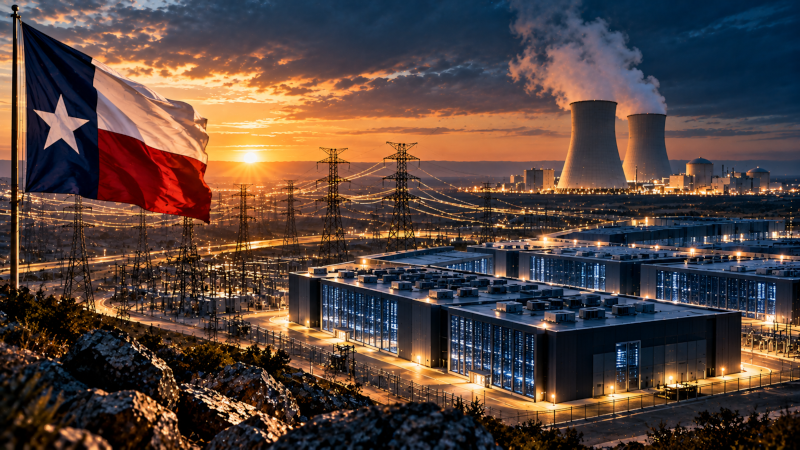
His letter was a direct warning that the AI build-out could endanger the reliability and stability of the Texas electric grid.
Think about it for a moment, and you realize why his caution makes a lot of sense.
We know that the line of projects waiting for a connection adds up to roughly 474 gigawatts.
To put a little more perspective on this number, consider that the most electricity Texas has ever used at one time is about 91 gigawatts (a record set this past July).
That’s more than five times the record!
Of course, roughly 90% of the requests come from data centers.
Let’s face it, nobody believes all 474 gigawatts are real.
The Best Free Investment You’ll Ever Make
Our analysts have traveled the world over, dedicated to finding the best and most profitable investments in the global energy markets. All you have to do to join our Energy and Capital investment community is sign up for the daily newsletter below.
I’ve heard some analysts call it a phantom load, insofar that developers can file for the same project in several states at once and expect to build in only one.
In December 2024 the list stood at 63 GW, and by June it was 474 GW.
And make no mistake, this audit tells us exactly how big the problem is.
Why? Well, because it covers about 250 to 300 projects representing around 200 gigawatts, which ERCOT was aiming to finish by December 10th. However, the grid operator has even said its study of the first batch won’t be done by its own April deadline.
Now this delay is starting to affect real projects.
Approximately 17 large data centers (roughly 6.6 GW in all), had cleared ERCOT’s stability review and were scheduled to come online later this year. Except, they now have to pass this audit, which could hold up nearly 50 gigawatts of new data center demand, which is close to 20% of the entire U.S. pipeline.
Then there are more dire warnings coming down from ERCOT.
Last July, EROCTO testified that the Permian Basin could face rolling blackouts by next summer unless new high-voltage lines get built, which are being fought tooth-and-nail by landowners and some legislators alike.
This is also not to mention the fact that the equipment is booked up tight. We know that the biggest gas turbine maker in the U.S. is taking orders for 2031 deliveries, which means if you place an order today, it may not arrive for another five or six years.
To be fair, this audit isn’t an outright ban.
Projects that bring enough of their own generation can still move ahead, and filings show some of the biggest campuses are planning exactly that.
However, anyone relying on the grid is now waiting in a long, long line.
Like it or not, the chips are coming and the models are getting bigger.
But the real question you should be worried about is this: Where’s the power coming from?
For the last two years, the AI narrative has been told through the chip story.
The situation in Texas has made it clear that chips are the easy part; the hard part is generating enough power to run them (and getting that power to the grid quickly).
Granted, natural gas WILL carry a lot of that load, but the delay for new turbines presents a very real concern. Wind and solar will help, but you know as well as I do that they only generate the intermittent power that’d make new data centers vulnerable — it’s not the steady, baseload power those data centers require.
And that, dear reader, presents a huge opportunity for a nuclear renaissance.
Remember, reactors run around the clock more than 90% of the time, which is why utilities have relied on them for decades.
Right now, Texas has four large reactors at two sites, the newest of which came online 33 years ago.
That’s why we’re going to start seeing them change course.
In fact, the state formed an Advanced Nuclear Energy Office last year, which opened a $350 million fund this year to help build the next generation.
So far, only two projects have filed the federal paperwork to qualify for construction money: a Dow project using X-energy technology, and a Fermi America project tied to Texas Tech.
That’s two projects in the state with the biggest line of power requests in the country.
Do you see us getting through the next decade of this AI boom without making a bigger bet to expand our power generation?
Don’t worry, neither do I.
Just make sure you’re looking in the right place, and I’ll show you that opportunity right here.
Until next time,

Keith Kohl
 Check us out on YouTube!
A true insider in the technology and energy markets, Keith’s research has helped everyday investors capitalize from the rapid adoption of new technology trends and energy transitions. Keith connects with hundreds of thousands of readers as the Managing Editor of Energy & Capital, as well as the investment director of Angel Publishing’s Energy Investor and Technology and Opportunity.
For nearly two decades, Keith has been providing in-depth coverage of the hottest investment trends before they go mainstream — from the shale oil and gas boom in the United States to the red-hot EV revolution currently underway. Keith and his readers have banked hundreds of winning trades on the 5G rollout and on key advancements in robotics and AI technology.
Keith’s keen trading acumen and investment research also extend all the way into the complex biotech sector, where he and his readers take advantage of the newest and most groundbreaking medical therapies being developed by nearly 1,000 biotech companies. His network includes hundreds of experts, from M.D.s and Ph.D.s to lab scientists grinding out the latest medical technology and treatments. You can join his vast investment community and target the most profitable biotech stocks in Keith’s Topline Trader advisory newsletter.


