

In 1990, the U.S. government committed roughly $3 billion and 13 years to a single audacious goal.
For the first time in history, we were going to sequence the entire human genome.
It was slow, absurdly expensive, and void of any practical use that anyone could honestly point to.
Today, a lab can sequence an entire human genome in about a day… and for under $200.
However, it was that first, expensive, unglamorous, government-funded map that became the foundation for everything after it — an entire generation of biotech, genetic medicine, and diagnostic tools that simply couldn’t have existed without it.
And recently, Washington just placed a very similar bet again.
Last month a serious bombshell was dropped.
Did you miss it?
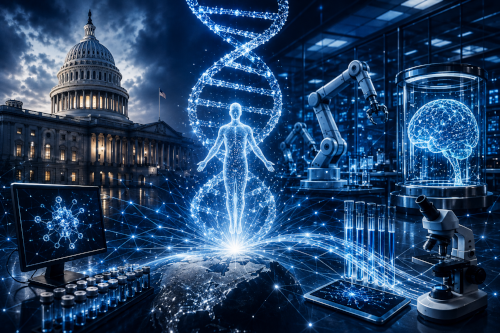
On July 22nd, the Department of Health and Human Services formally joined President Trump’s Genesis Mission. Yes, the same mission that became a sweeping federal push to harness AI for scientific discovery.
But HHS’s contribution has a name: the Bio Genesis Mission.
It’s being led by the NIH, backed by $1.2 billion in committed funding through next year.
Their goal is far from modest, too.
The plan is to halve the time it takes a biotech discovery to reach an actual patient, and then double the overall pace of biomedical innovation within five to ten years.
So what exactly are they funding?
First, chronic disease research — digging into root causes rather than just managing symptoms, a stated priority tied directly to HHS Secretary Robert F. Kennedy Jr.’s own agenda, combining longitudinal health data with environmental monitoring and DOE supercomputing power.
The second involves pediatric cancer.
The Best Free Investment You’ll Ever Make
Our analysts have traveled the world over, dedicated to finding the best and most profitable investments in the global energy markets. All you have to do to join our Energy and Capital investment community is sign up for the daily newsletter below.
You see, HHS is contributing its network of cancer centers and clinical data, while the Department of Energy is focusing its supercomputers at training AI models across hundreds of rare cancer subtypes simultaneously.
We’re talking about the kind of scale that no single research hospital could ever attempt on its own.
And then we have the most relevant of the three goals — accelerating drug discovery and clinical transition.
Our HHS, DOE, and the Department of War are constructing unified biomedical data infrastructure.
Essentially, they’re pulling together molecular, genomic, phenotypic, clinical, and real-world datasets that have historically sat in separate, disconnected silos.
The real attention grabber, however, is that alongside HHS, the Department of Energy, National Science Foundation, Department of War, and Department of Agriculture are jointly building what they’re calling “autonomous laboratories.” These are AI-directed systems that run experiments connecting proteins, genes, and molecular data to real biological outcomes, largely without a human standing at the bench making every individual call.
We’ve moved well past research proposals and late night brainstorming sessions among scientists.
They’re already under construction!
Think about that for a moment…
Right now, your traditional research lab is bottlenecked by how many experiments a human team can physically run in a day.
But you know as well as I do that an autonomous lab doesn’t have this bottleneck.
It can test a hypothesis, read the result, and design the next experiment in a continuous loop, around the clock, without waiting on a graduate student to come in Monday morning.
Then something happened just two days before HHS joined.
A sitting congressman decided to publish a letter pointing out a very uncomfortable fact — the nation’s largest biomedical research agency had been left out of Genesis Mission entirely since its launch back in November 2025.
But within 48 hours, things changed completely.
For the record, that’s NOT the normal pace at which Washington operates.
Granted, to NIH Director Jay Bhattacharya’s credit, he didn’t oversell it.
In his own statement launching the initiative, he acknowledged that skepticism is warranted whenever a powerful new tool meets the full complexity of human biology and the sensitivity of patient data.
It was a rare admission from someone announcing a $1.2 billion program, and worth noting that this is a sign of real seriousness, not just a press release.
Look, major public data infrastructure investments like this one rarely stay confined to the agencies that build them.
After all, the Human Genome Project’s data didn’t just sit in a government database — it became the raw material an entire generation of private biotech companies built their businesses on top of.
And unified, high-quality biomedical data is exactly the kind of foundation that private AI drug discovery companies need to train their own models faster and cheaper than building that infrastructure themselves.
What the Bio Genesis Mission adds is the public foundation underneath all of it, built at a scale no single private company could fund on its own.
That’s usually how these things play out.
I’m talking about that unglamorous infrastructure that gets built first… and it’s done quietly, funded by government money nobody’s particularly excited about.
However, it’s the applications built on top of it that make the real eye-popping headlines down the road.
Remember, the scientists who mapped the genome in the 1990s weren’t thinking about the biotech IPOs that would follow a decade later.
All they wanted to do was build the map.
And you can bet that map turned out to be more valuable than anyone predicted at the time.
This is all happening again.
Right now, most of the attention in AI-driven medicine is still pointed at individual drug candidates and headline-grabbing partnerships.
Fewer people are paying attention to the data plumbing being built underneath all of it — which is usually exactly where the earliest, least crowded opportunities tend to sit.
If you look close enough, you’ll find those rare opportunities.
I think it’s time you see those details for yourself firsthand.
Until next time,

Keith Kohl
 Check us out on YouTube!
A true insider in the technology and energy markets, Keith’s research has helped everyday investors capitalize from the rapid adoption of new technology trends and energy transitions. Keith connects with hundreds of thousands of readers as the Managing Editor of Energy & Capital, as well as the investment director of Angel Publishing’s Energy Investor and Technology and Opportunity.
For nearly two decades, Keith has been providing in-depth coverage of the hottest investment trends before they go mainstream — from the shale oil and gas boom in the United States to the red-hot EV revolution currently underway. Keith and his readers have banked hundreds of winning trades on the 5G rollout and on key advancements in robotics and AI technology.
Keith’s keen trading acumen and investment research also extend all the way into the complex biotech sector, where he and his readers take advantage of the newest and most groundbreaking medical therapies being developed by nearly 1,000 biotech companies. His network includes hundreds of experts, from M.D.s and Ph.D.s to lab scientists grinding out the latest medical technology and treatments. You can join his vast investment community and target the most profitable biotech stocks in Keith’s Topline Trader advisory newsletter.


