

$2 billion.
That’s what the federal government just committed to nine quantum computing companies in a single move.
But to really put that into perspective, consider that the Pentagon’s entire cumulative quantum computing budget since 2008 — that’s 18 years of research, grants, and contracts, combined — only comes out to $151 million.
So, this single commitment is more than thirteen times that.
Clearly something big has changed.
Why?
Well, because Trump didn’t just just write a check… he’s taking a full-blown stake in a quantum reality.
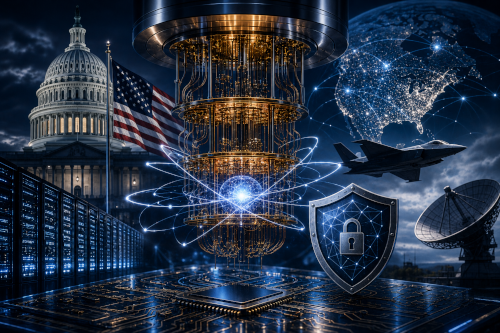
Harvest Now, Decrypt Later
Back in May, the Department of Commerce signed letters of intent to hand out $2 billion under the CHIPS and Science Act to roughly nine companies that’re building the actual guts of quantum computers.
IBM is getting a billion to build a domestic quantum foundry for superconducting wafers.
GlobalFoundries will pocket another $375 million for the same mission across multiple architectures.
And seven more companies — Atom Computing, Diraq, D-Wave, Infleqtion, PsiQuantum, Quantinuum, and Rigetti — will split the rest, each tackling a different piece of the hardest unsolved engineering problems in the field.
But I want you to dissect those “different” problems for a second…
You see, quantum computers aren’t all built the same way. Some trap individual ions with lasers, while others cool superconducting circuits to nearly absolute zero, and there’s even a few that utilize particles of light.
However, each approach has its own advantages and headaches, which is exactly why the government spread this money across so many companies at once.
Nobody’s sure yet which architecture wins, so Washington is funding the whole field of runners.
The details behind that flood of cash is interesting too.
In exchange for the money, the government takes a minority equity stake in every single company.
In other words, our government isn’t just funding quantum research, it’s actively investing in its future in the same way a venture capitalist would.
Let’s look at D-Wave specifically, because the before-and-after tells the whole story.
Prior to this program, D-Wave had received a grand total of $40,000 in federal funding. That’s it, folks, and it was spread across two decades.
Now, the company is poised to haul in about $100 million from this single initiative.
We’ve moved well beyond mere rounding errors.
Then, Trump doubled down in June after signing two executive orders on the same day — one that plays defense, and the other that goes on offense.
The defensive order sets hard deadlines for the entire federal government to migrate to quantum-resistant encryption with a key establishment by the end of 2030, and digital signatures the year after.
The reasoning here is pretty simple.
The Best Free Investment You’ll Ever Make
Our analysts have traveled the world over, dedicated to finding the best and most profitable investments in the global energy markets. All you have to do to join our Energy and Capital investment community is sign up for the daily newsletter below.
After all, nearly everything is digital today, from banking, email, national and defense systems. They’re all protected by encryption that relies on math problems that’s too hard for a regular computer to solve in any reasonable amount of time.
But a sufficiently powerful quantum computer could eventually solve those same problems in a fraction of the time, unlocking that protection.
So, our adversaries don’t need a working quantum computer today to benefit from one tomorrow. They can just harvest encrypted data right now, store it, and simply wait.
Then, once a capable enough quantum computer exists, years of “protected” data becomes readable all at once.
Security researchers call it “harvest now, decrypt later,” and it’s why the government is racing to swap out the locks before the tools to pick them exist.
Trump’s offensive executive order is just as aggressive.
This one sets up a coordinated federal effort — spanning the Department of Energy, the Department of War, and the intelligence community — to build and deploy a scientifically useful quantum computer at a national laboratory, with a hard target of 2028.
You can see the goal here, right?
Build up capability while defending against everyone else racing to get there first.
There’s one little catch in this whole story…
It turns out that the real opportunity has nothing to do with government spending.
Look, quantum computing lived mostly in research papers and press releases for years, but that’s starting to change quickly.
And 2026 produced some of the clearest proof yet for us.
Earlier this year, engineers achieved the first-ever commercial demonstration of two separate quantum computers connected and working together — talking to each other, sharing the computational load, rather than operating as isolated machines.
I know that might sound like a small technical footnote, but it’s the same kind of breakthrough that let ordinary computers evolve from single, room-sized machines into networks capable of far more than any one processor alone.
Remember, quantum computing is only useful at real scale if machines can eventually be linked the same way, and this was the first proof it’s mechanically possible.
Just as important, however, is the fact that quantum systems have started showing up in live, working infrastructure rather than laboratory demonstrations.
One deployment used a specific style of quantum computing called annealing, which is particularly good at solving optimization problems. It takes a network routing calculation that used to take about an hour and completes it in under 15 seconds.
That’s roughly a 240x speed-up that’s running on infrastructure people actually use every day, so it’s not just some curated lab result.
And that, dear reader, is the whole ballgame.
A discovery in a physics lab may tell us what’s possible, but a ramping up speed 240-times on live infrastructure is a waving flag that it’s ready to be utilized.
Right now, we’re seeing some serious work underway to combine quantum machines with the classical supercomputers that already exist. Think of them as hybrid systems designed to let each kind of computer do what it’s best at, rather than forcing quantum hardware to replace everything all at once.
Partnerships between quantum companies, research universities, and national supercomputing centers are building exactly these kinds of hybrid testbeds right now, with some expected to reach full operation within the next year or two.
Now let’s wrap it all together, and it’s easy to see the scope of where this is headed.
Quantum computing spent two decades as a promise, and today it’s not just the massive size of the checks being written, it’s the technology itself that’s keeping the promise.
Stay tuned.
Until next time,

Keith Kohl
 Check us out on YouTube!
A true insider in the technology and energy markets, Keith’s research has helped everyday investors capitalize from the rapid adoption of new technology trends and energy transitions. Keith connects with hundreds of thousands of readers as the Managing Editor of Energy & Capital, as well as the investment director of Angel Publishing’s Energy Investor and Technology and Opportunity.
For nearly two decades, Keith has been providing in-depth coverage of the hottest investment trends before they go mainstream — from the shale oil and gas boom in the United States to the red-hot EV revolution currently underway. Keith and his readers have banked hundreds of winning trades on the 5G rollout and on key advancements in robotics and AI technology.
Keith’s keen trading acumen and investment research also extend all the way into the complex biotech sector, where he and his readers take advantage of the newest and most groundbreaking medical therapies being developed by nearly 1,000 biotech companies. His network includes hundreds of experts, from M.D.s and Ph.D.s to lab scientists grinding out the latest medical technology and treatments. You can join his vast investment community and target the most profitable biotech stocks in Keith’s Topline Trader advisory newsletter.
P.S. The AI Boom Won’t Be Built in Space
Wall Street is captivated by SpaceX’s vision of orbital data centers, but the AI revolution is being built on the ground — where land and power are becoming the industry’s scarcest resources. One overlooked company has quietly spent decades assembling exactly the infrastructure today’s AI giants need, creating a potential opportunity most investors have completely missed.


