

When a young researcher at Oxford named Dorothy Hodgkin was handed a small sample of crystalline insulin more than 90 years ago, she had a burning desire to know its shape.
Mind you, she didn’t want to know what it did.
Everyone knew what insulin could do by then.
No, what she needed to know was how the molecules were actually put together, and where every atom sat.
Unfortunately, that was the year she started having a pain in her hands, which turned out to be rheumatoid arthritis.
It never let up, and her fingers and feet twisted and swelled for the rest of her life.
Still, she kept working anyway.
Four painful years later, she learned that penicillin has 17 atoms.
After another eight years, Dorothy had mapped out Vitamin B12, which consisted of 181 atoms.
However, her ambitious dream of figuring out insulin wasn’t solved for another 35 years in 1969.
It turns out that insulin has 788 atoms.
Naturally, she had already collected a Nobel Prize five years before she finished her grueling work.
That’s what it used to take to see the shape of a single protein — an entire career, and oftentimes a whole lifetime of work.
Today, the right AI drug development platform can do it all in half an hour.
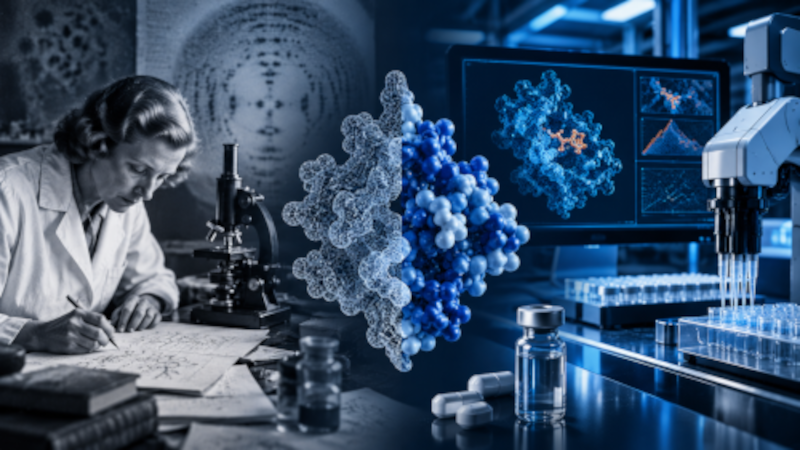
I want you to see what’s taking place in medicine right now, and specifically in the game-changer taking place in drug development.
Simply put, drugs work by fitting.
You see, a drug molecule has to physically grab onto a target protein, then slot into a pocket on its surface the way a key slots into a lock.
If you don’t know the exact three-dimensional shape of that lock, you’re not designing anything.
That’s called guessing.
The Best Free Investment You’ll Ever Make
Our analysts have traveled the world over, dedicated to finding the best and most profitable investments in the global energy markets. All you have to do to join our Energy and Capital investment community is sign up for the daily newsletter below.
And this is why so much of medical history reads like a series of lucky accidents.
You might recall that penicillin turned up on a contaminated petri dish.
In fact, one of the first real anticancer drugs came out of the bark of a Pacific yew tree.
There was no grand design with those society-changing breakthroughs in medicine, someone just got lucky and stumbled onto them.
Through more than half a century of X-ray crystallography, which was the technique Dorothy Hodgkin used, science painstakingly solved somewhere under 200,000 protein structures.
That sounds like a lot until you learn there are roughly 200 million proteins known to us.
So, we had only mapped out about one-tenth of one percent after 50 years of research and effort.
Then AI mapped essentially the rest of it.
I’m talking about every protein (all 200 million!) with predicted structures, released into a public database, and free for anyone to use.
At this pace, this kind of task would’ve taken the smartest scientists alive back in Dorothy’s time almost a billion years to accomplish.
Calling AI drug development a game-changer feels woefully underwhelming.
Within that, there’s a category of protein the industry calls “undruggable.”
Quite literally, we mean targets whose surfaces are flat and shallow, with no deep pocket for a drug molecule to grab. You know exactly what the protein does and that it’s driving the disease, yet still have nothing to bind it with.
KRAS is the famous one.
It’s among the most frequently mutated genes in human cancer, and for decades it sat there untouchable because its surface had nowhere useful to hold onto.
Roughly 85% of cancer-driving mutations fall into this undruggable category. That covers about 90% of pancreatic cancers, roughly half of brain cancers, half of colorectal cancers, and one-quarter of lung cancers.
Of course, this isn’t restricted to only cancer.
Alzheimer’s, Parkinson’s, cystic fibrosis, Huntington’s — a lot of what medicine has failed at for fifty years failed for this same reason.
You just can’t design a key when you can’t see the lock.
A few weeks ago, researchers at Mayo Clinic published work on a protein called GIPC1, which is a known driver in pancreatic cancer and a textbook undruggable target.
KRAS’ binding groove is shallow and floppy rather than deep and rigid, which is precisely why nobody had ever managed to hit it.
Those researchers used AI to screen close to 40,000 compounds, and found one that blocks it.
The result was tumor growth slowing during preclinical trials.
Yes, we’re still very early in all of this, nor has it been achieved in a human yet. The hard truth in drug development is that plenty of promising preclinical work never makes it to the next step.
But this is also a lock we’ve never been able to open by looking at it the way Dorothy Hodgkin and her contemporaries did.
What’s interesting, however, is that the most advanced AI-designed drug candidates aren’t in discovery anymore.
They’ve moved on to pivotal trials, with clinical readouts landing throughout this year and next.
That’s the first real test.
Granted, there’s a hard economic reason the industry is betting so heavily on this working.
Remember, Big Pharma’s return on investment for new drugs has fallen to somewhere around 1.2%, which is the lowest it’s ever been.
You know as well as I do that the average cost to bring one drug to market runs about $2.3 billion.
Now consider the fact that it takes the average drug candidate more than a decade to develop, or that 90% of new drug candidates never reach patients.
When the return on developing new treatments drops below what a savings account pays, it’s only natural that companies stop developing them.
Yet, AI attacks the input side of that equation directly, effectively cutting discovery timelines dramatically, while taking a serious bite out of the costs.
It’s a whole new ballgame, folks.
But the real work today isn’t deciding whether AI is going to change drug development.
We know that argument is over.
The hard work now is knowing which readouts are coming, when they land, and which ones actually have a decent chance of going the right way.
Dorothy Hodgkin waited thirty-five years for her answer.
These days we can mark it on a calendar.
Now let me show you exactly how to take advantage of it right here.
Until next time,

Keith Kohl
 Check us out on YouTube!
A true insider in the technology and energy markets, Keith’s research has helped everyday investors capitalize from the rapid adoption of new technology trends and energy transitions. Keith connects with hundreds of thousands of readers as the Managing Editor of Energy & Capital, as well as the investment director of Angel Publishing’s Energy Investor and Technology and Opportunity.
For nearly two decades, Keith has been providing in-depth coverage of the hottest investment trends before they go mainstream — from the shale oil and gas boom in the United States to the red-hot EV revolution currently underway. Keith and his readers have banked hundreds of winning trades on the 5G rollout and on key advancements in robotics and AI technology.
Keith’s keen trading acumen and investment research also extend all the way into the complex biotech sector, where he and his readers take advantage of the newest and most groundbreaking medical therapies being developed by nearly 1,000 biotech companies. His network includes hundreds of experts, from M.D.s and Ph.D.s to lab scientists grinding out the latest medical technology and treatments. You can join his vast investment community and target the most profitable biotech stocks in Keith’s Topline Trader advisory newsletter.


