

Most cancer doctors don’t stand up in the middle of a presentation and cheer.
As you might expect, they’re a reserved crowd suited for dense slides, carefully hedged language. Maybe if you’re lucky, you’ll see a polite round of applause at the end if the data holds up.
So imagine the surprise at this year’s American Society of Clinical Oncology meeting in Chicago, when thousands of them rose to their feet to give a thunderous applause… and that was before the speaker had even finished.
So what happened?
Well, the reason was a single comparison.
Patients with advanced pancreatic cancer who had already failed one round of chemotherapy and got more chemotherapy lived about 6.7 months, while patients who got an experimental pill called daraxonrasib lived about 13.2.
For the non-oncologists in our investment community, this is an unprecedented survival rate in the world of pancreatic cancer.
And for the record, pancreatic cancer is on track to become the second deadliest cancer in America by 2030. Treatment leans mostly toward chemotherapy, so you can understand why a result like this is celebrated.
Back in May, the FDA had already cleared an expanded access program, so patients who had run out of options could get the pill while the paperwork caught up.
But what makes things more remarkable is the target.
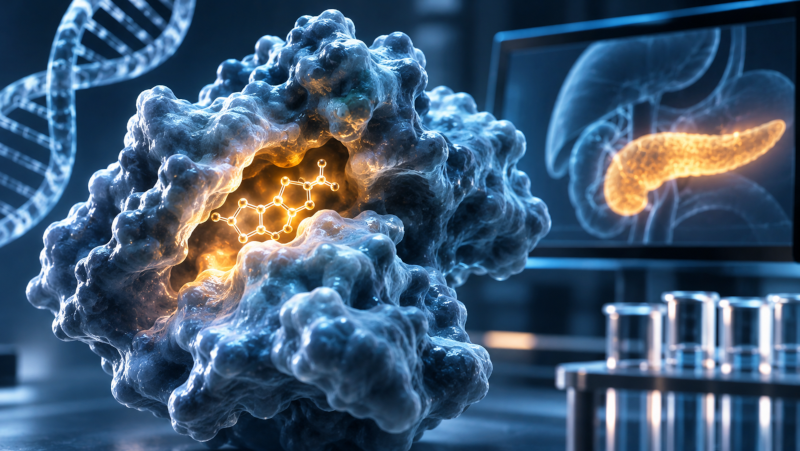
You see, the pill goes after a protein called KRAS, which drives more than 90% of pancreatic cancers. For decades pancreatic cancer was treated as a lost cause.
We’ve been tracking the race to build AI-designed medicine for a while now, and this result should tell us where we’re headed.
Look, most drugs work by settling into a pocket on the surface of a protein and jamming whatever it’s doing. The problem was that the surface of KRAS is exceptionally smooth, which left a drug nothing to hold on to.
To be fair, daraxonrasib wasn’t designed by AI, but it did settle an argument. If this target was previously written off as unreachable, you can’t help but wonder how many more are still sitting in the dark.
That’s where AI comes in.
You can’t design a grip for a shape you’ve never seen, and mapping a single protein by hand used to take years of lab work. AI systems learned to predict a protein’s shape from its sequence alone.
The Best Free Investment You’ll Ever Make
Our analysts have traveled the world over, dedicated to finding the best and most profitable investments in the global energy markets. All you have to do to join our Energy and Capital investment community is sign up for the daily newsletter below.
Today, the public AlphaFold database now holds more than 260 million predicted structures.
Now imagine a field where the first step, seeing the shape, takes mere minutes instead of years.
Not only is AI drug discovery real… Big pharma is starting to show the proof.
For Novartis, the average time from project start to a drug candidate has been nearly cut in half. Novo Nordisk says its design-make-test cycles dropped from about eight to three, and each cycle shrank from eight weeks to four.
Sanofi’s AI-enabled approach lets it skip a dose-selection study on an asthma treatment, which saves them at least a year.
And here’s the real hurdle…
Right now, nearly nine in ten drugs that enter clinical trials still fail, and the average cost of bringing a single asset to launch is around $2.23 billion.
You can see why cutting so much time and money is worth the race, right?
We’re still very much in the early stages of AI drug discovery, as the number of AI-enabled drugs in clinical testing rose only from about 117 to 129 over the last eight months, across 69 companies.
Of course, the real work for individual investors like us isn’t arguing about whether AI can find the next KRAS — that’s been proven already.
It’s far more important to uncover the small biotech players that are in the right position.
Sometimes the best science doesn’t always make the best investment, and a small developer with proven partners and a clear next step can behave nothing like a crowded field.
My readers and I have been following one such biotech closely. It pairs AI with quantum computing to go after the proteins the old methods couldn’t reach, and it has partnered with several of the largest names in pharma.


