

It seems like only yesterday that a small drilling crew stepped onto a rig in northeastern Iceland and dug a hole that ends careers… or makes them.
This wasn’t any normal hole, mind you. They were boring a geothermal test well beside the Krafla power plant, aiming to hit roughly four and a half kilometers down.
Sadly, they never got there.
At just 2,100 meters, a little over a mile, the bit punched into a pocket of molten rock sitting at 900 to 1,000℃
For the record, that was only the second time anyone had ever hit magma in a borehole anywhere on Earth.
Under the circumstances, most crews would’ve capped the hole and gone home. These guys, however, let the heat build up before finally opening the valve.
Immediately, the well blew superheated steam for months at more than 450℃ (yes folks, that’s a world record for geothermal heat). 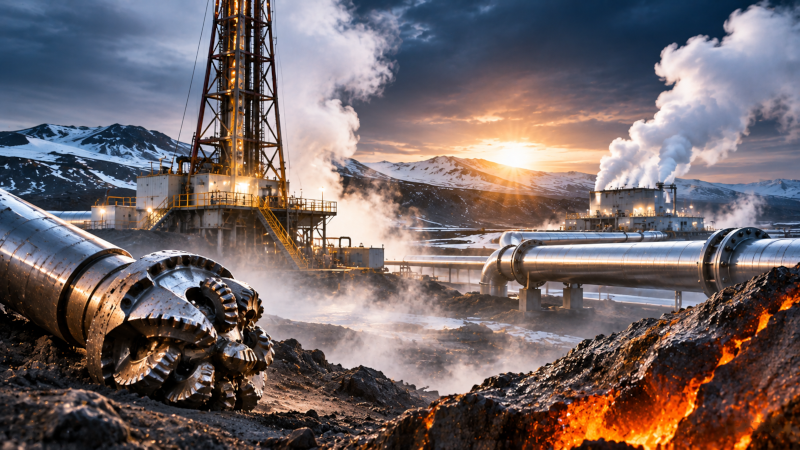
In fact, the measured output of that single hole could have produced up to 36 megawatts of electricity; compare that to the 60 megawatts of installed capacity at the entire power plant next door.
That’s not too shabby for one well to be sitting on more than half the output of a whole power station.
But the lesson there wasn’t from the magma. After all, nobody is planning to drill into volcanoes on purpose. Rather, the interesting thing here was the temperature, because how much power a well can deliver depends enormously on how hot the rock around it is.
Look, for most of its history, the geothermal business revolved around finding a reservoir of naturally hot water to tap. That’s what most people still think of it as today.
The Best Free Investment You’ll Ever Make
Our analysts have traveled the world over, dedicated to finding the best and most profitable investments in the global energy markets. All you have to do to join our Energy and Capital investment community is sign up for the daily newsletter below.
So when a group of drillers start changing the dynamic of geothermal energy, we can’t help but sit up and take notice.
And believe me, Big Oil is hungry for this clean energy.
I’ll bet that most of my readers know where I’m going with this.
Superhot rock geothermal targets resources above 705℉, or 374℃. Past that line, water turns supercritical, a state that is neither liquid nor steam, and every pound of it hauled up the pipe carries far more energy than a pound of ordinary hot water.
Now this is where the headlines get a little fast and loose, with some claims touting that these superhot wells can produce up to ten times the power of a traditional geothermal well.
Keep in mind that’s their internal numbers, but if you follow the money, you can see why they’re chasing EGS.
You see, drilling operations can swallow up to nearly 60% of the capital in a typical geothermal project. And if a single well can do the work of several, well then, that enormous bill gets cut down quite a bit.
To be sure, utilizing advanced drilling techniques has changed the geothermal game just as it did in the tight oil and gas boom we experienced nearly two decades ago.
Now that prize awaits.
If you’re curious why everyone isn’t already doing this, it’s because the same heat that makes the rock valuable also wrecks the equipment you need to reach it.
It makes sense, right? Extreme temperatures damage downhole tools and electronics, including the steering tools that keep a horizontal well on course.
Just imagine asking a surgeon to operate inside an oven. So, higher drilling and capital costs needed per megawatt remain the biggest barriers to commercial development.
Nobody disputes that.
But take a look around, and you’ll find some remarkable progress.
In central Oregon, a team ran what they describe as the first field use of supercritical carbon dioxide as a drilling fluid in a deep geothermal well. The rock around the hole sat at 645℉, and the fluid cooled the gear at the bottom of the hole to 195℉.
They also drilled 20% faster, or roughly 92 feet per hour.
Yet, this is much more than simple progress.
Things are ready to turn downright profitable given that the same company can drill a new well this year 80% faster than they could a year ago.
Cut the clock and you cut the bill.
And they’re not the only ones chasing the EGS dream.
Earlier this week, one of the largest technology companies on the planet signed a power purchase agreement for superhot geothermal power from a project in Central Oregon, with deliveries beginning as soon as 2030.
The size of that contract was for approximately 50 megawatts.
The first phase of that project will use conventional drilling technology to reach superhot conditions at commercial scale, which means the buyer is betting on the rock and the drill crew, not on some technology still sitting in a lab.
Are you starting to see a pattern too?
Just a few months ago, the largest enhanced geothermal contract to date was signed, which would deliver 396 megawatts with an option on roughly 600 more by mid-2030.
You know as well as I do what that means.
To be fair, the first deliveries are still roughly four years away.
That’s not to mention the fact that the Oregon test was a single well, and the media hype is calling for a tenfold power boost.
But step back for a minute and ask who benefits no matter how fast the superhot version arrives.
You see, the real work isn’t guessing whether rock will ever run 700 degrees on a utility bill.
The thing is, the winners in this era won’t necessarily be the first to hit the hottest rock. They’ll be the ones who already have the drill crews, the expertise to tap into the hot rock, and of course, the buyers sitting and waiting for that power to arrive.
I recommend you take a few minutes out of your day and let me show you who they are.
Until next time,

Keith Kohl
 Check us out on YouTube!
A true insider in the technology and energy markets, Keith’s research has helped everyday investors capitalize from the rapid adoption of new technology trends and energy transitions. Keith connects with hundreds of thousands of readers as the Managing Editor of Energy & Capital, as well as the investment director of Angel Publishing’s Energy Investor and Technology and Opportunity.
For nearly two decades, Keith has been providing in-depth coverage of the hottest investment trends before they go mainstream — from the shale oil and gas boom in the United States to the red-hot EV revolution currently underway. Keith and his readers have banked hundreds of winning trades on the 5G rollout and on key advancements in robotics and AI technology.
Keith’s keen trading acumen and investment research also extend all the way into the complex biotech sector, where he and his readers take advantage of the newest and most groundbreaking medical therapies being developed by nearly 1,000 biotech companies. His network includes hundreds of experts, from M.D.s and Ph.D.s to lab scientists grinding out the latest medical technology and treatments. You can join his vast investment community and target the most profitable biotech stocks in Keith’s Topline Trader advisory newsletter.


