

The biggest data center project in America is going up on the grounds of a former nuclear fuel plant.
And the power fueling it will burn natural gas.
We saw this coming from a mile away, too.
Last March, the Energy, Commerce and Interior Secretaries stood in Piketon, Ohio (where most of the old process buildings that enriched uranium are now rubble), and announced a 10-gigawatt data center with up to 10 gigawatts of new generation behind it.
Of that, 9.2 gigawatts will run on gas.
Tied to that project was $33.3 billion in Japanese funding, with another $4.2 billion being invested into transmission lines to carry the power.
For a little perspective, ten gigawatts is roughly the output of ten large reactors.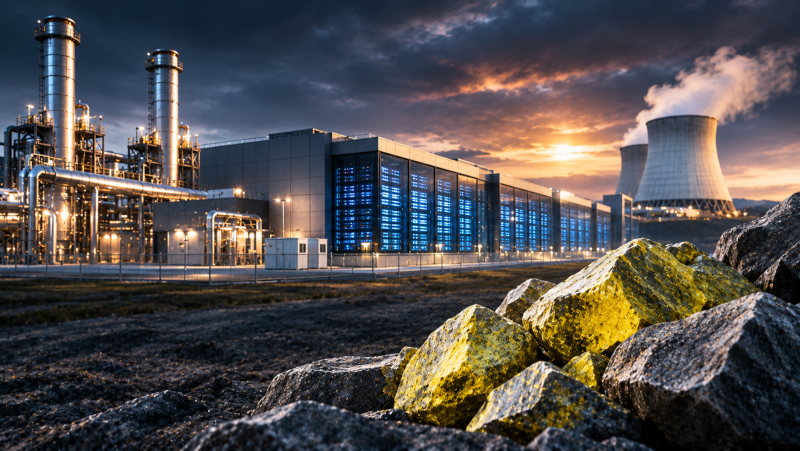
I know some people read those headlines and lost faith in nuclear power. After all, if the government won’t put a reactor on a site that spent half a century making reactor fuel, where would they?
Yet, Piketon isn’t finished with uranium… not by a long shot.
Of course, my readers know that our nuclear reckoning has just begun, and the site that just got a gas-fired data center is also getting something else – and the second project may matter far more to your portfolio than the first.
The Best Free Investment You’ll Ever Make
Our analysts have traveled the world over, dedicated to finding the best and most profitable investments in the global energy markets. All you have to do to join our Energy and Capital investment community is sign up for the daily newsletter below.
A Site Built to Eat Power
The Portsmouth Gaseous Diffusion Plant went up in the early 1950s with a single thought in mind — separate the uranium-235 that fuels a bomb or a reactor from the heavier uranium-238 that doesn’t.
Their method was pure brute force. You see, what they would do was push uranium gas through thousands of porous barriers, one stage after another, until the lighter atoms pile up on one side.
And you can bet that effort took up a whole lot of electricity.
At its peak, the plant drew about 2,100 megawatts, roughly two large reactors’ worth, to run one enrichment complex.
In fact, more than a dozen utilities pooled their money to build the power plants that kept it running.
Makes sense, right? After all, enrichment is really an electricity business that happens to end with uranium. It also explains why the site came with high-voltage lines already in place, which is exactly what a data center developer wants.
Now compare the old draw to the new plan and you get close to five times the electricity.
Right now, natural gas is the undisputed king of U.S. power generation.
And today, developers know how to finance, permit, and build capacity on a short clock. Doing the same with a nuclear power plant is something the U.S. is still relearning how to do, so it’s only natural that companies take the fastest path to get the power they need.
But don’t mistake that capitulation over nuclear energy. Remember, President Trump signed executive orders last May targeting 400 GW of U.S. nuclear capacity by 2050, and the goal is to have 10 large reactors under construction by 2030, along with 5 GW of uprates at existing plants.
It doesn’t take much thought to realize the sheer amount of fuel that every one of those reactors will need.
Keep in mind that reactor fuel doesn’t come out of the ground ready to burn. Mined uranium has to be converted and then enriched, and the U.S. has unfortunately let most of that supply chain wither.
In 2025, we produced roughly 2.1 million pounds, which was a huge jump over the 657,000 pounds produced the year before.
I know that sounds like progress, but then you see how much our reactors actually needed — 46.9 million pounds.
By the way, only 7% of it came from U.S. mines.
The thing is, enrichment is the tighter squeeze.
Russia supplied 26% of the enrichment services U.S. utilities bought in 2025. A 2024 law bans those imports, but it lets the Energy Department hand out waivers, and that authority runs out in January of 2028.
You can’t help but wonder what happens to a reactor fleet that makes about a fifth of our electricity when the Russian share of its enrichment comes with an expiration date.
To be fair, the government’s own numbers answer part of it…
At the end of 2025, U.S. reactor owners reported 186 million pounds of uranium requirements for 2025 through 2035 that no contract covers yet.
That’s roughly four years of last year’s total purchases, still waiting for a seller.
There’s also a little plot twist going on at Piketon.
A private enrichment company leases land on the same site, and it just shipped the first new centrifuge built for an expansion of its plant. The Energy Department awarded a $900 million task order to turn that operation into commercial-scale production of the more concentrated fuel advanced reactors will need, with new capacity expected to start coming online in 2029.
So, what we have is one site carrying two bets: Natural gas for the data center, and uranium for the reactors that come after.
Look, the real debate isn’t natural gas versus nuclear.
Both are going to pay off in spades.
The difference, however, is that we’re heavily leaning on Russia for 26% of our enrichment, and we certainly won’t be able to quadruple our nuclear capacity if that stays true.
The winners in this new energy era will be a small handful of U.S. producers that can change this dynamic.
Perhaps it’s time you discover those nuclear investment gems for yourself.


