

Elon Musk has been quietly buying land about 30 miles east of Austin, in the small town of Bastrop, Texas.
The 830 acres he picked up, however, also happens to sit right next to one of his Starlink factories.
But you may not realize what he’s going to use this land for.
You see, Musk is planning to construct a foundry where he can cast blades and vanes for gas turbines.
That may not make sense to most people right away, but it’s one of the most important projects Musk has ever started.
Why? Well, it’s because SpaceX has a bigger need right now than rocket parts.
Those future blades will spin inside a turbine in extreme heat, so they’re cast from nickel-based superalloys. The problem is that only four companies in the world can make them at industrial scale, and all four are booked tight.
So, Musk simply wants to take matters into his own hands and bring things in-house — doing so can speed up his timeline by nearly 18 months. 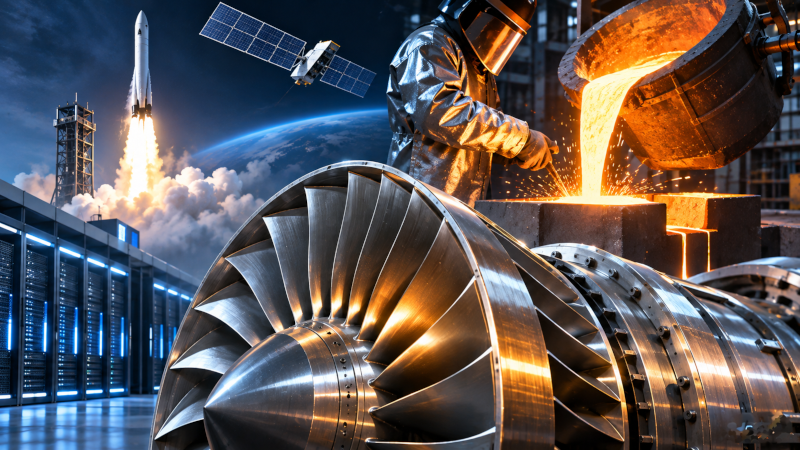
Again, we’re not talking about rocket parts; these blades are vital to generating electricity.
And I can’t help thinking of Henry Ford.
By 1928, Ford’s River Rouge complex outside Detroit could turn raw materials into running cars in a single location. The company controlled its own steel mill, glass plant, and power plant.
In fact, that same year Ford started a rubber plantation in the Amazon so he wouldn’t have to buy rubber from anyone else.
Granted, he lost more than $20 million on it and abandoned the first site in 1934 before selling out in 1945, but his intentions were crystal clear.
History does have a little knack of repeating itself, doesn’t it?
Last month, SpaceX proved it wasn’t necessarily a rocket company after posting $7.5 billion from its AI business during the third quarter.
Musk’s spending shift should’ve also stood out to you.
SpaceX put $19.6 billion into capital projects in the third quarter, with $16.4 billion of it going straight into AI infrastructure.
Elon gave us a hint at where future spending will be directed, too.
After all, the main constraint on deploying AI is power, cooling and infrastructure rather than chips.
He even mentioned that metal shortages are causing delays of 12 to 18 months for turbine makers — you can see why they’re starting to build components themself, right?
It’s not exactly a new problem.
SpaceX has been running gas turbines at its Colossus data centers in Memphis since 2024, where capacity has grown to 1.7 gigawatts.
Musk is banking hard on natural gas.
The Best Free Investment You’ll Ever Make
Our analysts have traveled the world over, dedicated to finding the best and most profitable investments in the global energy markets. All you have to do to join our Energy and Capital investment community is sign up for the daily newsletter below.
He isn’t exaggerating the supply squeeze, either.
GE Vernova is the largest turbine maker, and is sold out through 2030, which means it’ll take about three years for new orders.
Throughout this entire situation, the one constant has been demand.
SpaceX’s last flight was at the end of September, and was the first to reach orbit while carrying 26 next-gen Starlink satellites.
Nobody builds a foundry in a field in Texas because their supply chain is working fine.
There’s one little bit that we keep circling back to.
Look, any company that can spend $35 billion to $40 billion in a single quarter, yet still can’t buy enough turbines… it’ll have to cast its own blades.
It’s clear that the suppliers can be the key bottleneck here.
It’s also conveniently the part that the investment herd misses every time.
While their eyes are fixated on the rockets and satellites, they miss the juiciest part: the ones that actually deliver the pieces SpaceX can’t churn out fast enough.
Trust me, that is a long line that keeps growing.
Ford learned it the hard way, and SpaceX is just starting to realize it.
Whatever Musk can’t build himself needs to come from somewhere.
My colleague Jason Simpkins has spent months digging into exactly this, and he’s put all that research into his latest investment presentation. It highlights the little-known companies that supply SpaceX what it needs, and they stand to benefit as SpaceX keeps spending.
They aren’t household names, which is why they tend to fly under the radar.
Jason walks you through who’s in that chain, what they supply, and why they could end up with a bigger share of the build-out than most people expect.
You can see Jason’s cutting-edge research for yourself, at absolutely no cost to you, right here.
Until next time,

Keith Kohl
 Check us out on YouTube!
A true insider in the technology and energy markets, Keith’s research has helped everyday investors capitalize from the rapid adoption of new technology trends and energy transitions. Keith connects with hundreds of thousands of readers as the Managing Editor of Energy & Capital, as well as the investment director of Angel Publishing’s Energy Investor and Technology and Opportunity.
For nearly two decades, Keith has been providing in-depth coverage of the hottest investment trends before they go mainstream — from the shale oil and gas boom in the United States to the red-hot EV revolution currently underway. Keith and his readers have banked hundreds of winning trades on the 5G rollout and on key advancements in robotics and AI technology.
Keith’s keen trading acumen and investment research also extend all the way into the complex biotech sector, where he and his readers take advantage of the newest and most groundbreaking medical therapies being developed by nearly 1,000 biotech companies. His network includes hundreds of experts, from M.D.s and Ph.D.s to lab scientists grinding out the latest medical technology and treatments. You can join his vast investment community and target the most profitable biotech stocks in Keith’s Topline Trader advisory newsletter.


