

Four days ago, the EIA dropped a number that should make you angry.
While headlines in our media are razor-focused on any clickbait material over the U.S.-Iran war, you’d be surprised what slips through the cracks.
In this case, it was the EIA revealing that last year, U.S. reactor operators bought 3.28 million SWU of Russian enrichment services.
To put a little perspective on that number, it’s almost 26% of everything they purchased.
A decade ago, it was 17%.
In fact, we even passed a law to end this, and yet two years from that hard deadline we’re buying more Russian uranium than ever.
Let that sink in for a second.
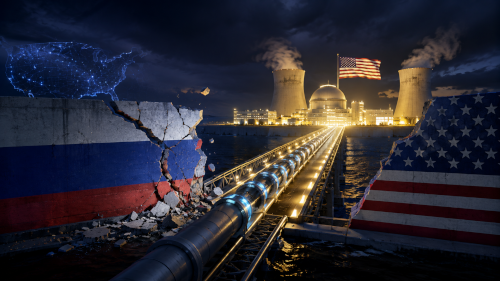
We can simplify this even further…
In 2024, Congress banned imports of Russian low-enriched uranium via the Prohibiting Russian Uranium Imports Act. Despite the ban, however, the DoE could still grant waivers if there weren’t any alternatives — but those waivers run out on January 1, 2028.
In other words, there are no more exceptions allowed in less than a year and a half.
If you’re scratching your head as to why that matters at all, understand that our reactors utilize Russian uranium to generate roughly a fifth of all U.S. electricity.
That’s one-fifth of our power grid.
Of course, that doesn’t mention the fact that foreign sources supplied 77% of all U.S. enrichment services last year.
“What about our domestic miners?” you ask.
Well, that covers just about 7% of what our reactors need.
The Best Free Investment You’ll Ever Make
Our analysts have traveled the world over, dedicated to finding the best and most profitable investments in the global energy markets. All you have to do to join our Energy and Capital investment community is sign up for the daily newsletter below.
In other words, we’re nowhere close to self-sufficient… and the clock keeps ticking down, 16 months left and counting.
To be fair, part of the solution is already in the works. Urenco USA has been adding capacity — 700,000 SWU a year, coming fully online by early 2027. Granted, that one’s on schedule, so we can give credit where it’s due.
But what about the bigger builds? Centrus and Orano’s larger projects aren’t expected before 2029.
That’s not a good timeline when shit hits the fan in 2027.
I wish I could tell you this was just a mere rounding error — but the entire premise of this deadline is falling apart in real time.
Of course, that’s just the easy fuel, too.
Advanced reactors — the small modular designs that are garnering more and more headlines these days — need something called HALEU, enriched to a higher grade, with almost none of the domestic supply chain built yet. If today’s fuel problem looks hard, that one’s harder.
Find the Bridge Builders
Perhaps we should find something a bit more useful.
You see, while Washington argues over a date the numbers don’t support, the DoE has already picked the players who will build this bridge. It’s committed $2.7 billion to four companies: Centrus Energy’s American Centrifuge subsidiary, General Matter, Orano Federal Services, and Urenco USA.
Make no mistake, that’s real money flowing into building our domestic enrichment capacity.
There’s a second track too — the companies holding contracts to handle HALEU deconversion (the processing step that turns enriched uranium into usable reactor fuel), with names like Centrus, GE Vernova, Orano, and Westinghouse taking the lead.
But look at that list again and you’ll find a veritable mix of nuclear players.
Some are large, familiar industrial names like GE Vernova and Westinghouse. Others, like Centrus Energy, are far smaller and rarely make it into mainstream headlines.
What they share isn’t obscurity, but rather the fact that every one of them is positioned where billions of guaranteed government money is headed, regardless of how the politics around 2028 shake out.
The deadline may be a fantasy, but the money isn’t.
I think it’s time you saw firsthand who’s in the right spot at the right time in this opportunity.
Until next time,

Keith Kohl
 Check us out on YouTube!
A true insider in the technology and energy markets, Keith’s research has helped everyday investors capitalize from the rapid adoption of new technology trends and energy transitions. Keith connects with hundreds of thousands of readers as the Managing Editor of Energy & Capital, as well as the investment director of Angel Publishing’s Energy Investor and Technology and Opportunity.
For nearly two decades, Keith has been providing in-depth coverage of the hottest investment trends before they go mainstream — from the shale oil and gas boom in the United States to the red-hot EV revolution currently underway. Keith and his readers have banked hundreds of winning trades on the 5G rollout and on key advancements in robotics and AI technology.
Keith’s keen trading acumen and investment research also extend all the way into the complex biotech sector, where he and his readers take advantage of the newest and most groundbreaking medical therapies being developed by nearly 1,000 biotech companies. His network includes hundreds of experts, from M.D.s and Ph.D.s to lab scientists grinding out the latest medical technology and treatments. You can join his vast investment community and target the most profitable biotech stocks in Keith’s Topline Trader advisory newsletter.


