

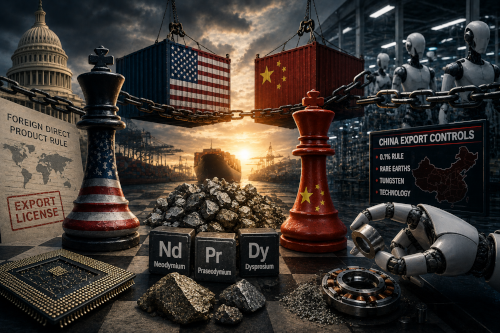
Back in 2020, the U.S. Commerce Department reached into a legal drawer most Americans never knew existed and pulled out something called the Foreign Direct Product Rule.
They only had one target in mind.
Huawei.
You see, the mechanism was brutal in its simplicity: if a semiconductor was made anywhere on Earth — Taiwan, South Korea, the Netherlands, it didn’t matter — using so much as a single piece of U.S.-origin equipment or software, that chip needed a U.S. export license before it could reach Huawei.
Washington didn’t need to control the factory, it just needed to control one link in the chain… anywhere in the world.
And the rule did the rest.
The best part for them is that it worked, too, as Huawei’s chip supply soon got strangled almost overnight.
The interesting part was something that nobody in Washington seems to have anticipated.
It turns out that Beijing picked up that exact playbook, read it cover to cover, and handed it back to us with our own fingerprints on it.
The 0.1% Rule Just Changed The Supply Chain Game
Right now, China’s Ministry of Commerce requires a Chinese export license for any product (manufactured anywhere in the world by anyone) that contains 0.1% or more of Chinese-origin rare earth content… or that was made using Chinese rare earth processing technology.
Stop and read that again.
We’re not talking 10% or even 1% — this is one-tenth of one percent!
This isn’t a tariff or a quota, either.
It’s Beijing officially establishing legal jurisdiction over products it never touched, built in factories it doesn’t own and in countries it doesn’t govern. This is the same thing as the extraterritorial logic the Trump administration invented for Huawei, except it’s aimed in the other direction.
You see the problem now, right?
The Best Free Investment You’ll Ever Make
Our analysts have traveled the world over, dedicated to finding the best and most profitable investments in the global energy markets. All you have to do to join our Energy and Capital investment community is sign up for the daily newsletter below.
So far, the reaction in the materials markets has been immediate and brutal.
Yttrium, for example, is the stuff that coats turbine blades and insulates semiconductor components. Since the price controls took hold, we’ve seen yttrium’s price climb 15-fold.
The result has been aerospace and chip supply chains scrambling for alternatives.
And that’s just one element on a much longer list.
However, there’s another squeeze happening in parallel that barely made headlines.
You see, China also happened to cap 2026-2027 tungsten exports to just 15 licensed companies. And for three straight years, Beijing cut its own tungsten mining quotas by roughly 6% annually, citing environmental cleanup and declining ore grades.
Meanwhile, exports of ammonium paratungstate — the compound that feeds tungsten carbide production for cutting tools, drilling equipment, and munitions — cratered from 782 tonnes in 2024 to just 243 tonnes during the first eleven months of 2025. If you’re keeping track, that’s a 70% decline as tungsten prices trade at record highs.
While Washington remains fixated on rare earth magnets, Beijing has been running a parallel chokehold that’s just as devastating.
The Robot Supply Chain Just Collided With The Minerals Supply Chain
To be fair, the West isn’t standing still.
In order to start diversifying supply, the Pentagon inked a deal with Australia’s Lynas Rare Earths, which happens to be the only heavy rare earth refiner operating outside China.
In fact, roughly $6.3 billion flowed into non-Chinese rare earth projects last year, with another $2.8 billion committed in the first quarter of 2026 alone.
That may be real money, dear reader, but it’s not nearly enough. That’s also not to mention the fact that China still controls somewhere north of 70% of global rare earth processing.
Look, you don’t out-invest three decades of industrial buildout in a single fiscal year.
But there is a part of this story that almost nobody’s pricing in… not yet, at least.
Keep in mind that every humanoid robot, from the Optimus units, Figure models, and waves of factory-floor humanoids China itself is now shipping out of Xiaomi’s production lines, requires roughly 1.3 kilograms of neodymium-praseodymium magnet material to actually move its joints.
So, what this means is that even a modest ramp to one million humanoid units a year works out to 1.3 million kilograms of NdPr magnet demand.
That’s 1,300 metric tons of a material China already rations to defense contractors and automakers today.
Industry researchers expect robotics to become the single largest driver of magnet demand by 2040. Yes, that’s well ahead of EVs and wind turbines — we’re talking about everything!
Now consider that the humanoid robot trade and the critical minerals trade are being priced by two completely different sets of investors who aren’t talking to each other.
You can see the opportunity opening up, right?
Just think, the companies actually positioned to supply magnet-grade material domestically — the ones we’ve been tracking as this squeeze develops — are sitting at the intersection of two megatrends that are about to merge into one.
There’s the structural demand from robotics that’s essentially locked in, as well as the other supply constraints from Beijing that are deliberately tightening.
Washington wrote the extraterritorial trade-weapon playbook first.
China just proved it works a lot better when you’re the one holding the mineral monopoly.
Until next time,

Keith Kohl
 Check us out on YouTube!
A true insider in the technology and energy markets, Keith’s research has helped everyday investors capitalize from the rapid adoption of new technology trends and energy transitions. Keith connects with hundreds of thousands of readers as the Managing Editor of Energy & Capital, as well as the investment director of Angel Publishing’s Energy Investor and Technology and Opportunity.
For nearly two decades, Keith has been providing in-depth coverage of the hottest investment trends before they go mainstream — from the shale oil and gas boom in the United States to the red-hot EV revolution currently underway. Keith and his readers have banked hundreds of winning trades on the 5G rollout and on key advancements in robotics and AI technology.
Keith’s keen trading acumen and investment research also extend all the way into the complex biotech sector, where he and his readers take advantage of the newest and most groundbreaking medical therapies being developed by nearly 1,000 biotech companies. His network includes hundreds of experts, from M.D.s and Ph.D.s to lab scientists grinding out the latest medical technology and treatments. You can join his vast investment community and target the most profitable biotech stocks in Keith’s Topline Trader advisory newsletter.


