

The first reports came in around 9 p.m. local time.
But if you were there, you wouldn’t need to wait for the official report because you’d know something was very, very wrong at Qatar’s Ras Laffan facility.
Why? Well, because a massive fireball exploded into the air and was visible for miles around. Soon after, black smoke started rising above the industrial skyline.
Within minutes, social media erupted with eyewitness accounts blaming Iranian drones as every energy trader on the planet went very quiet very fast.
Then QatarEnergy clarified what happened: It wasn’t drones, but rather a technical malfunction during startup operations. This was the kind of accident that happens when you try to restart the world’s largest LNG complex after it’s been sitting damaged and idle for months.
The Barzan gas supply facility erupted during the startup sequence, injuring dozens of people and killing thirteen.
Even though this wasn’t an attack, the Ras Laffan incident revealed something far more important to us — Qatar’s road back is infinitely harder than anyone publicly admitted. And for U.S. LNG exporters, every day that road gets longer is another day they’re the only address left standing in the world.
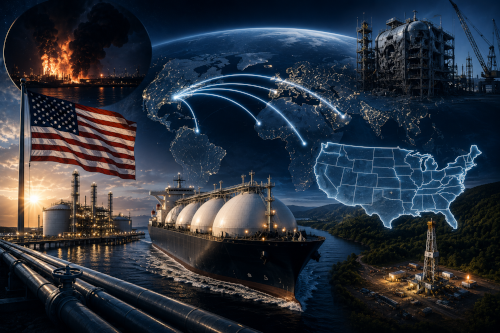
The Explosion That Locked In 25 Years of U.S. LNG Profits
Let’s back up for anyone who missed what happened back in March.
We were still in the early weeks of the U.S-Iran war when Iranian missiles struck Ras Laffan Industrial City.
Ultimately, two LNG trains took significant damage. Train 4 took hits, yet it was worse over at Train 6 where the primary heat exchangers partially collapsed.
But here’s what most people don’t understand about that damage — these aren’t components you swap out over a weekend.
A heat exchanger on an LNG train is a multi-story, precision-engineered system designed to operate at temperatures approaching absolute zero. You can’t just improvise replacements, nor can you rush the process.
At the time Qatari officials told us that the repair timeline was three to five years.
Minimum.
A few days later, force majeure notices went out to Italy, Belgium, South Korea, and China.
The Best Free Investment You’ll Ever Make
Our analysts have traveled the world over, dedicated to finding the best and most profitable investments in the global energy markets. All you have to do to join our Energy and Capital investment community is sign up for the daily newsletter below.
Every major buyer got the same message: We can’t deliver your contracted LNG.
And the capacity loss was absolutely staggering…
Roughly 17% of Qatar’s total LNG export capacity — about 12.8 million tonnes per year — went dark overnight. And the North Field Expansion project, which was 85% complete and supposed to add significant new capacity by 2027, was suspended mid-construction.
Qatar told its buyers it could restore 50% of production capacity within one month of safe Hormuz transit resuming. So, markets started pricing in a recovery on every optimistic headline, no matter how realistic it was.
Tankers were repositioned and analysts modeled timelines based on that assumption.
Then came last Sunday, which showed us how difficult it’s going to be to get things back to normal.
Qatar’s Fragile LNG Restart
Look, restarting a facility this complex after months of damage, idle time, and wartime disruption isn’t like flipping a switch.
It’s a series of high-pressure, high-temperature, cryogenic operations where a single miscalibration ends exactly the way Sunday night ended.
The Barzan facility — part of Qatar’s domestic gas supply infrastructure — exploded.
Fortunately, the energy minister ruled out hostile action and reported that it was a technical malfunction.
But here’s what that clarification doesn’t change: the facility is down again, and the world just got a live demonstration of how fragile Qatar’s restart actually is.
This wasn’t a one-time mistake, either. It was a proof of concept that restarting energy infrastructure damaged by war, left idle for months, and subjected to years of deferred maintenance is exponentially harder than the optimistic timelines suggested.
Is it clear yet that Qatar’s LNG exports won’t come on a smooth and predictable schedule?
Because the market is going to have to absorb that reality whether it wants to or not.
Locking In 25 Years of U.S. LNG Profits
What’s more interesting is the position that U.S. LNG exporters are in right now.
You see, they’ve already proved they can handle exactly this kind of situation — because they’ve already done it once!
If you remember a few years back when Russia cut off natural gas to Europe, the EU was staring at an existential supply shortfall.
Up to that point, Russia had been supplying roughly 40% of European gas.
Then the U.S. stepped in.
The United States went from supplying 27% of European LNG imports in 2021 to 44% in 2022.
By 2023, it was 48%.
Suddenly, new regasification terminals got fast-tracked across Germany as long-term contracts were signed under emergency conditions.
The U.S. didn’t just fill the hole, dear reader, it became the structural backbone of European energy security in under 18 months.
Now the same playbook is running again.
Except this time, the U.S. is already in a dominant position before the crisis even fully materializes.
Last year, the U.S. exported 111 million metric tons of LNG.
For the record, we were the first country in history to export 100 million tons in a single year. That put U.S. exports roughly 20 million tons ahead of Qatar — and that was before March’s strikes took Qatar partially offline!
At the end of April, the first cargoes of LNG were starting to ship out of Golden Pass LNG — the joint venture between QatarEnergy and ExxonMobil.
Again, that was right when the market had absolutely zero excess supply to draw from.
We were just in time.
By 2027, our export capacity is forecast to exceed 18.1 billion cubic feet per day — more than double what it was in 2020.
More importantly, every new terminal coming online is hitting the market at precisely the moment when Qatar’s restart timeline is getting pushed back.
Now, every buyer who got hit with Qatar’s force majeure notice needs to re-contract.
Not only do they need this supply, but they need it immediately. Of course, they also need the confidence that the supply won’t disappear on them again.
There’s exactly one counterparty on Earth with the infrastructure, the political stability, and the geographic insulation to take that business at scale — the U.S. Gulf Coast.
Today, the contracts they’re signing aren’t quarterly negotiations. These are multi-decade take-or-pay agreements.
These contracts will run beyond 2050.
You see, the buyers signing today are signing into a world where Qatar’s reliability is permanently in question. We’re talking about technical malfunctions during startup (like we saw Sunday), repairs that could stretch for years, and geopolitical risk that can close the Strait of Hormuz for months at the drop of an Iranian hat.
These are real constraints, folks.
The good thing for us is that the U.S. Gulf Coast isn’t blocked by a 22-mile-wide chokepoint between Sabine Pass and Rotterdam —- nobody has any kind of geopolitical leverage they can weaponize.
So what happened at Ras Laffan in March — and what happened again on June 21st — simply cannot happen to American export infrastructure.
Today, the export terminals get all the attention.
That makes sense, doesn’t it? After all, they’ll draw the most headlines and analyst coverage.
The market loves to focus on the terminals, and for good reason.
But that flood of future U.S. LNG exports has to come out of the ground somewhere.
Every LNG cargo leaving a U.S. terminal — whether its Sabine Pass, Corpus Christi, Plaquemines, all of them — is natural gas that has to be extracted from underground.
It’s a good thing that the U.S. is an absolute powerhouse natural gas producer.
Appalachian gas producers are the feedstock suppliers to the most strategically important export infrastructure on the planet right now.
When Sabine Pass liquefies a cargo and ships it to Europe, that’s Appalachian gas; when Golden Pass ramps production over the next 12 months, that’s Appalachian gas flowing through Corpus Christi.
And every new long-term contract signed at a U.S. export terminal is a decade-long call on that domestic gas supply. As export capacity grows and the premium persists — and it will persist because of Qatar’s fragile restart timeline — the producers capturing that spread are locking in structural value that doesn’t go away in 18 months.
These aren’t traders capturing a temporary market dislocation. These are 25-year contracts locked in at premium economics because the alternative just became visibly unreliable to everyone.
Most investors are still watching the terminals, but the smart money is already tracking the players feeding them.
Until next time,

Keith Kohl
 Check us out on YouTube!
A true insider in the technology and energy markets, Keith’s research has helped everyday investors capitalize from the rapid adoption of new technology trends and energy transitions. Keith connects with hundreds of thousands of readers as the Managing Editor of Energy & Capital, as well as the investment director of Angel Publishing’s Energy Investor and Technology and Opportunity.
For nearly two decades, Keith has been providing in-depth coverage of the hottest investment trends before they go mainstream — from the shale oil and gas boom in the United States to the red-hot EV revolution currently underway. Keith and his readers have banked hundreds of winning trades on the 5G rollout and on key advancements in robotics and AI technology.
Keith’s keen trading acumen and investment research also extend all the way into the complex biotech sector, where he and his readers take advantage of the newest and most groundbreaking medical therapies being developed by nearly 1,000 biotech companies. His network includes hundreds of experts, from M.D.s and Ph.D.s to lab scientists grinding out the latest medical technology and treatments. You can join his vast investment community and target the most profitable biotech stocks in Keith’s Topline Trader advisory newsletter.


