

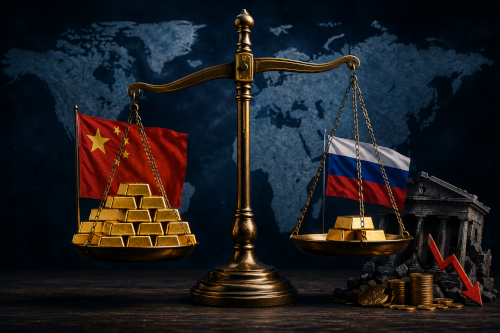
Last month, two of the world’s largest holders of gold did the exact opposite thing.
First, we saw the People’s Bank of China take delivery of over 7 tonnes of gold bullion.
For the record, that was their 18th consecutive month of buying, and Xi’s reserves now sit at 2,313 tonnes.
Yet at the same moment, the Bank of Russia became the single largest seller of gold in 2026 — Putin’s golden war chest is bleeding out.
I guess sanctions and three years of military spending left him no choice.
During the first quarter this year, Russia sold 22 tonnes of the precious metal — its largest drawdown since 2002.
Is that really surprising given that the country’s budget deficit hit 4.6 trillion rubles by the end of March. In fact, the National Wealth Fund collapsed from 550 tonnes in 2022 to roughly 160 tonnes today; war spending has officially exceeded all social welfare allocations.
Look folks, Russia’s selling gold because it has to, and China’s buying gold because it wants to.
China’s buying isn’t panic-driven, nor is it selling during corrections — just methodical, policy-driven conversion of currency reserves into physical metal.
One country is liquidating the past, while the other is positioning for the future.
And the price of the metal sitting between them — the metal Wall Street says is finished — just keeps quietly grinding higher in the Far East.
Wall Street missed it.
You see, while ETFs bled $13 billion in March — the largest monthly outflow on record — Asian buyers absorbed 474 tonnes of physical gold.
That’s the second-highest quarterly total ever recorded.
As Russia’s gold coffers bleed, China isn’t trading gold, it’s hoarding it.
We saw global gold demand hit 1,231 tonnes earlier this year — worth a record $193 billion.
To put a little perspective on this, that’s up 74% in value year-over-year on just 2% more volume.
Meanwhile, global bar and coin demand reached 474 tonnes, up 42% over a year ago, as North American ETF outflows in March alone erased every inflow accumulated in January and February.
But here’s what the West saw:
- Real yields holding above 1.9%.
- Fed rate cut expectations completely priced out through the end of 2026.
- April inflation at 3.8% — the highest reading since May 2023 — killing any dovish hopes.
Of course, China isn’t alone in its quest to own more gold.
Poland led all buyers with 31 tonnes in Q1, pushing closer toward its 700-tonne target. India, Uzbekistan, and Kazakhstan also kept adding to reserves.
So you can understand why analysts over at JPMorgan expect central banks to add 755 tonnes by year-end.
Eastern buyers aren’t watching real yields or Fed policy, but rather geopolitical risk.
It’s also safe to say that the freezing of $300 billion in Russian reserves in 2022 has changed the calculus to this situation.
Why? Well, because gold can’t be seized or sanctioned, nor can it be diluted by foreign central banks printing currency.
Unlike foreign exchange reserves denominated in dollars or euros, gold sits outside the jurisdiction of any government other than the one holding it.
Believe me, that matters in a world where reserve assets can disappear overnight through executive order.
Not only is de-dollarization accelerating — China’s settling energy trades in yuan, Saudi Arabia’s accepting yuan for oil — but BRICS nations are actively exploring gold-backed trade settlement systems.
In fact, Poland’s central bank governor cited “monetary sovereignty” when announcing the 700-tonne target.
Again, don’t think for a second that these are speculative trades, because they feel more like policy decisions underpinning a decades-long time horizon.
The numbers confirm it…
Gold hit $5,589 per ounce on January 28, 2026 — an all-time high.
By mid-May, we saw gold prices correct roughly 16% to around $4,700 per ounce.
Yet, institutional price targets didn’t budge.
Remember, JPMorgan is pegging gold prices to reach $6,000/oz to $6,300/oz by year-end, Goldman Sachs is eyeing $5,400/oz, Deutsche Bank sees $6,000/oz, and Wells Fargo forecasts prices between $6,100/oz to $6,300/oz.
In other words, these aren’t retail newsletters chasing momentum.
They’re institutional research desks with access to order flow data, central bank surveys, and supply-demand models.
This also isn’t to mention the fact that central banks are absorbing nearly one-third of annual global mine production.
Total mine output runs about 3,500 tonnes per year. So taking JPMorgan’s 755-tonne forecast this year into account, that means central banks alone are taking more than 20% of new supply before it reaches any other buyer.
Granted, Asian gold ETFs posted a record $14 billion in Q1 inflows — seven consecutive months of net buying.
China’s gold ETF assets under management hit an all-time high of $36 billion, and you can bet that Chinese investors weren’t selling during the March correction.
No, dear reader, they were doing what the smart money always does — they were buying the dip!
Interestingly, Russia’s gold sales confirm the thesis from the opposite direction.
You see, when a country with the world’s fifth-largest gold reserves starts liquidating to fund a war, it’s not because gold lost its strategic value.
Rather, it’s because nothing else is left.
Russia can’t sell dollars because they’re frozen; they can’t sell euros, either. Of course, they also can’t borrow in international markets.
Putin is shut out by sanctions.
So, things start to make sense because gold became the last liquid asset standing.
The fact that Russia had to sell 22 tonnes during the first quarter to cover a budget deficit tells you how constrained the Kremlin’s options have become.
It also looks like Turkey is in a similar position…
The lira hit another record low in May, and its central bank reduced gold reserves by 131 tonnes in March through swaps and outright sales in an effort to stabilize the currency.
Unfortunately, it didn’t work, and the lira kept falling.
However, Turkey’s selling action isn’t necessarily a vote against gold — it’s an emergency measure to defend a collapsing currency in real time.
This pullback looks like a correction, and the data says it’s a reallocation.
After all, we saw western institutions sell paper as eastern institutions buy gold hand over fist.
And when the world’s second-largest economy spends 17 consecutive months converting currency reserves into physical gold while the world’s fifth-largest gold holder liquidates to fund a war, the message is clear.
One system is betting on dollars, the other is betting against them.
Given that gold has fallen roughly 16% from January highs, Wall Street can’t help but see a bear market.
However, central banks, Asian buyers, and institutional forecasters see it as a buying opportunity.
You can see that geopolitical fragmentation is accelerating, not resolving.
This correction is an opportunity, especially if gold prices can establish a floor around $4,700/oz before its next run higher.
Now here’s what almost nobody’s talking about yet…
As this long-term bull market unfolds and gold re-establishes itself as the cornerstone of the global monetary system, one thing we can count on is that the market itself will evolve.
That’s just the way investors access gold today. However, we’re quickly seeing both infrastructure and technology shifting to adapt to today’s market.
Right now, they’re scrambling to buy physical gold.
But it’s only a matter of time before the next generation of gold investors won’t have to worry about that.
We’ll talk about this more next week.
Until next time,

Keith Kohl
 Check us out on YouTube!
A true insider in the technology and energy markets, Keith’s research has helped everyday investors capitalize from the rapid adoption of new technology trends and energy transitions. Keith connects with hundreds of thousands of readers as the Managing Editor of Energy & Capital, as well as the investment director of Angel Publishing’s Energy Investor and Technology and Opportunity.
For nearly two decades, Keith has been providing in-depth coverage of the hottest investment trends before they go mainstream — from the shale oil and gas boom in the United States to the red-hot EV revolution currently underway. Keith and his readers have banked hundreds of winning trades on the 5G rollout and on key advancements in robotics and AI technology.
Keith’s keen trading acumen and investment research also extend all the way into the complex biotech sector, where he and his readers take advantage of the newest and most groundbreaking medical therapies being developed by nearly 1,000 biotech companies. His network includes hundreds of experts, from M.D.s and Ph.D.s to lab scientists grinding out the latest medical technology and treatments. You can join his vast investment community and target the most profitable biotech stocks in Keith’s Topline Trader advisory newsletter.


