

Of all the places on Earth that we would expect to embrace a next-gen technology to solve an energy crisis. Yes, the last area we’d look at is actually a quiet industrial estate near Redruth in Cornwall, England.
You see, for the first time in British history, geothermal electricity started flowing into the national grid.
I know the United Downs geothermal plant didn’t look like much from the surface.
There are no visible cooling towers, nor are their smokestacks dotting the horizon.
All we see is just a modest facility sitting on top of the deepest onshore well ever drilled in the United Kingdom — 5,275 meters straight down into granite.
For the record, that’s over three miles deep.
At that depth, water hits 190℃.
That’s hot enough to generate electricity using a binary Organic Rankine Cycle system and power approximately 10,000 homes. Twenty-four hours a day. Seven days a week. No wind required. No sunshine needed.
Yes, that’s stable, baseload power feeding the grid 24 hours a day, with no wind or sun necessary.
Although the project took 15 years and £50 million to build, it proved something that had been theoretical for decades — you don’t need to live near a volcano to tap geothermal energy at scale.
You just need to drill deep enough.
More importantly, you need the right technology to do it.
My veteran readers know right away that I’m referring to Enhanced Geothermal (EGS). Think of it as geothermal energy liberated from geography… drill anywhere, then fracture hot rock and inject water, and you’ll be ready to extract heat and generate power.
Now here’s the kicker: the technology that makes it work came straight from the shale oil and gas boom that we’ve witnessed for more than a decade.
You see, the same techniques that unlocked American shale are now unlocking geothermal energy anywhere on the planet.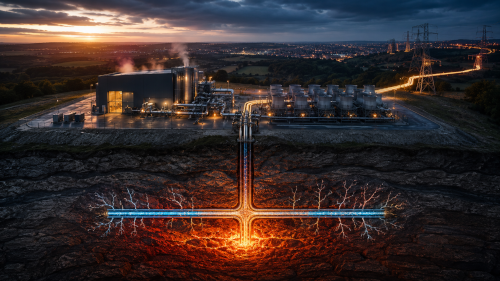
And while Cornwall was celebrating its breakthrough, they’re not alone in wanting to tap into this clean underground baseload power. The U.S. DOE just said it’s shelling out a $14 million grant for Pennsylvania’s first Enhanced Geothermal Systems project in Indiana County, Pennsylvania.
As you might expect from a project in the Marcellus region, it’s located at an existing natural gas well owned by CNX. They’re converting a horizontal shale gas well into a geothermal well.
If this gambit is successful, it’ll become a replicable model that could unlock geothermal potential across the entire eastern United States — thousands of miles from the volcanic hotspots out West where conventional geothermal has been confined for decades.
Remember, it was less than three years ago that a DOE study estimated that enhanced geothermal could account for up to 12% of the nation’s electricity by 2050.
Geothermal is finally getting the attention it deserves.
And now let me show you why…
The Best Free Investment You’ll Ever Make
Our analysts have traveled the world over, dedicated to finding the best and most profitable investments in the global energy markets. All you have to do to join our Energy and Capital investment community is sign up for the daily newsletter below.
The elephant in the room that nobody is talking about right now is the fact that AI data centers need 24/7 baseload power.
Unfortunately, that demand simply cannot be satisfied from intermittent power sources. They need to operate regardless of whether or not the sun is shining or the wind is blowing.
Constant, reliable, around-the-clock electricity.
But at this point, is this really a new revelation?
Not for us.
However, the power demand needed is starting to get all too real — data center demand in the U.S. alone is projected to hit somewhere between 210 terawatt-hours and 1,540 terawatt-hours by 2030.
That’s a massive range, but the direction is clear: Demand is exploding.
Again, solar and wind don’t work for AI training running 24/7.
Of course, you’d also need batteries for multi-day coverage, and the cost at that scale is prohibitive.
Natural gas works (and will play a major role!), but with it comes the constant grips and pressure over the carbon emissions it makes — and every major tech company has net-zero pledges.
Nuclear could work (and a strong option), but you’re looking at 10-plus year timelines and regulatory battles that make drilling look easy by comparison.
But let’s also be clear that Geothermal solves all of it.
Every one of those boxes are checked: 24/7 operations, steady baseload power, and it all comes carbon-free.
That’s also not to mention the fact that the capacity factor is around 90%.
And make no mistake, Big Tech has taken notice… and they have that greedy glint in their eyes.
Recently, Google signed a 115-megawatt Enhanced Geothermal Systems deal with Fervo Energy for Nevada data centers, and then another 150 megawatts of conventional geothermal with Ormat Technologies.
Meanwhile, Meta inked a 150 megawatts deal with Sage Geosystems for a project east of the Rockies — the first major EGS project announced outside the western U.S., as well as another 150 megawatts with XGS Energy in New Mexico.
Keep in mind that these aren’t pilot projects. They’re gigawatt-scale commitments backed by billion-dollar companies that need firm power and can’t wait a decade for nuclear reactors to come online.
The interesting part that few understand is that EGS works because it’s taking a playbook straight out of the shale boom.
You see, EGS uses the same horizontal drilling techniques developed for oil and gas. That’s the same hydraulic fracturing that creates permeability in rock formations, and the same fiber-optic diagnostics to monitor downhole conditions in real time.
That’s how Fervo Energy — the company building the 500-megawatt Cape Station project in Utah — has cut drilling times in half.
Early wells that took around a month to complete now take half that time.
In fact, the DOE’s FORGE research site in Utah demonstrated drilling rates doubling from 8 meters per hour to 15 meters per hour, with peak rates hitting 26 meters per hour.
Today, Fervo’s consistently hitting 30 meters per hour.
Those are shale-level drilling speeds applied to next-gen geothermal technology. And it’s done using the same skill sets and supply chains as companies used during the tight oil and gas boom.
And that’s why EGS is suddenly viable at scale.
Truth is, the oil and gas industry spent the last 15 years perfecting exactly the techniques geothermal needs to go from niche renewable to baseload workhorse.
Politically, geothermal energy is a win-win situation because EGS satisfies everyone.
The environmental crowd gets carbon-free, 24/7 power with no emissions. The all-of-the-above energy development crowd gets a technology built on American oil and gas innovation that creates jobs and delivers reliable baseload electricity.
You probably know just how rare bipartisan support for anything is these days.
Pennsylvania’s $14 million grant to convert a shale gas well into geothermal is proof that everyone’s on board.
Why? Because this isn’t happening in California or Nevada. It’s happening in the Appalachia region — coal and gas country.
By 2050, the DOE puts geothermal potential at more than 90 gigawatts — and this industry is still in its infancy.
Therein lies our opportunity.
The obvious plays that aren’t much of a secret are the pure plays like Fervo Energy.
Right now, they’re positioning for an IPO as they build the Cape Station project — 500 megawatts by 2028, and all of it contracted to Southern California Edison, Shell Energy, Clean Power Alliance, and Google.
First power from the project should come online in the next six months.
So, don’t be surprised that Fervo captures all the headlines.
After all, they ARE the growth story and first-mover in geothermal right now; the company is turning EGS from theory into commercial reality.
And of course… they’ll IPO at a premium valuation because of it.
But here’s what most people are missing: Fervo didn’t invent the technology making EGS viable.
They’re simply applying it.
So, what about the players hiding behind the curtain? You know, the ones that perfected horizontal drilling, hydraulic fracturing, fiber-optic monitoring, and high-temperature completion systems that got us to the point we are today?
Those are the stocks that’ll take EGS to the next level.
And you can bet they’re public, profitable, and still trading at valuations that would make Warren Buffett blush.
They’re the ones supplying the rigs, the drill bits, the downhole tools, the completion systems, and the subsurface expertise that every EGS developer needs.
And still, the market’s still pricing them as pure oil and gas service plays.
That’s the gap we cannot ignore.
Until next time,

Keith Kohl
 Check us out on YouTube!
A true insider in the technology and energy markets, Keith’s research has helped everyday investors capitalize from the rapid adoption of new technology trends and energy transitions. Keith connects with hundreds of thousands of readers as the Managing Editor of Energy & Capital, as well as the investment director of Angel Publishing’s Energy Investor and Technology and Opportunity.
For nearly two decades, Keith has been providing in-depth coverage of the hottest investment trends before they go mainstream — from the shale oil and gas boom in the United States to the red-hot EV revolution currently underway. Keith and his readers have banked hundreds of winning trades on the 5G rollout and on key advancements in robotics and AI technology.
Keith’s keen trading acumen and investment research also extend all the way into the complex biotech sector, where he and his readers take advantage of the newest and most groundbreaking medical therapies being developed by nearly 1,000 biotech companies. His network includes hundreds of experts, from M.D.s and Ph.D.s to lab scientists grinding out the latest medical technology and treatments. You can join his vast investment community and target the most profitable biotech stocks in Keith’s Topline Trader advisory newsletter.


