

It was a gray afternoon on December 20, 1951 in a windswept patch of Idaho desert about 50 miles west of Idaho Falls.
Inside a flat-roofed concrete building called Experimental Breeder Reactor I, a physicist named Walter Zinn watched a row of dials creep upward.
Four 200-watt light bulbs, strung across the wall in a neat little line, flickered, hummed, then burned steady against the dusk light coming through the windows.
For the first time in human history, the bulbs were powered by atoms.
In fact, the whole demonstration produced enough electricity to light those four bulbs — about 800 watts.
By the next afternoon, the reactor was producing 100 kilowatts and powering its own building. Zinn’s crew chalked the date and time on the reactor wall in white block letters and posed for a photograph — four ordinary tungsten filaments lit by the most extraordinary energy source ever built.
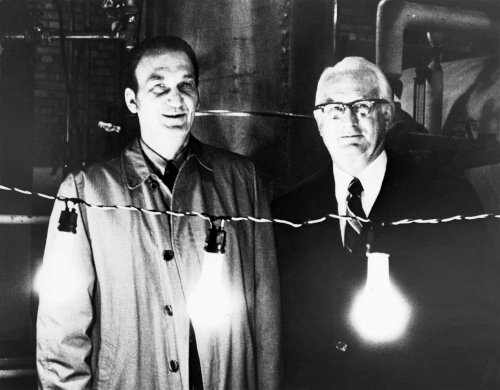
You can actually still visit that wall, because the DoE has preserved it as a National Historic Landmark.
But here’s why I’m telling you about a 75-year-old physics demonstration in a desert most Americans have never heard of…
You see, what those four bulbs accomplished in 1951 — splitting atoms and turning the heat into electricity — is now the only technology on planet Earth that can keep the lights on through the next decade.
The U.S is running out of its cushion for electricity.
While everyone watches the precarious state of energy prices in the wake of the Third Gulf War, a different energy crisis snuck up the back stairs of the American grid.
Data centers.
The Lawrence Berkeley National Laboratory’s most recent forecast — funded by the Department of Energy — pegs U.S. data center electricity consumption at 580 terawatt-hours by 2028.
For the record, that’s roughly 12% of total U.S. electricity demand, which is up from just 4.4% in 2023.
In fact, Bloomberg’s grid analysts now project AI workloads alone will consume more power than 22 million American homes by the end of this decade.
And these aren’t the kind of customers who flip a light switch off when they leave the room.
A modern hyperscale GPU cluster pulls baseload power — 24 hours a day, 365 days a year — at flow rates that would have rivaled a small steel mill in the 1980s.
If a single Nvidia H200 server rack draws around 11 kilowatts at full tilt, then we can multiply that across 100,000 racks at one facility to understand the constant power draw of a mid-sized American city.
The grid simply cannot deliver this from coal (it’s being decommissioned), wind (it’s intermittent), or solar (it sleeps for 12 hours at a time).
Of course, that’s not to mention the fact that our battery capacity is nowhere near the levels to make wind and solar reliable for data center usage.
However, there IS exactly one technology that can… and it just happens to be the same one Walter Zinn switched on 75 years ago.
The Best Free Investment You’ll Ever Make
Our analysts have traveled the world over, dedicated to finding the best and most profitable investments in the global energy markets. All you have to do to join our Energy and Capital investment community is sign up for the daily newsletter below.
Big Tech Has Already Picked Its Side, Have You?
Trust me, the smart money has already figured this out.
They’re just waiting for the herd to catch up.
Back in September of 2024, Microsoft inked a 20-year power purchase agreement with Constellation Energy to restart Three Mile Island Unit 1 — the same site that scared a generation of Americans away from nuclear power in 1979.
The price tag was reportedly more than $100 per megawatt-hour, which is roughly double what wholesale baseload power was trading at in 2023.
Think about that for a second…
Microsoft is paying double on purpose, but it’s also setting itself up for two decades worth of power.
Then Amazon Web Services dropped $650 million to buy Talen Energy’s Cumulus data center campus, which rests right next door to the 2.5-gigawatt Susquehanna nuclear plant in Pennsylvania.
That power purchase agreement is locked in tight.
Google followed in October that year with a deal to buy 500 megawatts of small modular reactor power from Kairos Power.
Larry Ellison personally announced a 1-gigawatt SMR-powered Oracle data center campus on the company’s earnings not long after that.
Do that math with me.
Microsoft + Amazon + Google + Oracle, just on announced deals through May 2026 = roughly 6.4 gigawatts of contracted nuclear power.
That’s the equivalent of six brand-new full-scale reactors — all plugged into AI workloads.
And yet, the United States hasn’t broken ground on a new full-scale reactor in over a decade.
You see the problem now, right?
The Uranium Squeeze The Market Hasn’t Priced In
Here’s the catch nobody on CNBC seems willing to mention.
Every reactor — the restarted ones, the SMRs, the legacy fleet trying to extend its license another 20 years — runs on uranium. Specifically, we’re talking about enriched U3O8 milled from the world’s relatively concentrated uranium mining base.
And you can bet that that base is structurally short.
Kazatomprom, the state-owned giant that controls roughly 43% of global primary uranium mine production, has missed its production guidance for four straight years. Then there’s the sulfuric acid shortages, the permitting delays that have dragged on, and the sanctions-adjacent capital constraints.
Folks, the world’s largest uranium producer simply cannot deliver what it promised.
In Niger — which used to supply close to 25% of the EU’s enriched uranium feedstock — a mining minister has said that no uranium has been sold since the 2023 coup.
And Russia’s enrichment exports to the United States are being phased out under the Prohibiting Russian Uranium Imports Act, signed into law in 2024.
So let’s take a closer look at that math…
- Global reactor demand for U3O8 in 2026: Approximately 195 million pounds.
- Global mine supply in 2026: Approximately 155 million pounds.
- The Gap: 40 million pounds, every single year.
That gap has been bridged for years by secondary supply — strategic stockpile drawdowns, decommissioned weapons material, Russian enriched uranium product.
However, all three of those buckets are running dry at exactly the moment U.S. utilities are signing 20-year power purchase agreements they cannot fulfill without more fuel.
As you might expect, the uranium spot price has already responded.
U3O8 traded under $30 a pound for most of the 2010s, and today it’s hovering near $84. Some forecasters at Bank of America see it pushing past $130 before the end of next year.
But here’s the thing — the equity market has barely caught up.
Trading the Stocks Wall Street Hasn’t Found Yet
Here’s where most analysts will tell you, go buy Cameco or one of the other senior uranium producers the institutional crowd has been circling for two years.
And look — those are fine companies. I think they’ll do just fine in the long run.
But the veteran members of our investment community here know that’s never been how I play a setup like this.
You see, the biggest energy fortunes have never been made by buying the obvious name after the front page of the Wall Street Journal catches up.
They’re made by getting positioned in the small operator nobody is watching — the one sitting on the right asset, with the right timing, at a market cap the institutional herd still considers “too small to bother with.”
That’s exactly where my readers and I spent the better part of a year digging.
Wall Street’s Blind Spot
For 75 years, nuclear power has lived in two extreme states in the American imagination — either the existential threat of Three Mile Island and Fukushima, or the science-fiction promise of unlimited clean energy that always seemed 20 years away.
Both of those framings are now obsolete.
Microsoft, Amazon, Google, and Oracle aren’t waiting another 20 years. They’re paying premium prices today, locking in 20-year contracts today, building infrastructure today.
Why? Well, because they know that the structural electricity demand from AI is real, it’s measurable, and more importantly, it can’t be served by any other technology at the scale and reliability required.
The uranium supply chain is short, and U.S. enrichment capacity is nowhere near sufficient — all while our reactor fleet matures.
New builds are arriving — but slowly. And every quarter this gap persists, the equities tied to nuclear fuel and reactor technology compound the discount the market refuses to fully price.
Walter Zinn’s four light bulbs in that Idaho desert weren’t just a science demonstration.
They were a warning shot from a future that was always going to need more energy than it could conventionally produce.
That future is here.
Until next time,

Keith Kohl
 Check us out on YouTube!
A true insider in the technology and energy markets, Keith’s research has helped everyday investors capitalize from the rapid adoption of new technology trends and energy transitions. Keith connects with hundreds of thousands of readers as the Managing Editor of Energy & Capital, as well as the investment director of Angel Publishing’s Energy Investor and Technology and Opportunity.
For nearly two decades, Keith has been providing in-depth coverage of the hottest investment trends before they go mainstream — from the shale oil and gas boom in the United States to the red-hot EV revolution currently underway. Keith and his readers have banked hundreds of winning trades on the 5G rollout and on key advancements in robotics and AI technology.
Keith’s keen trading acumen and investment research also extend all the way into the complex biotech sector, where he and his readers take advantage of the newest and most groundbreaking medical therapies being developed by nearly 1,000 biotech companies. His network includes hundreds of experts, from M.D.s and Ph.D.s to lab scientists grinding out the latest medical technology and treatments. You can join his vast investment community and target the most profitable biotech stocks in Keith’s Topline Trader advisory newsletter.


