

Sundays are for peace. Mondays are for war.
It’s been the same pattern for weeks now.
Oil markets close Friday afternoon.
Then like clockwork, the headlines shift.
Suddenly, there’s progress in Islamabad, and Iran is reviewing proposals. Meanwhile, Trump’s representatives are having very positive discussions and peace is seemingly around the corner.
Markets then open Monday morning, and the missiles start flying again.
That brings us to this week’s version of this charade… Project Freedom.
When President Trump announced his Project Freedom on Sunday — a “humanitarian mission to guide trapped ships through the Strait of Hormuz” — the herd was fully on board that peace would win the day.
Well, that hope lasted less than 24 hours. 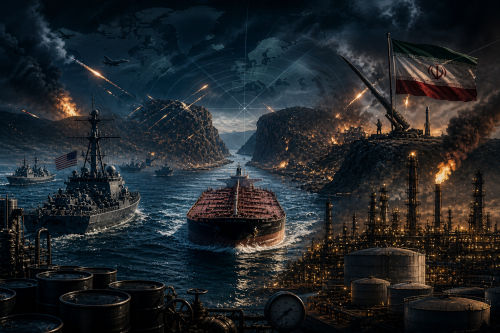
By Monday morning, Iran was raining down missiles once again, this time attacking BOTH ships that were being “escorted” by the U.S. Navy, as well as direct attacks against the UAE’s Fujairah’s oil facility.
So much for the UAE peacefully leaving OPEC, right?
Depending on which news sources you believe, either the U.S. responded by destroying seven Iranian attack boats, or the IRGC took out two U.S. warships.
We’re witnessing an absolute media shitshow, and it’s only making the situation far more dangerous.
Either way, the weekend’s peace evaporated into Monday’s war.
Again.
But here’s the thing nobody wants to admit: none of this matters anymore.
Listen, we’re not approaching some breaking point from which we’ll fall.
Folks, we’ve already jumped headfirst.
This supply crisis is going to take time to rear its ugly head and show us the real fallout.
And yet, the warning signs are already bubbling to the surface — if you know where to look.
Let’s talk about what Project Freedom actually is — and why it changes absolutely nothing.
The plan is for the U.S. Navy to guide trapped commercial vessels OUT of the Strait of Hormuz. We’re talking about those ill-fated ships that have been stuck in the Persian Gulf since the war started in late February.
For the record, that’s hundreds of vessels and thousands of crew members running low on food and supplies.
Sounds reasonable, right?
The Best Free Investment You’ll Ever Make
Our analysts have traveled the world over, dedicated to finding the best and most profitable investments in the global energy markets. All you have to do to join our Energy and Capital investment community is sign up for the daily newsletter below.
You see the problem, don’t you? It’s there, hovering just under the surface.
Project Freedom only escorts ships OUT.
They’re not helping anyone get IN.
Believe me, that’s a huge distinction because it means all the crude oil and refined products that normally flow through the strait — roughly 20% of global oil consumption — stays locked out.
Saudi Arabia’s pumping oil and bypassing the Strait of Hormuz via the east-west pipeline, but only 4 million barrels per day can be exported through Yanbu on the Red Sea.
What about the rest, you ask? If you can’t bypass the Strait, you’re shit out of luck right now.
Unfortunately, Kuwait has been in that exact position for over a month. In fact, April was the first time in 30 years that Kuwait exported ZERO barrels of oil.
Let that digest a little before we go on.
What about the rest? Those exports are tightly shut-in, and Iran is even targeting the facilities that bypass the Strait. The east-west pipeline was hit a few weeks ago, and yesterday the IRGC went after UAE’s Fujairah facility — a key oil terminal.
Pre-war production from the Persian Gulf stood around 21 million barrels per day.
Right now, current flows after rerouting through pipelines are maybe around 9 to 10 million barrels per day if everything’s running perfectly.
That’s 11 to 12 million barrels per day still locked out.
Although it may have sounded like the Strait was ready to open up due to Project Freedom, the bitter truth here is that it doesn’t change that math at all.
Of course, Project Freedom assumes that Iran doesn’t attack every vessel that tries to cross — which they’ve already done!
Yesterday morning, Iran fired four cruise missiles at the UAE. Three were intercepted and one fell into the sea.
At the same time, drones struck the Fujairah oil facility, which sits at the end of the Abu Dhabi pipeline that’s been keeping UAE exports flowing.
Iranian fast boats launched at U.S. vessels escorting two American-flagged merchant ships. In response, the U.S. destroyed up to seven boats using Apache helicopters.
So much for a ceasefire.
But even the basic facts are in dispute — nobody in the media can agree on what actually happened.
That’s the situation we find ourselves in.
The U.S. claims a South Korean cargo ship was struck, yet Iran denied hitting it.
All we know is that SOMEONE hit it.
Meanwhile, CENTCOM claimed two ships successfully transited, which is a tiny step in the right direction. Except, the IRGC reported that nobody passed through.
Who to believe? I’ll let you decide that one.
Either way, Iran’s now in a lose-lose situation.
If they keep attacking, Trump gets his justification to resume a full-scale war.
In that event, then we both know that Kharg Island becomes the priority target. Read into that a little deeper, and you can’t help but ask if ground troops will get involved.
Granted, Iran’s already hemorrhaging oil revenue — exports are down 70% since the U.S. blockade started April 13th.
The thing is, if Iran backs down and lets ships pass freely, the IRGC loses all leverage in any negotiation going forward (yes, I mean actual peace talks!).
Monday proved which path Iran chose, and it appears we’re going to get escalation over capitulation.
And with the recent attack on Fujairah, are we about to enter the next phase of the Third Gulf War?
Now here’s what everyone’s missing…
You see, it doesn’t matter whether Project Freedom works or not.
It certainly doesn’t matter if ships get through or don’t get through — the supply crisis is coming no matter what happens, and we’re finally starting to see it materialize.
Last week’s massive draws reported by the EIA are the first of many that are going to take place.
In fact, they’ll continue regardless of when “true peace” descends.
Why? Because even if a ceasefire holds tomorrow, it’ll take months to clear the strait of mines, then another few months to restore full production from fields that have been shut in since April
Look, nobody can forecast prices or flows from here.
In fact, Goldman’s oil forecast looks dangerous:
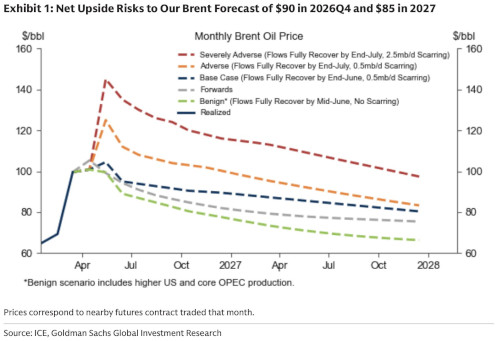
Take a look again, and you’ll see that even the most severe case calls for flows to fully recover by the end of July — that’s looking extremely unlikely given the the time we’ll need to restore flows AFTER an actual peace deal is agreed upon.
Nothing in history resembles what we’re facing, and yet the opportunities are clear.
Right now, U.S. oil companies are printing money.
Exxon and Chevron just reported massive earnings, and Gulf Coast refiners are running flat-out to feed export demand from Europe and Asia.
But what about the next phase?
That’s the real opportunity.
We’re talking about the “what comes next” after the initial chaos settles and this structural shift becomes permanent.
In the coming weeks, we’ll get a jump on the herd and take a look at exactly what it’ll take to get back to normal — and the players patiently wait for their turn.
For now, just remember this…
Sundays may be for peace, and Mondays may be for war, but the real supply crisis doesn’t care which day of the week it is.
P.S. Trump’s Tariff Revenue Is Replacing Income Taxes — Are You Collecting?
Hundreds of billions in tariff revenue are flooding the U.S. Treasury every year — and a portion is already being redirected into quarterly “Tariff Rebate Checks” paying qualifying Americans up to $8,276. The next payout window is approaching fast. Discover how to get positioned before your check goes to someone else.
Until next time,

Keith Kohl
 Check us out on YouTube!
A true insider in the technology and energy markets, Keith’s research has helped everyday investors capitalize from the rapid adoption of new technology trends and energy transitions. Keith connects with hundreds of thousands of readers as the Managing Editor of Energy & Capital, as well as the investment director of Angel Publishing’s Energy Investor and Technology and Opportunity.
For nearly two decades, Keith has been providing in-depth coverage of the hottest investment trends before they go mainstream — from the shale oil and gas boom in the United States to the red-hot EV revolution currently underway. Keith and his readers have banked hundreds of winning trades on the 5G rollout and on key advancements in robotics and AI technology.
Keith’s keen trading acumen and investment research also extend all the way into the complex biotech sector, where he and his readers take advantage of the newest and most groundbreaking medical therapies being developed by nearly 1,000 biotech companies. His network includes hundreds of experts, from M.D.s and Ph.D.s to lab scientists grinding out the latest medical technology and treatments. You can join his vast investment community and target the most profitable biotech stocks in Keith’s Topline Trader advisory newsletter.


