

Can things possibly get worse for Saudi Arabia right now?
Before you answer, just keep in mind where they’re sitting currently.
There’s no question that the House of Saud has absolutely dominated the global oil market since the mid-20th century.
When did they truly take control, you ask? Well, some of you might think it was the successful oil strike in Dammam, where a Texas-like gusher was struck in 1933 and Chevron fumbled $20.6 trillion worth of oil; or perhaps in the early 1970s when the Saudi government snagged a 25% stake Aramco’s oil assets, then increased that stake to 60% a year later.
It wasn’t until 1980 that the Saudis took full control of the company.
You’d even have a sound argument for 1988, when a royal decree issued by King Fahd Bin Abdulaziz Al Saud established Aramco as a full state-owned entity, cementing itself as Saudi Aramco forevermore.
Yes, things have been quite good for the young princes in Saudi Arabia for a long, long time.
So, when the Saudis experienced their terrible, horrible, no good, very bad day last July, it’s hard to imagine the situation getting worse for them.
After all, even at their lowest point in the war, the Saudis always had their backup plan in mind.
The truth is that this emergency plan had been in the works since 1981, when Iran and Iraq were at war and tankers were coming under fire in the Gulf.
At the time, the Saudis did something expensive and a little paranoid. It built a 1,200-kilometer pipeline across the desert to the Red Sea.
Call it their insurance in case the Strait of Hormuz ever closed.
And for 45 years, it sat there like an unused fire escape.
Then the strait effectively closed, and that fire escape started carrying millions of barrels per day west to Yanbu to bypass Hormuz and get their oil out via the Red Sea.
Unfortunately, all it took was a measly $35,000 to shut it all down.
Think about that for a second…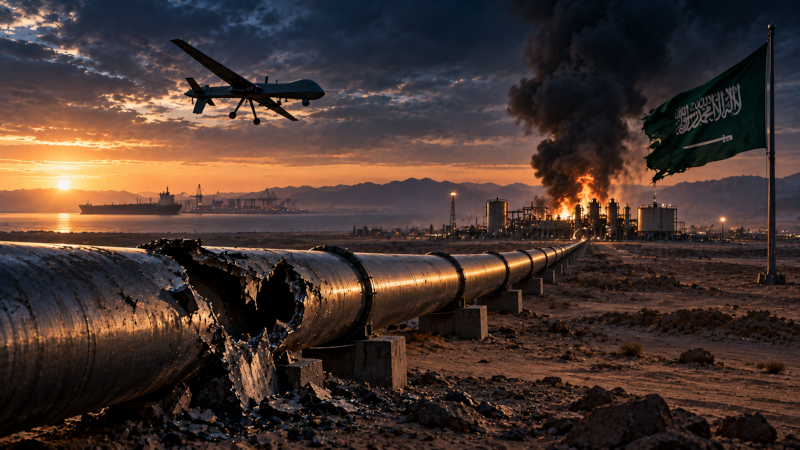
Two weeks ago, the drones launched from Iraq’s Maysan province and struck pumping stations along the line.
Three stations were damaged, and satellite images show extensive fire damage at one. For a little more perspective on that number, it’s roughly 4% of the world’s oil supply that suddenly went offline.
Riyadh expects to restore about half the capacity within days, but a full restart could take up to six weeks.
Just one of those drones comes at a cost of about $35,000, and there’s absolutely nothing stopping another attack, not just on the pipeline again, but also Yanbu itself.
Remember, Yanbu has days of stored crude to draw on, not weeks, and Aramco has already paused some loadings there.
Make no mistake, this war is far from over.
And at the risk of sounding like a broken record: Things can get a lot worse before they get better.
You know as well as I do that actions have consequences.
And those recent attacks are taking their toll on Europe, with Saudi Aramco telling EU buyers that their October term crude isn’t coming.
We’re not talking about restricted exports to EUM countries.
The Best Free Investment You’ll Ever Make
Our analysts have traveled the world over, dedicated to finding the best and most profitable investments in the global energy markets. All you have to do to join our Energy and Capital investment community is sign up for the daily newsletter below.
ALL of it!
Take the two major crude refineries in Poland, operated by Orlen. Those facilities get about 40% of their crude from Saudi Arabia, and was forced to run more than ten tenders in a matter of days to secure 16 replacement cargoes from Norway, Britain, Algeria, Kazakhstan, Azerbaijan and the Americas.
I’m not suggesting that Europe will suddenly run dry of crude. EU members took in about 577,000 barrels a day of Saudi crude in June — a small slice of what that pipeline was moving.
However, those barrels were never a luxury.
Remember, Europe had to walk away from the easy crude supply coming out of Russia, and the Saudi route through the Red Sea and Egypt’s pipeline to the Mediterranean was a key way to replace it.
Another problem is that swapping their Saudi supply for U.S. barrels isn’t exactly a clean fix, either.
From the Gulf Coast, it takes up to three weeks to reach Europe versus about a week from Yanbu. And most of it is light and sweet, while Saudi grades are heavier, the kind many European refineries were built to run.
Europe isn’t the only one in this bidding war.
Aramco sold about 60 million barrels through ship-to-ship transfers off Oman, headed for China, South Korea, India and Japan.
Everyone’s crowding the same shopping aisle.
So what’s cushioning the blow? Actually, not much.
Here’s where the shock absorbers stand:
- The U.S. emergency reserve holds 285 million barrels, the lowest since 1982, and the emergency release is over.
- Global inventories are down roughly 400 million barrels this year.
- Saudi supply fell to about 6.2 million barrels a day in August, the lowest in more than three decades.
- The government’s own forecast has Middle East output staying below pre-conflict levels until the second quarter of 2027
Let’s face it, that doesn’t sound like a market with room to spare.
Given the narrative war being waged across social media, it seems that nobody can tell you which way this’ll break.
Washington’s energy secretary says the outage will be measured in days (spoiler: It won’t), and analysts say weeks.
Meanwhile, Brent settled at $108.75 last Tuesday and has since drifted back toward $102, with diesel topping $6 a gallon nationally for the first time ever.
Trust me, when the experts can’t agree on whether this is a bad week or a bad winter, the market isn’t about to settle down.
The real question you need to answer is where our next barrels will come from, because this conflict is far from over?
Although plenty of people are pointing at Venezuela, I wouldn’t hold my breath.
I know Chevron has committed more than $7 billion to double its output there over the next five years, from about 280,000 to 600,000 barrels a day.
However, the country produces about 1.25 million barrels a day, which is down from more than 3 million two decades ago.
Even the friendliest coverage of the mess PDVSA has made in Venezuela will admit it won’t replace Gulf crude.
Granted, five years is a long time to wait when the pipeline needs six weeks.
The market is blind to that lengthy timeline.
Meanwhile, U.S. crude output has grown to about 13.8 million barrels a day in June, above last year’s record average of 13.7 million, as we exported 4.7 million barrels a day abroad.
But look closer at the growth.
That means our domestic output rose just 300,000 barrels a day in 2024 and 400,000 barrels a day in 2025.
This year we’re barely ahead of that pace.
It may sound like much needed growth during a global supply crisis, but it’s far from the boom years we’ve seen in the past.
When growth is modest, stability in the tight oil plays is the whole ballgame.
And you can bet that any stumble in the shale patch would hurt more than another Houthi strike in the Middle East.
Stay tuned.
Until next time,

Keith Kohl
 Check us out on YouTube!
A true insider in the technology and energy markets, Keith’s research has helped everyday investors capitalize from the rapid adoption of new technology trends and energy transitions. Keith connects with hundreds of thousands of readers as the Managing Editor of Energy & Capital, as well as the investment director of Angel Publishing’s Energy Investor and Technology and Opportunity.
For nearly two decades, Keith has been providing in-depth coverage of the hottest investment trends before they go mainstream — from the shale oil and gas boom in the United States to the red-hot EV revolution currently underway. Keith and his readers have banked hundreds of winning trades on the 5G rollout and on key advancements in robotics and AI technology.
Keith’s keen trading acumen and investment research also extend all the way into the complex biotech sector, where he and his readers take advantage of the newest and most groundbreaking medical therapies being developed by nearly 1,000 biotech companies. His network includes hundreds of experts, from M.D.s and Ph.D.s to lab scientists grinding out the latest medical technology and treatments. You can join his vast investment community and target the most profitable biotech stocks in Keith’s Topline Trader advisory newsletter.


