

The story of strategic minerals is a long, deep trip into history.
At any time or any place, chances are you’ll find a war over critical resources.
Back in 1940, Portugal found itself sitting on something both Hitler and Churchill desperately sought. It’s not a hyperbole to suggest that without it, the second World War could’ve swung in either direction.
And there’s a good chance you’ve never heard of it before: Wolframite.
This was simply the ore of tungsten, which changes everything.
Look, tungsten doesn’t get much attention today unless you’re a machinist or a defense contractor.
However, 80 years ago it was THE ONLY material hard enough to machine hardened steel at scale.
This was the stuff that turned raw metal into tank armor and armor-piercing shells.
Back then, it meant surrender.
In fact, wolfram was so sought after that Portugal exported 3,709 tons of it in 1940 alone.
Within three years, prices climbed roughly 775%!
Yet, the price spike wasn’t because the supply side of the equation collapsed, but rather because the U.S. and Britain were buying it up hand-over-fist.
It wasn’t enough that the Allies needed it, they also needed the Germans to not have it.
In other words, we weren’t stockpiling tungsten for ourselves. More important was the fact that we were outbidding the Nazis purely to starve them of it.
We don’t need an economist on-hand to know an entire regional economy sprang up almost overnight — somewhere between 80,000 and 90,000 Portuguese were pulled into wildcat mining at the peak of the wolfram fever.
Things got to the point that Portugal’s Prime Minister, António de Oliveira Salazar, finally banned wolfram exports to Axis countries in June 1944.
Of course, the lesson was already learned by then.
All it took was one strategic resource fought over by two global superpowers with a war strategy bent around who controlled the ore.
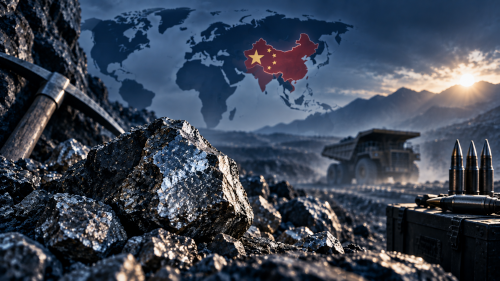
Today, just swap Lisbon for Beijing and you’ll find the metal hasn’t changed a bit.
The New Wolfram Fever
The interesting part about the scramble for tungsten in 2026 is that it never actually went away as a strategic chokepoint.
We just stopped paying attention to it.
Right now, China controls somewhere around 80% of global tungsten mine production. But things get worse when you also realize that it controls close to 85% of ammonium paratungstate (APT) refining capacity, which is the intermediate step that turns raw ore into something industry can actually use.
Remember, mining ore is one thing, but monopolizing the world’s refining capabilities is an entirely different beast altogether.
And make no mistake, Beijing owns both ends of this situation.
Then late last year, China replaced its old quota system with something tighter: A whitelist.
What this meant was that only 15 state-designated companies would be legally permitted to export tungsten products under a 2026–2027 framework.
The Best Free Investment You’ll Ever Make
Our analysts have traveled the world over, dedicated to finding the best and most profitable investments in the global energy markets. All you have to do to join our Energy and Capital investment community is sign up for the daily newsletter below.
We’ve moved past tariff wars and taxes, dear reader. This is a pure, state-issued permission slip given to a handful of exporters.
You can guess what happened to prices.
So far, international tungsten prices have surged somewhere between 550% and 666% since early 2025, depending on which product line you’re tracking.
And you know as well as I do that there’s no ceiling when a market loses its price-discovery mechanism. It means that global supply is rationed out by the good graces of President Xi.
If you don’t like… oh well.
Don’t get me wrong, the demand side isn’t exactly standing still either.
Three sectors are leaning on tungsten harder than they were even two years ago:
- Defense — armor-piercing rounds, missile components, turbine hardware. Military tungsten demand alone is projected to climb roughly 12% in 2026 as global conflict spending rises.
- Aerospace — high-temperature, high-wear components that simply don’t have a substitute material.
- Semiconductors — tungsten interconnects, a niche most people never think about until the chip doesn’t get made.
Not surprisingly, we’re starting to see Washington start to move our pieces on the board.
Two months ago, the administration delegated Defense Production Act authority over recoverable critical minerals straight to the Commerce Department, which was aimed at keeping scrap tungsten from leaving the country at all.
Trust me, that’s not a small decision.
You can bet there’s a catch in this story.
It turns out that the U.S. hasn’t mined a single ton of tungsten domestically since 2015.
Zero.
And that dearth in tungsten output has lasted for more than a decade, all while we’ve been sitting on a critical dependence for 80% of our imports.
This is no longer a China problem, and there’s one huge gap just waiting for someone to take advantage of it.
The Critically Profitable Gap in Strategic Minerals
Although it’s not easy to trade geopolitics, you can see where this is going.
Actually, President Trump has already made his move.
The veteran members of our investment community remember when Trump launched Project Vault, the first-ever civilian strategic minerals reserve, modeled directly on the old Strategic Petroleum Reserve.
In other words, the Defense Production Act is now being invoked to fund domestic production directly, issue purchase guarantees, and put federal lands to work for domestic mining.
It doesn’t matter which strategic mineral you’re looking at, whether it’s lithium, antimony, tungsten, or rare earths.
Now, the pattern is starting to emerge.
You see, the Pentagon didn’t just talk the talk when it came to our dependence on rare earths. Our government became a direct equity holder in a domestic miner.
If you recall, Guardian Metal picked up a Title III investment to push tungsten production forward for the first time in over a decade, while Perpetua Resources is reopening Idaho’s old Stibnite mine after China cut off antimony exports.
We’ve watched this exact setup play out before, and you can bet a small handful of players are still flying under Wall Street’s radar.
Tungsten is just the latest domino, but you can sure as hell bet it won’t be the last.
Until next time,

Keith Kohl
 Check us out on YouTube!
A true insider in the technology and energy markets, Keith’s research has helped everyday investors capitalize from the rapid adoption of new technology trends and energy transitions. Keith connects with hundreds of thousands of readers as the Managing Editor of Energy & Capital, as well as the investment director of Angel Publishing’s Energy Investor and Technology and Opportunity.
For nearly two decades, Keith has been providing in-depth coverage of the hottest investment trends before they go mainstream — from the shale oil and gas boom in the United States to the red-hot EV revolution currently underway. Keith and his readers have banked hundreds of winning trades on the 5G rollout and on key advancements in robotics and AI technology.
Keith’s keen trading acumen and investment research also extend all the way into the complex biotech sector, where he and his readers take advantage of the newest and most groundbreaking medical therapies being developed by nearly 1,000 biotech companies. His network includes hundreds of experts, from M.D.s and Ph.D.s to lab scientists grinding out the latest medical technology and treatments. You can join his vast investment community and target the most profitable biotech stocks in Keith’s Topline Trader advisory newsletter.


