

In 1946, President Harry Truman quietly offered Denmark $100 million in gold for the entire island of Greenland.
For a little perspective, that’s roughly $1.7 billion in today’s dollars.
And remember, we’re talking about gold, not flimsy paper with dead presidents on the front.
It was a serious offer, to be sure. President Truman and all of his Joint Chiefs of Staff had agreed that in this deal, money was no object.
Denmark’s foreign minister flatly turned him down almost immediately.
The little-known line that escaped his lips at the time was, “I do not feel that we owe them the whole island of Greenland.”
But again, this offer was kept secret for more than 45 years until it finally broke in a Danish newspaper in 1991, long after the documents had been declassified and quietly forgotten.
Folks, President Trump isn’t the first of our leaders to want Greenland.
He’s actually the third.
And you know what?
Once he receives the same reply from the Danish, it’ll make his next move even more consequential to the future of U.S. security.
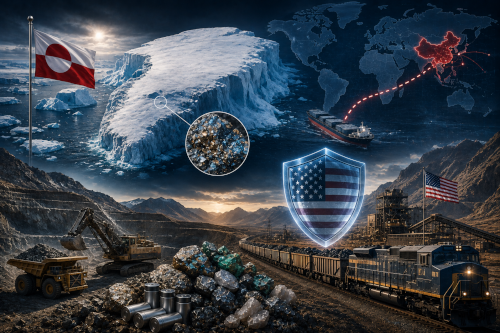
Let me tell you what’s driving the renewed interest in President Trump’s quest to own Greenland, and I’ll tell you right now it’s got nothing to do with real estate.
Trump’s eyes are fixed on what’s below the surface.
After all, Greenland ranks eighth in the world for rare earth reserves. That’s roughly 1.5 million proven tons, with some estimates running as high as 36 million tons once further exploration is factored in.
It’s also home to two of the largest rare earth deposits anywhere on Earth: Kvanefjeld and Tanbreez.
And unlike most of the geopolitical noise around this story, real money is already flowing.
Just last week, Greenland’s government formally approved a license transfer clearing a key regulatory hurdle for Greenland Mines’s Sarfartoq project.
Just days later, an independent valuation came back on that same project estimating that it was worth up to $2.05 billion, with a pre-tax internal rate of return north of 118%.
We’ve moved beyond mere speculation and on to hard value attached to real-time drilling data.
You can bet the market noticed the political rhetoric too, after President Trump revived his talk of acquiring Greenland outright. Right away, shares of Critical Metals Corp. (the guys developing the Tanbreez project) jumped about 25% in a single session.
The Best Free Investment You’ll Ever Make
Our analysts have traveled the world over, dedicated to finding the best and most profitable investments in the global energy markets. All you have to do to join our Energy and Capital investment community is sign up for the daily newsletter below.
That wasn’t a solitary phenomenon, either. Energy Transition Minerals, which owns Kvanefjeld, climbed more than 30% during trading.
However, here’s where we need to separate fact from hype, because you may not realize how difficult it is to mine in Greenland.
Keep in mind that only about 20% of the island is even ice-free, and that temperatures can drop below -40 degrees Fahrenheit.
Then, even if you get the ore out of the ground, there’s a familiar problem waiting on the other end — most experts agree that material would likely still need to be shipped to China for processing.
This is the exact midstream bottleneck we’ve talked about extensively this year with rare earth magnets and other critical minerals.
Of course, there’s also a China angle sitting quietly on the side that’s worth noting.
It involves a Chinese company named Shenghe Resources, which holds a stake in the firm that owns the Kvanefjeld deposit.
Yes, that’s the same kind of backdoor exposure we’ve flagged before — Washington trying to build independence from China while China still has control of the supply side of the equation.
Even the geology itself works against the speedy timeline.
The problem is that carbonatite deposits like Kvanefjeld and Tanbreez tend to carry a wider mix of rare earth elements than some deposits elsewhere, which sounds like an advantage until you realize it also means more complex, more expensive separation and processing work before any of it becomes usable material.
Now, none of this is reason enough to write Greenland off, but it’s a reason to understand the timeline that’s in play, rather than getting swept up in the political theater engulfing it.
It also brings us back to President Trump’s not-so-secret desire to “buy Greenland,” and why this headline may be more of a red herring.
You see, the real story is what’s been building underneath this narrative all year.
The veteran members of our investment community can go beyond this noise and see the sustained, accelerating campaign to build critical minerals independence right here on American soil.
We’ve seen wave after wave of it, including a multi-billion-dollar strategic minerals stockpile, an executive order tightening the waivers that let defense contractors keep sourcing from China, and an export ban locking domestic scrap material inside U.S. borders.
This is also on top of a single Friday roundtable that recently produced more than $2 billion in fresh domestic commitments across half a dozen different materials.
Greenland fits into that picture as one interesting, early-stage piece of a much bigger map — not the headline, mind you, and certainly not the whole story.
The ice, the cold, the processing gap, and the Chinese ownership stake sitting inside one of its two biggest projects all mean Greenland is a longer, harder path than most of what’s happening domestically right now.
Compare that to a mine in Nevada or Wyoming that’s already permitted, already funded, and already producing.
One of those paths involves shipping equipment across the Arctic Circle, and the other one involves a truck and a highway.
I’ll let you figure out which one is preferable.
That’s the actual playbook at play.
But that’s a longer horizon story, layered on top of a resource story that’s still years away from meaningful production.
The immediate opportunity is sitting inside America’s own borders, where permits are moving faster than they have in decades and the checks are already being written.
What Washington is gunning for today is under its own feet — and that story doesn’t need a single headline about buying an island to keep moving forward.
But hey, don’t take my word for it, you should see these details for yourself right here.
Until next time,

Keith Kohl
 Check us out on YouTube!
A true insider in the technology and energy markets, Keith’s research has helped everyday investors capitalize from the rapid adoption of new technology trends and energy transitions. Keith connects with hundreds of thousands of readers as the Managing Editor of Energy & Capital, as well as the investment director of Angel Publishing’s Energy Investor and Technology and Opportunity.
For nearly two decades, Keith has been providing in-depth coverage of the hottest investment trends before they go mainstream — from the shale oil and gas boom in the United States to the red-hot EV revolution currently underway. Keith and his readers have banked hundreds of winning trades on the 5G rollout and on key advancements in robotics and AI technology.
Keith’s keen trading acumen and investment research also extend all the way into the complex biotech sector, where he and his readers take advantage of the newest and most groundbreaking medical therapies being developed by nearly 1,000 biotech companies. His network includes hundreds of experts, from M.D.s and Ph.D.s to lab scientists grinding out the latest medical technology and treatments. You can join his vast investment community and target the most profitable biotech stocks in Keith’s Topline Trader advisory newsletter.


