

Oh to live on copper mountain, with the barkers and the colored balloons.
We often get caught up in resource dominance today, whether it’s China’s unerring control over rare earths or the fact that six out of every 10 barrels of oil pumped out of the ground in the United States comes from tight oil basins.
But the truth is that we’ve seen this throughout history.
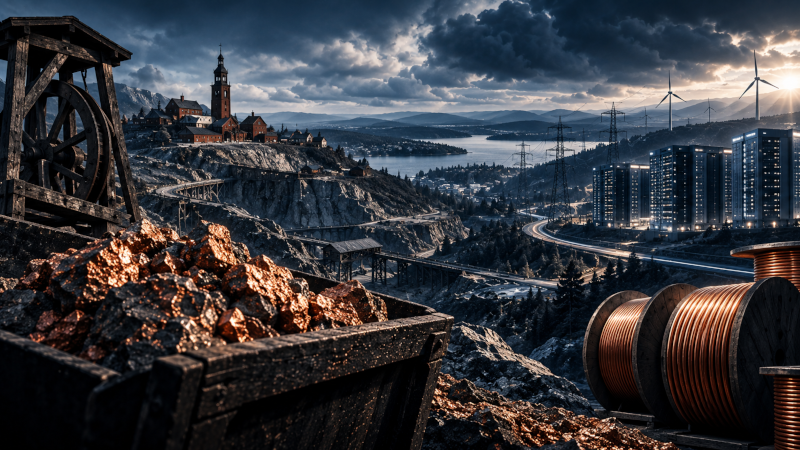
Nowhere is this more apparent than in the story of the Stora Kopparberget, or the Great Copper Mine.
For a thousand years, this single Swedish mountain supplied as much as two-thirds of Europe’s copper.
Bought and paid for by Sweden’s wars, the copper extracted from the Falun mine contained within the Stora Kopparberget funded the country’s rise into a genuine European power.
The company chartered to run the thing back in 1347 is generally considered the oldest corporation on Earth.
Its peak came in the mid-17th century as copper production reached a little over 3,000 metric annually.
Then, that output started thinning out and production slid. So the company survived by pivoting into iron and timber, and somebody discovered gold there in 1881 and sparked a brief rush that essentially went nowhere.
On December 8, 1992, they fired the last blast and closed the mine forever.
Now think about this…
At its peak, one of the world’s biggest copper mines in history only produced what we burn through in an hour today.
Let that sink in for a moment, because nobody standing in Falun in 1650 thought they were mining something finite.
They thought they were mining the thing.
And that’s about where the copper market has been standing for the last ten years.
Let’s dig into that just a little deeper, shall we?
If I asked you how many major copper discoveries have been made since 2020, what would you think?
Twenty? Thirty? Maybe 50?
Well, the answer is a depressing SIX, totaling about 8.8 million metric tons.
For a little context, the world consumed somewhere around 27 million metric tons of refined copper last year alone.
That means that half a decade of global discovery doesn’t even cover four months of demand.
And believe me, it’s not because companies are spending cash looking for this vital resource.
In fact, copper exploration budgets actually climbed to roughly $3.3 billion in 2025.
The money is there, it’s just being spent in the wrong place.
Of course, by that I mean grassroots exploration. You know, the speculative stuff that involves drilling into unproven ground where nobody’s ever found anything before — that activity fell to just 21% of global capital budgets last year.
This is the lowest share we’ve seen to date.
Meanwhile, mine site exploration accounts for nearly half of all spending, which is at an all-time high.
To compare, grassroots exploration back in the 1990s and early 2000s ran somewhere between 50% and 60% of a miner’s budget.
It’s official, the industry has flipped its own strategy completely on its head.
Honestly, we can understand why.
The Best Free Investment You’ll Ever Make
Our analysts have traveled the world over, dedicated to finding the best and most profitable investments in the global energy markets. All you have to do to join our Energy and Capital investment community is sign up for the daily newsletter below.
After all, drilling around a mine you already own is safer and cheaper. It can also reliably add metric tons to your reported resource base, and the investment herd will reward you on your next earnings call.
Drilling a hole in the middle of nowhere usually just produces an expensive hole in the middle of nowhere.
The problem is that extending a deposit you already have isn’t the same as building a new mine.
Now look at where the “new” copper has actually been coming from.
Most of the tonnage that was added to global resources over the past several years came out of deposits found back in the 1990s, with the largest single deposit driving growth today having been discovered in 2000.
Again, that was 26 years ago.
Is copper’s doomsday clock ticking?
I’ll let you decide that for yourself, but I can’t help but remind you that a new copper mine takes somewhere between 15 and 20 years to go from discovery hole to actual production.
At that pace, the deposits that are SUPPOSED to supply the world in 2040 need to be found already.
They weren’t.
In fact, primary mine output is expected to peak somewhere around 2030, and then start rolling over after that.
Don’t get me wrong, I’m not suggesting that we’re running out of copper underground. There’s plenty beneath the surface, according to USGS figures, which reported more than tens of millions of metric tons of identified resources inside U.S. borders alone.
As you can start to see, the problem isn’t in the geology, it’s the pipeline that brings tomorrow’s copper to market.
And it’s these warning signals, dear reader, that provide us with an interesting opportunity.
Let’s flip things around and look at the demand side of the equation, because this is what turns a dismal supply forecast into a full-blown resource crisis.
S&P Global put out a study earlier this year projecting copper demand hitting 42 million metric tons by 2040.
For the record, that’s about a 50% increase from where we are right now.
Now add in the projections of production peaking at 33 million metric tons in 2030, and you get a gap somewhere in the neighborhood of 10 million metric tons.
That’s only about one-quarter of what the world actually needs.
And that’s after assuming recycled scrap more than doubles supply!
Where’s the driver, you ask?
Well, it’s everything, all at once.
We’re looking at a dire need to build out our grid, the electrification of everything under the sun. We’ve got EV growth, as well as two huge factors that are building a crazy amount of momentum right now — AI data centers and an upcoming global rearmament cycle.
Truth is, grid demand for copper tied to data centers alone is projected to run about 1.1 million metric tons a year by 2030.
Meeting that demand would take roughly 8 million metric tons of new mine capacity and north of $210 billion in investment.
The industry’s investment simply isn’t cutting it right now, with total capital deployed into copper mining over the past six years coming closer to $76 billion.
That means new copper investment is being underfunded by a factor of 3x.
Tick-tock goes copper’s doomsday clock.
As we should expect, prices are already reacting and are up roughly 46% from a year ago.
Didn’t we just see copper prices briefly punched above $14,500 per metric ton back in January?
Meanwhile, treatment charges (think of what smelters earn for turning concentrate into metal) collapsed to essentially nothing this year, which is exactly what you’d expect when there isn’t enough concentrate to go around.
Look, every great deposit in history felt like a permanent wealth machine right up until the day it wasn’t.
The copper from Stora Kopparberget didn’t vanish overnight. Things slowly wound down until somebody realized the situation.
The interesting question over the next ten years isn’t whether copper gets tight.
That matter has already been settled.
No, the real question is which miners are sitting on quality ore in stable jurisdictions; the ones capable of making the handful of genuine new discoveries make it into production before 2030 shows up.
That’s a much shorter list than most investors realize.
Stay tuned.
Until next time,

Keith Kohl
 Check us out on YouTube!
A true insider in the technology and energy markets, Keith’s research has helped everyday investors capitalize from the rapid adoption of new technology trends and energy transitions. Keith connects with hundreds of thousands of readers as the Managing Editor of Energy & Capital, as well as the investment director of Angel Publishing’s Energy Investor and Technology and Opportunity.
For nearly two decades, Keith has been providing in-depth coverage of the hottest investment trends before they go mainstream — from the shale oil and gas boom in the United States to the red-hot EV revolution currently underway. Keith and his readers have banked hundreds of winning trades on the 5G rollout and on key advancements in robotics and AI technology.
Keith’s keen trading acumen and investment research also extend all the way into the complex biotech sector, where he and his readers take advantage of the newest and most groundbreaking medical therapies being developed by nearly 1,000 biotech companies. His network includes hundreds of experts, from M.D.s and Ph.D.s to lab scientists grinding out the latest medical technology and treatments. You can join his vast investment community and target the most profitable biotech stocks in Keith’s Topline Trader advisory newsletter.
P.S. Why Are Gold’s Biggest Miners in Panic-Buying Mode?
The world’s biggest gold miners are paying huge premiums to acquire junior companies because they’re running out of new discoveries to replace depleted reserves. With another wave of acquisitions likely ahead, 10 overlooked gold stocks could be next in line — offering investors a chance to get in before the buyout headlines hit.


