
Last updated: November 17, 2026 | By Keith Kohl, Managing Editor, Energy and Capital
What is geothermal investing? Geothermal investing means buying shares of companies that make electricity from the earth’s heat: the operators that own geothermal power plants, the developers drilling a new generation of “enhanced” geothermal wells, and the drilling and equipment companies that build them.
Geothermal supplies only about 0.4% of America’s electricity today. But it runs around the clock, and that’s exactly what AI data centers need. Google and Meta have signed deals for hundreds of megawatts of new geothermal power, Fervo Energy went public in May 2026 and switched on the world’s first commercial enhanced geothermal plant in September, and Washington kept geothermal’s tax credits in place through 2033 even as it cut them for wind and solar.
What Is Geothermal Energy?
The deeper you drill, the hotter it gets. Geothermal power plants bring that heat to the surface as hot water or steam and use it to spin a turbine, just like a coal or gas plant, but without burning any fuel. Because the earth’s heat never switches off, a geothermal plant can run day and night in any weather. That makes it “firm” power, the same kind of always-on supply that nuclear and natural gas plants provide.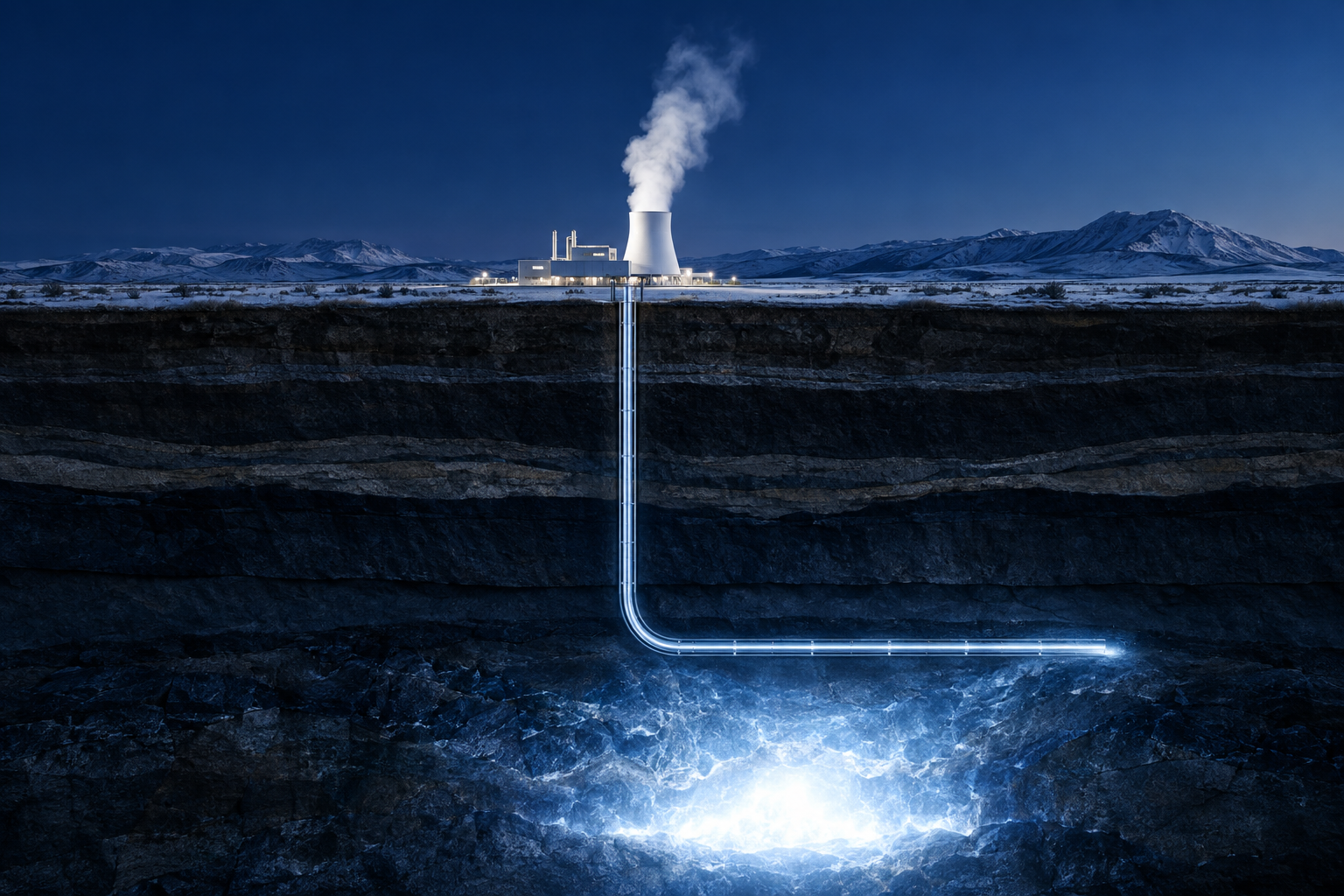
Until recently, geothermal only worked in the rare places where hot water sat close to the surface. That’s why nearly all U.S. geothermal power comes from California and Nevada. The new wave of geothermal changes that by borrowing the horizontal drilling and fracking techniques that unlocked the shale boom. There are four main types:
| Type | How it works | Where it works | Who’s doing it |
|---|---|---|---|
| Conventional (hydrothermal) | Taps natural reservoirs of hot water or steam and runs it through a turbine. | Only where heat, water and permeable rock occur together, mostly in California and Nevada. | Ormat, Constellation (The Geysers) |
| Enhanced geothermal systems (EGS) | Drills into hot, dry rock, fractures it with oilfield techniques and circulates water through it to bring heat to the surface. | Far more places, wherever hot rock can be reached by drilling. | Fervo, Ormat, Sage Geosystems |
| Closed-loop (advanced) geothermal | Circulates fluid through sealed underground pipes, like a radiator in the rock, with no fracturing. | Wherever deep rock is hot enough. | XGS Energy, Eavor |
| Superhot rock | Drills to rock above about 300°C (572°F), where each well can produce far more power. | Very deep wells almost anywhere, but the technology is still experimental. | Quaise Energy |
Why Geothermal Is in Focus: Where Things Stand (November 2026)
AI data centers need power that never shuts off
Tech companies building AI data centers need electricity 24 hours a day, and they want it to be carbon-free. Wind and solar can’t deliver that on their own. Geothermal can, which is why Big Tech has become its biggest new customer:
- Google signed a 15-year, 396-megawatt power purchase agreement with Fervo Energy for a project at Cape Station in Utah, with an option to expand it to nearly 1 gigawatt. In February 2026, Google also signed a deal with Ormat for up to 150 MW of new geothermal power in Nevada through NV Energy’s Clean Transition Tariff program.
- Meta has lined up 150 MW from Sage Geosystems and another 150 MW from XGS Energy in New Mexico.
The shale playbook is driving costs down
Enhanced geothermal uses the same tools as the shale oil boom: long horizontal wells, hydraulic fracturing and fiber-optic sensing. And just like in shale, costs are falling with every well. Fervo says the first phase of Cape Station cost about $7,000 per kilowatt to build, its Google project targets $5,500 per kilowatt, and its long-term goal is $3,000. An independent study raised Cape Station’s estimated potential to about 8.4 gigawatts, up from 4.3 GW.
Much of that progress traces back to FORGE, the Department of Energy’s field lab in Milford, Utah, which has tested enhanced geothermal drilling since 2019 and shared its data publicly. Fervo built Cape Station right next door.
The Best Free Investment You’ll Ever Make
Our analysts have traveled the world over, dedicated to finding the best and most profitable investments in the global energy markets. All you have to do to join our Energy and Capital investment community is sign up for the daily newsletter below.
Washington kept geothermal’s tax credits
The One Big Beautiful Bill Act, signed in July 2025, cut tax credits for wind and solar projects. But geothermal kept its full investment and production tax credits for projects that begin construction by the end of 2033, with the credits phasing down after that. Geothermal also has bipartisan support, in part because it relies on the oil and gas industry’s drilling skills and workforce.
Fervo’s IPO put geothermal on Wall Street’s radar
Fervo Energy went public on the Nasdaq on May 13, 2026, under the ticker FRVO. It priced its shares at $27, above its expected range, and raised $1.89 billion. Cape Station’s first 33-megawatt block began commercial operation on September 30, and Fervo expects the rest of the roughly 100 MW first phase to follow by January 1, 2027. By the end of the third quarter, Fervo had 1,054 MW of binding power contracts worth about $11.9 billion in revenue.
Geothermal by the Numbers
- U.S. capacity: about 3,950 MW at the end of 2025, the most of any country, according to ThinkGeoEnergy.
- Global capacity: about 17,170 MW at the end of 2025, in 35 countries.
- Share of U.S. electricity: about 0.4%.
- Where it’s generated: California produced about 69% of U.S. geothermal electricity in 2025 and Nevada about 25%, according to the EIA.
- Room to grow: The Department of Energy sees potential for at least 90 GW of U.S. geothermal capacity by 2050, more than 20 times today’s level.
How to Invest in Geothermal Energy
There are only a handful of ways to buy geothermal directly, so many investors also look at the companies that supply the drilling and equipment. Here are the main publicly traded options:
| Company (ticker) | Geothermal role | What to know |
|---|---|---|
| Ormat Technologies (NYSE: ORA) | Leading U.S.-listed geothermal operator; builds its own power plants | Owns and runs plants in the U.S. and abroad, plus a fast-growing battery storage business; expanding into enhanced geothermal |
| Fervo Energy (Nasdaq: FRVO) | Enhanced geothermal developer | Went public in May 2026; Cape Station in Utah began commercial operation September 30, 2026 |
| Constellation Energy (Nasdaq: CEG) | Owns The Geysers in California, the world’s largest geothermal complex | Geothermal is a small piece of a large nuclear and natural gas fleet |
| Baker Hughes (Nasdaq: BKR) | Drilling, subsurface and power equipment for geothermal | Partnered with Helmerich & Payne on geothermal drilling in May 2026 |
| Halliburton (NYSE: HAL) | Drilling, completion and well services for geothermal wells | Adapting oilfield technology for high-temperature geothermal wells |
| Helmerich & Payne (NYSE: HP) | Supplies geothermal-capable land drilling rigs | Teamed with Baker Hughes to support U.S. geothermal projects |
Geothermal operators and developers
Ormat Technologies has been in the geothermal business for about six decades and is the closest thing to a pure-play geothermal stock. Its third-quarter 2026 revenue rose 10.2% to $275.1 million, mostly thanks to its energy storage business, and it raised the midpoint of its 2026 guidance. It also expanded its estimate of its enhanced geothermal pipeline to 5 to 6 GW and invested $25 million in Sage Geosystems.
Fervo Energy is a bet on enhanced geothermal itself. It has a big contract backlog and $1.9 billion in cash, but it reported just $116,000 in revenue in the third quarter because its first plant only recently started up. Its first full quarter of Cape Station revenue will be the fourth quarter of 2026.
Drilling and services companies
Every geothermal project starts with a drill rig. Oilfield service companies like Baker Hughes, Halliburton and Helmerich & Payne already supply the rigs, equipment and expertise that enhanced geothermal depends on. Geothermal is still a small part of their business, but it gives them a new market for the same skills they built in shale.
Private companies to watch
Several of the most closely watched geothermal companies are still private, including Sage Geosystems, XGS Energy, Quaise Energy, Zanskar and Eavor. Most investors can’t buy them directly, but their deals and test results move the whole sector, and Fervo’s IPO showed that the public market is open to geothermal companies.
Funds
Few funds focus only on geothermal. Geothermal stocks usually show up as a small part of broader clean energy or infrastructure funds, so check a fund’s holdings before assuming it gives you meaningful geothermal exposure.
How to Evaluate a Geothermal Stock
- Is it producing power yet? Separate companies with operating plants and steady revenue from those still drilling their first wells.
- Who is buying the power? Long-term contracts with creditworthy buyers such as utilities and big tech companies make future revenue more predictable.
- Are drilling costs falling? Track cost per kilowatt and drilling times from one project to the next.
- How big is the resource? Look at independent estimates of how much power a site can support, not just company claims.
- How is it funded? Geothermal plants are expensive up front, so check cash, debt and how much more capital a company will need.
Risks of Investing in Geothermal
- Early-stage technology. Enhanced and superhot geothermal are only now moving from pilots to commercial plants. Wells can underperform and projects can slip.
- High up-front costs. Drilling is expensive, and much of the money is spent before a plant earns a dollar.
- Little revenue at newer companies. Developers like Fervo trade on future growth, so their shares can swing sharply on project news.
- Weak spots in the existing business. Ormat’s geothermal electricity revenue slipped in the third quarter of 2026 after a hurricane-related outage at its Puna plant in Hawaii, and the company lowered its electricity revenue guidance.
- Permitting and local opposition. Many projects sit on federal land and need federal permits, and fracturing rock can raise concerns about small earthquakes.
- Policy risk. Geothermal’s tax credits begin phasing down for projects that start construction after 2033, and future laws could change them.
Geothermal Investing FAQ
What is geothermal energy?
Geothermal energy is heat from inside the earth. Power plants bring that heat to the surface as hot water or steam and use it to spin turbines that make electricity, without burning fuel.
Is geothermal energy a good investment?
Geothermal offers around-the-clock clean power, strong demand from data centers and federal tax credits through 2033. But much of the sector is early-stage, drilling is expensive and some companies have little revenue yet. Whether it fits your portfolio depends on your goals and risk tolerance.
What are the main geothermal stocks?
The most direct publicly traded geothermal companies are Ormat Technologies (ORA) and Fervo Energy (FRVO). Constellation Energy (CEG) owns The Geysers in California. Oilfield service companies such as Baker Hughes (BKR), Halliburton (HAL) and Helmerich & Payne (HP) supply drilling and equipment for geothermal projects.
What is enhanced geothermal (EGS)?
Enhanced geothermal systems drill into hot, dry rock and fracture it so water can circulate through it and carry heat back to the surface. It lets geothermal work in many more places than conventional plants, which need natural underground hot water.
Why do data centers want geothermal power?
AI data centers run 24 hours a day and need power that never shuts off. Geothermal plants can run around the clock in any weather without emitting carbon, which is why Google and Meta have signed long-term geothermal deals.
How much electricity does geothermal produce in the U.S.?
About 0.4% of U.S. electricity. The U.S. had about 3,950 MW of geothermal capacity at the end of 2025, the most of any country, almost all of it in California and Nevada.
Does geothermal still get federal tax credits?
Yes. Under the One Big Beautiful Bill Act, geothermal power projects can still claim the full clean electricity investment or production tax credit if they begin construction by the end of 2033. The credits phase down after that.
Is there a geothermal ETF?
Few funds focus only on geothermal. Geothermal stocks typically make up a small part of broader clean energy or infrastructure funds, so review a fund’s holdings to see how much geothermal exposure it really has.
More on Geothermal and Power From Energy and Capital
- Geothermal’s Quiet Momentum Is Hot Enough to Melt Steel
- Big Oil’s Billion-Dollar Pivot Away From Oil
- Big Tech’s Biggest Energy Bet
- Big Tech’s Last Power Stand
- Trump’s Roadmap for Big Tech Power Plays
- LNG and Natural Gas Investing: How to Invest in LNG Stocks
Sources
- Fervo Energy, third-quarter 2026 results, November 9, 2026
- Fervo Energy, IPO pricing announcement, May 12, 2026; Renaissance Capital and IPOScoop IPO coverage, May 2026
- Ormat Technologies, third-quarter 2026 results and Form 10-Q, November 4, 2026
- TechCrunch, “Fervo now has $12B in orders for its geothermal power tech,” November 9, 2026
- ThinkGeoEnergy, “Global Top 10 Geothermal Power Countries at Year-End 2025,” January 2026
- U.S. Energy Information Administration, “Geothermal Explained” and “Enhanced geothermal systems could expand geothermal power generation,” February 2026
- U.S. Department of Energy, GeoVision analysis (90 GW by 2050 potential)
- Canary Media and IEEE Spectrum, geothermal provisions of the One Big Beautiful Bill Act, 2025
- Canary Media, “Sage Geosystems brings its first next-gen geothermal plant online,” August 2026
- ESG Dive and The Verge, Meta geothermal agreements with XGS Energy and Sage Geosystems
- Energy Global, “Baker Hughes and H&P collaborate to advance US geothermal development,” May 26, 2026
- ThinkGeoEnergy, “Constellation completes acquisition of Calpine’s Geysers assets,” January 2026
This page is for educational purposes only and is not a recommendation to buy or sell any security. Energy and Capital does not provide individual investment advice. Figures are accurate as of the date above and may change. All investments carry risk, including loss of principal.


