

Imagine this sight for a moment…
There you are, enjoying the morning on your front porch in Thule, Greenland, when suddenly a painfully long convoy of Army tractors passes by.
But it’s not the long line of vehicles that catches your eye.
It’s the nuclear reactor they’re dragging across 138 miles of ice.
Believe it or not, this situation happened in 1961 when the U.S. Army decided to bring a “portable” nuclear reactor to Camp Century, a small base carved into the ice sheet that housed about 200 men.
I’ll let you decide how portable this sucker was, given the fact that it weighed a hefty 330 tons and each piece had to fit inside its own cargo plane.
That pitch must’ve been impressive.
After all, about 44 pounds of uranium could replace more than a million gallons of diesel fuel.
Then when all was said and done, they finally decided to turn it on.
And when the reactor first went critical in October 1960, engineers immediately shut it right back down.
Turns out that a reactor leaking neutrons isn’t a good thing. 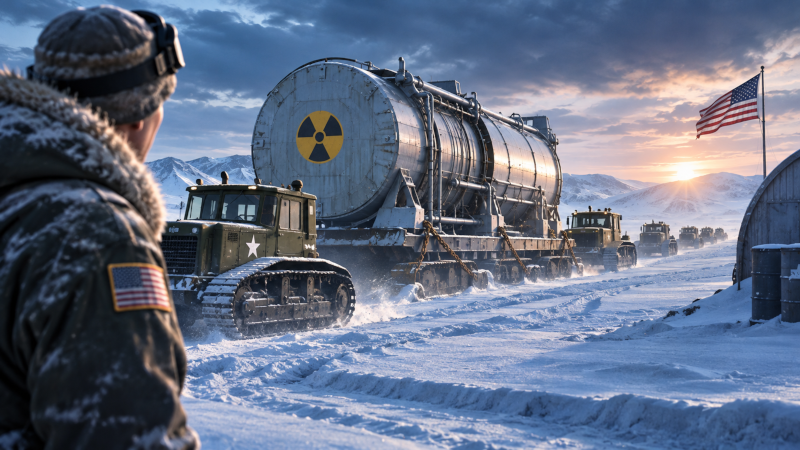
To solve the issue, the crew added lead shielding by stacking walls of 55-gallon drums around it, each packed with ice and sawdust.
The reactor ended up running for about three years until the camp was abandoned and their portable reactor was shipped over to Idaho where it was buried.
This wasn’t the Army’s only nuclear gambit, by the way.
By the time the program wound down around 1977, the Army had built eight small reactors, one of which was the first nuclear plant ever connected to a U.S. electrical grid.
After that, the whole idea mostly went quiet for decades.
Until August.
That’s when the Army picked five companies to build and run more than 20 microreactors on five of its bases, the first of which is expected to be up and running in September of 2028.
So what changed their minds on nuclear power?
The answer starts with a test that actually didn’t produce any electricity at all.
In May 2025, an executive order told the Energy Department to get at least three advanced test reactors to criticality by July 4, 2026.
The Best Free Investment You’ll Ever Make
Our analysts have traveled the world over, dedicated to finding the best and most profitable investments in the global energy markets. All you have to do to join our Energy and Capital investment community is sign up for the daily newsletter below.
Ten companies were ultimately picked for the program, but just four reactors beat the deadline.
There was a slight catch, however.
You see, every one of those was a zero-power test. Nothing was producing electricity, even though they proved a design can sustain a chain reaction.
That’s an important step, sure, but it’s still a long way from keeping the lights on.
It also took place under the DoE’s authorization, not a license from the Nuclear Regulatory Commission.
What happened next was the Army’s Janus program, which was announced last August. It will receive $2.2 billion over the next five years.
Under that program, five companies will own, build and operate the reactors at five posts. Antares goes to Fort Bragg and BWXT to Fort Campbell, while General Atomics gets Fort Hood, Radiant gets Fort Benning, and Westinghouse gets Fort Drum.
Naturally, the Air Force is running its own version, this time pairing Radiant with Buckley Space Force Base in Colorado, Westinghouse with Malmstrom Air Force Base in Montana, and Antares with Joint Base San Antonio in Texas.
For the record, these reactors aren’t meant to replace the grid. Instead, the goal is to keep critical operations running in case the grid goes down.
They’re also designed to be moved by truck, rail or plane, except this time they don’t have to be moved over a hundred miles of ice.
Don’t get me wrong, I like the direction.
For once, the government is putting real contracts behind the idea, and there are real payments tied to milestones.
But let’s face it, a test and a customer are two VERY different things.
And right now, there are more than two dozen companies in public-private partnerships on military microreactors. You and I both know the Pentagon can’t back all of them forever. Sooner or later, it will have to pick.
The difference here is between a company that has passed a test and a company that has a customer paying for power.
One proves the technology works, but the other means it’s economical, and a milestone is not a finished product.
That’s the gap the market tends to ignore.
The winners in this new atomic era won’t necessarily be the first to make a chain reaction, but rather the ones that can deliver a track record to show utilities and industrial buyers.
Look, there’s a reason why the Army is working with the Nuclear Regulatory Commission.
And here are the players I’m looking at first.
Until next time,

Keith Kohl
 Check us out on YouTube!
A true insider in the technology and energy markets, Keith’s research has helped everyday investors capitalize from the rapid adoption of new technology trends and energy transitions. Keith connects with hundreds of thousands of readers as the Managing Editor of Energy & Capital, as well as the investment director of Angel Publishing’s Energy Investor and Technology and Opportunity.
For nearly two decades, Keith has been providing in-depth coverage of the hottest investment trends before they go mainstream — from the shale oil and gas boom in the United States to the red-hot EV revolution currently underway. Keith and his readers have banked hundreds of winning trades on the 5G rollout and on key advancements in robotics and AI technology.
Keith’s keen trading acumen and investment research also extend all the way into the complex biotech sector, where he and his readers take advantage of the newest and most groundbreaking medical therapies being developed by nearly 1,000 biotech companies. His network includes hundreds of experts, from M.D.s and Ph.D.s to lab scientists grinding out the latest medical technology and treatments. You can join his vast investment community and target the most profitable biotech stocks in Keith’s Topline Trader advisory newsletter.


