

In the early 1980s, the Carter administration sent a classified memo to Congress that barely made the papers.
For most, the subject was far from exciting — chromium. How many people do you know that get excited over that topic? So, you can understand why it didn’t get the coverage it deserved.
And yet, most people probably don’t realize that chromium goes into the turbine blades of every jet engine in the U.S. Air Force, into the reactor cladding at every nuclear plant, and the stainless steel in virtually every weapons system the military operates.
Without it, our defense manufacturing grinds to a halt.
The problem was that South Africa and Rhodesia (now Zimbabwe) controlled over 80% of global chromium reserves. As if that weren’t enough, the Soviet Union was actively backing Marxist factions in both countries.
The Pentagon’s strategic planners had done the math and arrived at an uncomfortable conclusion — a foreign adversary had quietly acquired a kill switch over U.S. weapons manufacturing.
That memo became one of the foundational arguments for strategic mineral stockpiling. The debate raged in Congress as reports were written on the critical importance of chromium, cobalt, and a handful of other minerals that were formally recognized.
Then the Cold War ended and markets globalized… the lesson we learned was filed away for a rainy day.
Today, 46 years later, the list of kill switches is longer.
Except this time, the hand holding them belongs to Beijing.
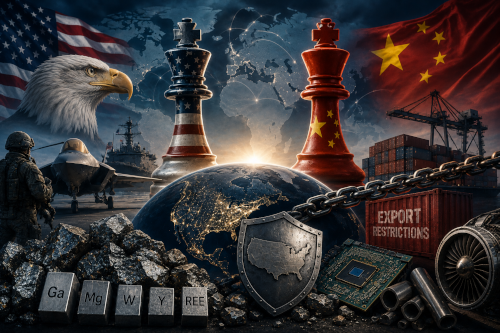
China’s Strategic Chokehold
By now, I know that most of you recognize that China’s position in critical resources isn’t simply a market advantage —- it’s a chokehold.
How bad is this monopoly on strategic minerals?
Well, just keep in mind that China produces 98.7% of the world’s supply of gallium, which is essential for semiconductors and radar systems. That’s not to mention the 95% monopoly they hold on magnesium, which is used in aerospace alloys and automotive components, or the fact that China controls about 82% of global tungsten supply — the same material the Manhattan Project nearly ran out of in 1944.
And things get even scarier with rare earth elements, where China controls approximately 69% of mining and roughly 90% of global refining and processing capacity.
The separation infrastructure that turns raw ore into usable rare earth materials simply doesn’t exist at scale anywhere else on Earth.
Here’s what that dependency looks like when Beijing decides to use it…
The Best Free Investment You’ll Ever Make
Join Gold World today for FREE. Get the latest insight on gold, silver, and precious metals delivered straight to your inbox. When you become a member today, you’ll get our latest free report: “The #1 Golden Token to Buy Now.” Don’t Delay!
After getting your report, you’ll begin receiving the Gold World e-Letter, delivered to your inbox daily.
In April 2025, China implemented export restrictions on gallium, germanium, and rare earth elements in retaliation for U.S. tariffs.
Chinese customs data shows the U.S. received just 17 tonnes of yttrium — used in military-grade lasers and high-temperature superconductors — in the eight months following those restrictions. In the eight months prior, the U.S. received 333 tonnes.
In other words, we saw a 95% collapse in supply of a single critical material in less than a year.
Then a few months later, China blacklisted ten U.S. companies, including MP Materials Corp (the only U.S. company currently operating a fully integrated rare earth mine and processing facility) and USA Rare Earth (one of the few domestic producers actively trying to break the dependency).
Beijing’s message was loud and clear: We know which American companies threaten our market position and we’ll constrain them directly if you push us.
This isn’t a slow-moving threat anymore.
Trump’s Call to Arms Over Critical Minerals
So far, Trump’s policy response has been the most aggressive in a generation — and it’s moving faster than most investors realize.
President Trump announced Project Vault back in February, a $12 billion strategic reserve for critical minerals that’s structured as a public-private partnership backed by a $10 billion EXIM direct loan — more than double the largest financing in EXIM’s 90-year history.
The reserve will store essential materials in secure U.S. facilities, giving domestic manufacturers a price and supply buffer against Beijing’s export levers.
This is the chromium lesson that’s finally being applied at scale.
Of course, permitting reforms are equally significant.
That’s why new executive orders compressed the federal review timeline for priority mining projects from three years to six months, and the USGS expanded its official critical minerals list from 50 to 60 materials — adding copper, uranium, and silicon alongside rare earths and battery metals.
Now, over 50 projects carry priority designation, which means expedited federal coordination and direct access to Defense Production Act financing.
And the best part is that the capital is already flowing, too.
We’re seeing a $455 million rare earth processing facility under development. Arkansas lithium projects received $400 million in federal backing.
The EnergySource geothermal lithium project secured $1.4 billion in support, and the DOE added $45.7 million in May 2026 for critical mineral recovery and processing technology.
But there IS a tiny caveat here — mining timelines don’t bend to executive orders. From discovery to production at a major new mine, the realistic timeline is 15 to 20 years.
Project Vault and permitting reform address the immediate emergency — they buy time and reduce vulnerability to price manipulation… yet the structural domestic supply that actually ends the dependency on Chinese processing is a decade out at minimum.
Naturally, the companies positioned to benefit aren’t the ones that will be mining in 2035.
They’re the ones processing, refining, and supplying materials today — while the strategic reserve is being filled and new mines are being permitted. MP Materials is the clearest example, and China blacklisted them.
That tells you everything about how seriously Beijing views domestic U.S. rare earth capacity as a threat.
When your adversary starts targeting specific American companies by name, it’s usually a good time to look at those companies closely.
Here’s where I’m looking in the critical minerals space right now.
Until next time,

Keith Kohl
 Check us out on YouTube!
A true insider in the technology and energy markets, Keith’s research has helped everyday investors capitalize from the rapid adoption of new technology trends and energy transitions. Keith connects with hundreds of thousands of readers as the Managing Editor of Energy & Capital, as well as the investment director of Angel Publishing’s Energy Investor and Technology and Opportunity.
For nearly two decades, Keith has been providing in-depth coverage of the hottest investment trends before they go mainstream — from the shale oil and gas boom in the United States to the red-hot EV revolution currently underway. Keith and his readers have banked hundreds of winning trades on the 5G rollout and on key advancements in robotics and AI technology.
Keith’s keen trading acumen and investment research also extend all the way into the complex biotech sector, where he and his readers take advantage of the newest and most groundbreaking medical therapies being developed by nearly 1,000 biotech companies. His network includes hundreds of experts, from M.D.s and Ph.D.s to lab scientists grinding out the latest medical technology and treatments. You can join his vast investment community and target the most profitable biotech stocks in Keith’s Topline Trader advisory newsletter.


