

Today, the spot price for uranium is sitting right around $86 a pound.
Looking further down the road at long-term contracts, we saw long-term contracts trade above $90/lb earlier this year — the highest level since 2008.
But what about uranium mining stocks, you ask?
Well, those have careened lower this year.
This is the same sector and commodity, yet two completely different stories.
And one of them is wrong.
Let me show you which…
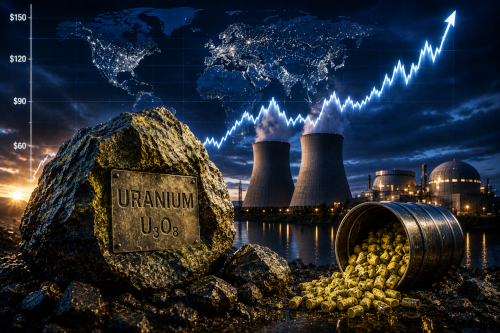
No matter what sentiment you see nowadays on Wall Street, you can’t argue with the numbers.
Every year, the world’s nuclear reactors burn through somewhere around 180 to 190 million pounds of uranium. And every year, mines across the globe extract only 130 to 140 million pounds of it.
But interestingly, that gap has actually existed for years.
The thing is, it just didn’t matter because uranium stockpiles and alternative supply quietly covered the difference, so nobody had to sweat it.
Trust me, those buffers are running dry.
The Best Free Investment You’ll Ever Make
Our analysts have traveled the world over, dedicated to finding the best and most profitable investments in the global energy markets. All you have to do to join our Energy and Capital investment community is sign up for the daily newsletter below.
Just look at Kazatomprom, the largest uranium producer on Earth. Wellfield is underperforming, and sulfuric acid shortages are an unglamorous but critical input for processing the ore.
That’s not to mention the political uncertainty layered on top, too.
However, the catch in all of this is the fact that demand isn’t slowing down.
It’s accelerating!
Right now, China has 39 reactors under construction, which officially makes it the largest nuclear buildout on the planet.
But it’s not just the chinese driving demand. India, Russia, Egypt, and Turkey are all building too as AI data centers have turned nuclear power into a handy power source to have access to.
You know as well as I do that these data centers require reliable, round-the-clock baseload power at a huge scale.
And if you’re wondering how serious Washington is taking this situation, just consider that uranium was quietly added back onto the official USGS critical minerals list in 2025.
For the record, this is the same list that’s now steering billions of dollars in federal money toward developing the strategic resources that we simply can’t afford to keep importing
Of course, having a decade-long timeline for starting up new mine projects doesn’t help when we need this new supply asap.
We can’t ignore this supply-demand gap much longer.
That’s why it’s not surprising to see U.S. utilities have locked in contracts for 174 million pounds of uranium through 2035.
However, their actual uranium requirement over that same stretch will be roughly 360 million pounds.
Again, that’s 186 million pounds — more than half of everything the industry will need over the next decade — sitting with no contract attached to it at all.
Utilities aren’t stupid, and they’re fully aware that this gap exists.
So, they simply didn’t move for most of 2026. Call it a standoff if you want, with buyers praying for lower prices from sellers unwilling to commit at prices that don’t justify building new mines.
But something shifted recently…
After months of almost no contracting activity, more than half a dozen active requests for proposals showed up within a few weeks of each other. As you might guess, that tends to show up right before contracts actually start getting signed, not after.
Trust me, when six or seven buyers all come off the sidelines at once, we’ve moved beyond coincidences.
This could be the start of the next major move.
The analysts on Wall Street are finally starting to reach the same conclusion, too, calling for uranium prices to climb as high as $150 a pound. Goldman is modeling spot prices at around $91/lb by the end of the year. Analysts are lining up behind the same conclusion, even if the exact number varies.
Just make sure you beat them to the punch. Check out the full details behind this emerging opportunity.
Until next time,

Keith Kohl
 Check us out on YouTube!
A true insider in the technology and energy markets, Keith’s research has helped everyday investors capitalize from the rapid adoption of new technology trends and energy transitions. Keith connects with hundreds of thousands of readers as the Managing Editor of Energy & Capital, as well as the investment director of Angel Publishing’s Energy Investor and Technology and Opportunity.
For nearly two decades, Keith has been providing in-depth coverage of the hottest investment trends before they go mainstream — from the shale oil and gas boom in the United States to the red-hot EV revolution currently underway. Keith and his readers have banked hundreds of winning trades on the 5G rollout and on key advancements in robotics and AI technology.
Keith’s keen trading acumen and investment research also extend all the way into the complex biotech sector, where he and his readers take advantage of the newest and most groundbreaking medical therapies being developed by nearly 1,000 biotech companies. His network includes hundreds of experts, from M.D.s and Ph.D.s to lab scientists grinding out the latest medical technology and treatments. You can join his vast investment community and target the most profitable biotech stocks in Keith’s Topline Trader advisory newsletter.


