

Yesterday, the U.S. government made it illegal to sell garbage overseas.
No, I’m not talking about the actual garbage you just tossed in the trash a moment ago, but close enough that most people would have thrown it in the bin a few years ago.
I’m referring to shredded battery scrap… old tungsten.
You know, the kind of stuff left over after you ditch your phone for a new model, or upgrade to a new computer, or even scrap your EV for the next generation of Tesla.
And starting today, none of that scrap can leave the country due to a one-year ban coming straight from the Bureau of Industry and Security that’s aimed squarely at defense supply chains.
But I want you to really think about what that means. After all, we used to pay someone to haul this junk away.
Now it’s too strategically valuable to let out the door.
However, it’s the WHY that’ll have you seeing the big picture in your portfolio.
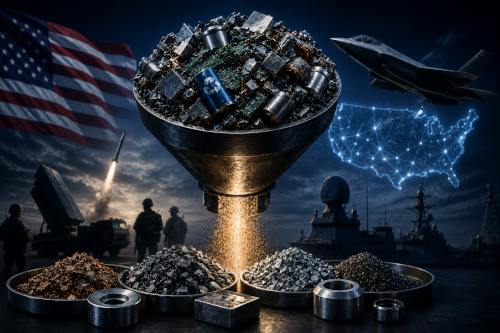
First let me put an interesting little number into perspective…
A $150 million weapons system can be rendered completely useless by about $30,000 worth of missing critical minerals.
Oh yeah, you read that correctly — losing just one-tenth of a percent of the cost, and the whole thing doesn’t work.
That’s the position the U.S. finds itself in right now.
You see, the Pentagon needs somewhere between 50 and 100 tons of samarium every single year. Keep in mind that this is the metal that goes into the permanent magnets used in fighter jets, missiles, and radar systems.
And if you’re wondering what our domestic production capacity is currently at?
Well, it’s nothing more than a rounding error.
The Best Free Investment You’ll Ever Make
Our analysts have traveled the world over, dedicated to finding the best and most profitable investments in the global energy markets. All you have to do to join our Energy and Capital investment community is sign up for the daily newsletter below.
So, the Trump administration went looking for supply in a place most people would never think to look — the trash.
Why? Well, tucked inside a New Hampshire office park, a company called Phoenix Tailings runs a refinery that zaps mining waste and recycled magnets with electricity, pulling out the critical minerals hiding inside.
They call the planned expansion the “Freedom Facility,” and it’s no accident the Pentagon just handed them a $500 million loan to build it.
Right now, they’re producing about 200 kilograms of samarium a year. Within three months, they’re hoping to boost that volume to five tons.
By 2027 or 2028, the goal is 120 tons.
This goes beyond merely incremental growth, especially when a company is looking to grow output six hundredfold in under two years.
And here’s the best part — they’re not alone.
Arnold Magnetic Technologies, which makes the magnets that go into Tomahawk cruise missiles, used to source samarium from China.
Not anymore, folks.
Now, that supply comes straight from a Belgian company reprocessing decades-old, abandoned mining waste in France.
Again, this is old trash that’s been sitting untouched for decades, but suddenly finding enormous value all over again.
Trust me, this isn’t optional urgency.
In fact, the Center for Strategic and International Studies has said that it could take at least three years to fully replenish America’s Tomahawk, Patriot, and THAAD stockpiles after the drawdown from the Iran war.
Of course, that’s not to mention the separate, harder deadline bearing down specifically on tungsten on January 1, 2027 — in a market where China controls roughly 80% of global mine supply.
The New Gold Rush Comes With a Hazmat Suit
Look, here’s the problem when it comes to new supplies of critical minerals: New mines.
These massive holes in the ground take time, grueling environmental permit processes that stretch into ten-year timelines before a single truckload of ore comes out.
To be fair, that’s not wrong, it’s just slow… painfully slow.
So, the companies actually moving at the speed this crisis demands aren’t digging new mines. They’re mining what’s already been dug up and thrown away — old magnets, spent batteries, mountains of mining waste nobody bothered to process the first time around, because it wasn’t profitable enough to bother.
The only difference is that it’s profitable now.
And the thing is, today’s export ban just locked that exact feedstock inside U.S. borders.
All that scrap material — the raw ingredient this entire recycling approach depends on — can’t be sold to the highest global bidder anymore. That means it has to stay here for companies like Phoenix Tailings to process.
This isn’t a coincidence, by the way.
It’s simply one way our government is making sure its own bet pays off.
Don’t forget the government is directly pouring $10 billion into critical mineral production since January, 2025.
You’ve seen this flood of cash firsthand, haven’t you? Perhaps you’ll remember the $12 billion Project Vault reserve buying against actual manufacturer commitments instead of guesswork.
Naturally, the demand side of this trade is about as guaranteed as it gets in this business. And the domestic suppliers standing underneath a supply chain the government has decided, one way or another, it’s going to fix with also benefit.
Simply put, somebody’s getting rich from this push to secure our strategic metals.
Until next time,

Keith Kohl
 Check us out on YouTube!
A true insider in the technology and energy markets, Keith’s research has helped everyday investors capitalize from the rapid adoption of new technology trends and energy transitions. Keith connects with hundreds of thousands of readers as the Managing Editor of Energy & Capital, as well as the investment director of Angel Publishing’s Energy Investor and Technology and Opportunity.
For nearly two decades, Keith has been providing in-depth coverage of the hottest investment trends before they go mainstream — from the shale oil and gas boom in the United States to the red-hot EV revolution currently underway. Keith and his readers have banked hundreds of winning trades on the 5G rollout and on key advancements in robotics and AI technology.
Keith’s keen trading acumen and investment research also extend all the way into the complex biotech sector, where he and his readers take advantage of the newest and most groundbreaking medical therapies being developed by nearly 1,000 biotech companies. His network includes hundreds of experts, from M.D.s and Ph.D.s to lab scientists grinding out the latest medical technology and treatments. You can join his vast investment community and target the most profitable biotech stocks in Keith’s Topline Trader advisory newsletter.


