

When rebel forces invaded a remote province in Zaire back in May of 1978, the West suddenly had a very serious problem on their hands.
Practically overnight, we had lost access to roughly 65% of the world’s cobalt supply.
As you might expect, that’s a big deal.
Remember, cobalt isn’t some curious metal.
It’s a vital ingredient in the superalloys that go into jet engines, missiles and submarines.
And you can bet that none of those things will function without it.
However, cobalt prices didn’t just rise. They spiked more than sevenfold over the following two years.
That’s when the Pentagon discovered a rather uncomfortable truth. They learned just how much of America’s advanced weaponry depended on a mineral controlled almost entirely by one unstable region, half a world away.
Make no mistake, dear reader, that’s precisely the same vulnerability playing out again right now, except this time around it’s a different metal being constrained by a different adversary.
This time, it’s rare earths.
And unfortunately for us, China is holding all the cards… but not for long.
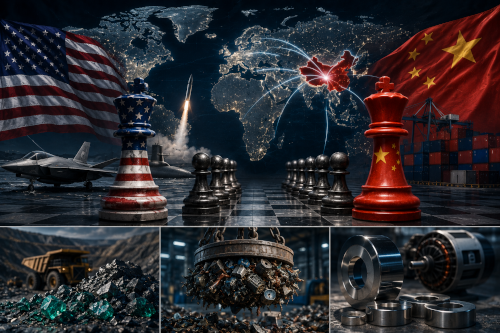
Oddly enough, most people get something wrong when it comes to our rare earth situation in the United States.
It turns out that we actually have real rare earth mining capacity.
Some of you already know that players like MP Materials and a handful of others are pulling raw material out of the ground right now.
Knowing that is the easy part, because mining was never our vulnerability.
You see, China controls somewhere between 90% and 94% of global sintered magnet processing.
This is the actual step that turns raw rare earth oxide into a finished, usable neodymium-iron-boron magnet.
Mining the ore is one thing, but refining, alloying and sintering it into a magnet with the exact performance characteristics of a weapons system is a whole new ballgame.
That’s the step we severely lack here at home.
Think about that for a moment…
We’re talking about things like F-35 actuators, precision-guided munitions, and even submarine propulsion motors.
In fact, the tracking and guidance hardware inside the Golden Dome missile shield that you know all about needs a sintered magnet, not just raw ore.
Now think back to what happened in 1978.
Our weakness was that our cobalt supplies were in jeopardy, and this became a political flashpoint. The same is happening now with rare earths.
Now processing rare earth magnets isn’t geographically concentrated by accident.
The Best Free Investment You’ll Ever Make
Our analysts have traveled the world over, dedicated to finding the best and most profitable investments in the global energy markets. All you have to do to join our Energy and Capital investment community is sign up for the daily newsletter below.
It’s concentrated in China because they spent decades deliberately building the refining, alloying and sintering expertise that nobody else bothered to develop.
Granted, that problem is a little harder to fix, because it’s not about finding a new deposit, but rather rebuilding an entire specialized manufacturing skill set from scratch.
And Beijing knows this.
So far this year, China tightened its export licensing specifically on finished magnets — not just raw rare earth material, the way earlier restrictions worked.
That’s a much sharper signal than over the last few years, and it proves they know exactly what kind of leverage they’re sitting on.
It’s also why President Trump has responded the way he has.
After all, the partnership between MP Materials and the Department of Defense was a very calculated move, and a meaningful first step toward guaranteeing a domestic market exists.
Remember, the partnership involved everything from price floors, a solid equity stake for the U.S. government and a 10-year offtake commitment.
That kind of rare earth security can’t come soon enough, either. Demand for magnets from EVs, humanoid robotics and defense platforms is projected to blow past announced Western processing capacity by 2030.
It even accounts for all of that capacity that’s CURRENTLY under construction.
So, that gap will continue to widen.
And it presents us with an interesting opportunity.
Look, all the major miners have had their moment in the spotlight this year. However, quietly forming beneath that story is a brand new layer, with new players emerging that are eager to build the recycling and processing capacity we need, turning scrap, end-of-life magnets and alloy powder into finished sintered magnets — domestically, without ever touching a Chinese supply chain.
As we’ve seen, some of this technology is genuinely clever. Perhaps you’ll remember the hydrogen-based processes that pull usable magnetic alloy powder directly out of old hard drives, motors and industrial scrap, effectively skipping the far more expensive route of extracting new ore entirely.
We’ve also seen early demonstration facilities that are already capable of shipping real recycled magnet material to real industrial customers, years ahead of the large-scale mining projects still working through permitting.
Naturally, that’s a fundamentally different kind of business than a mine.
A recycler doesn’t need to win a drilling permit or wait a decade for a deposit to reach production.
All that company needs is a secure feedstock (such as the mountain of old electronics, decommissioned motors, and industrial scrap that’s already sitting in warehouses and landfills across the country), and an efficient process enough to convert that scrap back into usable magnets.
This is the resource war that won’t end anytime soon.
Until next time,

Keith Kohl
 Check us out on YouTube!
A true insider in the technology and energy markets, Keith’s research has helped everyday investors capitalize from the rapid adoption of new technology trends and energy transitions. Keith connects with hundreds of thousands of readers as the Managing Editor of Energy & Capital, as well as the investment director of Angel Publishing’s Energy Investor and Technology and Opportunity.
For nearly two decades, Keith has been providing in-depth coverage of the hottest investment trends before they go mainstream — from the shale oil and gas boom in the United States to the red-hot EV revolution currently underway. Keith and his readers have banked hundreds of winning trades on the 5G rollout and on key advancements in robotics and AI technology.
Keith’s keen trading acumen and investment research also extend all the way into the complex biotech sector, where he and his readers take advantage of the newest and most groundbreaking medical therapies being developed by nearly 1,000 biotech companies. His network includes hundreds of experts, from M.D.s and Ph.D.s to lab scientists grinding out the latest medical technology and treatments. You can join his vast investment community and target the most profitable biotech stocks in Keith’s Topline Trader advisory newsletter.


